


A Business Impact Analysis, or BIA, is a systematic process for figuring out what could happen if a disruption hits your critical business operations. Think of it as a strategic health check-up for your company; it pinpoints the essential functions that keep everything running smoothly. This proactive analysis gives you the foundational intelligence needed to prepare for anything from cyberattacks and power outages to supply chain failures.
Understanding Your Business Vitals
Imagine trying to navigate a city without a map. You might get to your destination eventually, but the journey will be inefficient and full of frustrating wrong turns. A Business Impact Analysis is that essential map for navigating operational disruptions. It helps you move beyond guesswork to get a clear, data-driven picture of what truly matters most inside your organization.

The whole process works on two core assumptions:
- Every part of your business depends on other parts to function.
- Some functions are more critical to your survival than others and need immediate attention when things go wrong.
By identifying these critical functions first, you can prioritize your resources and create a recovery strategy that protects your most vital operations. This is the absolute cornerstone of building a resilient organization.
The Real Cost of Skipping a BIA
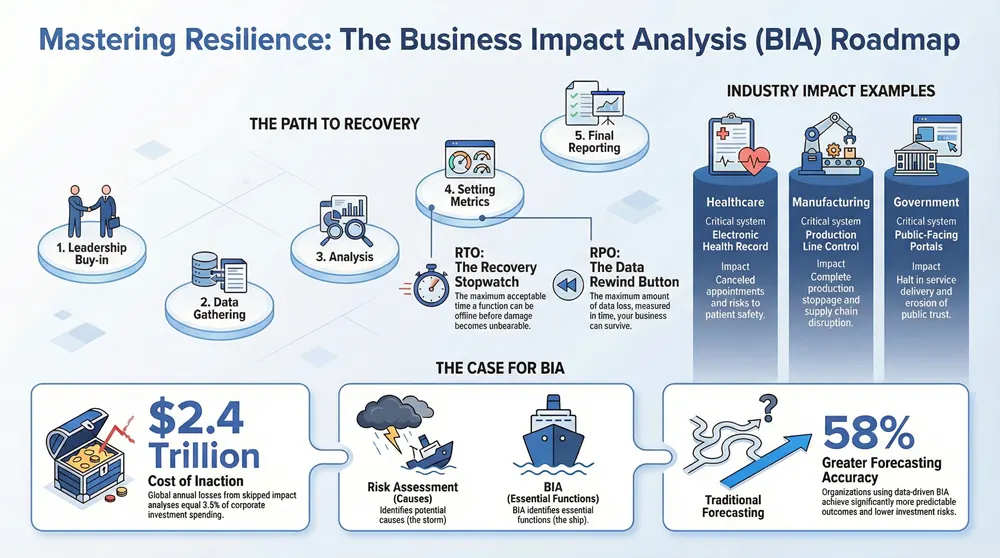
Ignoring this foundational step can have brutal financial consequences. Organizations that skip a systematic impact analysis lose an estimated $2.4 trillion globally each year through botched investments, failed projects, and missed opportunities. That staggering figure is equivalent to 3.8% of worldwide corporate investment spending. The financial impacts are real, and the risk is massive.
A BIA isn’t just an IT exercise. It’s a strategic business process that directly impacts your bottom line by giving you the clarity needed to make smart decisions about where to invest in protective measures.
Differentiating BIA from Risk Assessment
It’s easy to confuse a Business Impact Analysis with a risk assessment, but they serve two very different—yet complementary—purposes. A risk assessment identifies potential threats and vulnerabilities, focusing on the causes of a disruption. It asks, “What could go wrong, and how likely is it?”
A BIA, on the other hand, focuses on the consequences of that disruption, no matter the cause. It asks a completely different set of questions:
- What are our most critical business functions?
- How long can we afford for these functions to be down before we’re in serious trouble?
- What are the operational and financial impacts of that downtime?
In simple terms, a risk assessment identifies the storms on the horizon, while a BIA tells you which parts of your ship must be protected at all costs to stay afloat.
This distinction is crucial. The BIA provides the context for the risk assessment, telling you what is most critical to protect. Together, they form a powerful foundation for your entire resilience strategy.
The outputs of a BIA are the essential inputs for creating effective recovery plans. Our guide on business continuity and data recovery explores how these findings get turned into actionable strategies. Without a proper BIA, any continuity or disaster recovery plan is just built on assumptions rather than a solid understanding of your organization’s unique operational DNA.
Understanding RTO and RPO in Your Analysis
Once your business impact analysis has pinpointed which functions are absolutely critical, the next step is to get specific. We need to assign real, hard numbers to them. Two of the most important metrics you’ll define are the Recovery Time Objective (RTO) and the Recovery Point Objective (RPO).
These terms might sound a little technical, but they answer two very simple, practical questions about what it takes to survive a disaster.
Think of RTO as a stopwatch. It’s the maximum acceptable time a critical business function can be offline before the damage becomes unbearable. It answers the question: How quickly do we absolutely need to be back up and running?
RPO, on the other hand, is like a rewind button for your data. It defines the maximum amount of data—measured in time—that your business can afford to lose forever. This metric answers the question: To what point in time must we recover our data?
Defining Your Recovery Timelines
Let’s make this real. Imagine a busy healthcare clinic here in Michigan. Through its BIA, it determines the patient scheduling system is a mission-critical function.
- RTO Example: The clinic figures it can manage appointments manually for about two hours before the front desk descends into utter chaos, leading to angry patients and lost revenue. So, its RTO is two hours. The IT team’s recovery plan must get that system back online within that two-hour window.
- RPO Example: That same clinic can’t afford to lose appointment data. If the system crashes, losing even 30 minutes of recently booked appointments would cause a nightmare of double-bookings and scheduling conflicts. The clinic sets its RPO at 15 minutes, meaning its backups can never be more than 15 minutes old.
These aren’t just abstract goals; they are the bedrock of your entire disaster recovery strategy. The BIA is what gets you these numbers, eliminating the guesswork. It quantifies precisely how long critical processes like payroll or customer support can be down before the financial bleeding starts.
A low RTO and RPO (think minutes or a few hours) will demand more robust—and often more expensive—recovery solutions. A higher RTO and RPO (say, 24 or 48 hours) might allow for more budget-friendly options.
How RTO and RPO Shape Your Strategy
Defining these two values has an immediate, direct impact on your technology decisions and where you spend your money. They dictate the exact kind of solutions you need to meet your own recovery targets.
For instance, an RPO of 15 minutes pretty much requires frequent, automated backups, maybe even real-time data replication. An RPO of 24 hours, however, might be perfectly fine with a simple backup that runs every night.
Likewise, an RTO of one hour probably means you need a failover system that can kick in almost instantly. An RTO of 12 hours gives you a much wider window for your team to perform a manual restoration.
Understanding these values is the key to building a recovery plan that actually works. You can go much deeper into how these metrics inform a solid plan in our comprehensive guide to data backup and recovery. At the end of the day, RTO and RPO are what turn your BIA from a theoretical exercise into a practical, actionable roadmap for resilience.
How to Conduct Your Business Impact Analysis
Running your first business impact analysis might feel like a huge project, but it’s really just a series of straightforward, manageable steps. Think of this as a roadmap that any organization—even one without a dedicated risk management team—can follow to get real, meaningful results.
The whole process flows from a high-level kickoff to a detailed, documented plan. Each stage builds on the one before it, making sure your final strategy is grounded in solid data and ready to go.
Step 1: Kick Off the Project and Get Leadership on Board
Before you start interviewing anyone or digging into data, the BIA needs to be treated like an official project. That means defining its scope, what you want to achieve, and who’s on the team responsible for making it happen. Without clear goals, the whole thing can lose focus fast.
Most importantly, you need buy-in from the top. Senior leadership’s support is what gets you the resources you need—people’s time, a budget, and the authority to conduct a thorough analysis. When leaders champion the BIA, it sends a clear message to the whole company that this is a priority, which makes getting cooperation from every department a lot easier.
Step 2: Gather Intel with Focused Interviews and Surveys
This is where you get your hands dirty and start collecting data. The goal is simple: understand how each part of your business works, pinpoint its most critical functions, and map out how they all depend on each other. The best way to get this information? Talk to the people who actually do the work every day.
A mix of methods usually works best:
- Structured Interviews: Sit down with department heads and key players. Ask them specific questions about their day-to-day processes, the tools they can’t live without, and what would break if those tools suddenly vanished.
- Questionnaires: For a wider net, use detailed surveys. They’re a great way to efficiently gather the same data points from a larger group of employees across the company.
One common mistake is missing the not-so-obvious connections. For example, you might find out from the finance team that they can’t send invoices without a specific report from the customer service department. If that report stops, cash flow stops. That’s a critical impact you might have completely missed otherwise.
Step 3: Analyze the Data to Pinpoint Critical Functions
Once you have a pile of interview notes and survey answers, it’s time for analysis. You’ll sift through all that raw information to map out the operational DNA of your business. Your main objective is to create a prioritized list of every single business function.
During this stage, you’re looking for the answers to a few key questions:
- Which processes would cause the biggest financial hit if they went down?
- Which functions are absolutely essential for keeping customers happy and protecting our reputation?
- What are the upstream and downstream dependencies for each process?
Think of it like creating a map of your business’s nervous system. You’re tracing every connection to understand how a failure in one spot could ripple out and affect everything else. This analysis sets the stage for the next crucial step.
A data-driven BIA isn’t just about spotting risks; it’s about building a more predictable, resilient business. When you get it right, it dramatically improves your ability to forecast outcomes and cut down on investment risks.
Step 4: Define RTOs and RPOs for Each Function
With your prioritized list of critical functions in hand, you can now assign the two most important recovery metrics: the Recovery Time Objective (RTO) and the Recovery Point Objective (RPO). These numbers turn the fuzzy idea of “critical” into concrete, measurable targets for your tech team.
For each essential function, you’ll figure out the maximum acceptable downtime (RTO) and the maximum tolerable data loss (RPO). This infographic breaks down the difference between these two vital metrics.
As you can see, RTO is all about the clock—how fast you need to get things back online. RPO is about the data—how much information you can afford to lose.
Step 5: Document and Report Your Findings
The final step is to pull all your hard work together into a formal BIA report. This document is the culmination of your analysis and becomes the playbook for building out your business continuity and disaster recovery plans.
A solid BIA report should include:
- An executive summary with the key takeaways.
- The scope and objectives of the analysis.
- A detailed list of critical business functions and their dependencies.
- The established RTOs and RPOs for each of those functions.
- Clear recommendations for the next steps and recovery strategies.
This report isn’t meant to collect dust on a shelf. It’s a living document that provides actionable insights. According to frameworks like NIST IR 8286D-upd1, the BIA is used to prioritize risks across financial, missional, and reputational exposures for IT assets that support critical services. In fact, organizations that adopt a data-driven BIA achieve 58% greater accuracy in outcome forecasting, which directly slashes 41% of investment risks. You can explore the full NIST framework and its approach to risk prioritization to learn more.
Real-World BIA Scenarios in Michigan Industries

Theory is one thing, but seeing a business impact analysis play out in the real world is where its value truly clicks. The core idea—pinpointing what’s critical and what a disruption would cost—applies everywhere, but the actual impacts look wildly different from one industry to the next. Let’s walk through some tangible scenarios right here in Michigan to connect the dots.
These examples show how a single point of failure can trigger a massive ripple effect, leading to financial, reputational, and even regulatory nightmares. It’s this kind of storytelling that makes the “why” behind a BIA so obvious. If you’re looking for more practical examples of how companies bounce back, these business continuity and resilience case studies offer some great insights.
Healthcare Provider in Grand Rapids
Let’s start with a large multi-specialty clinic in Grand Rapids. Imagine they get hit with a ransomware attack that completely locks down their Electronic Health Record (EHR) system. A BIA would have flagged that EHR system as the absolute heart of the clinic—its single most critical function.
Without it, the clinic is paralyzed. Patient appointments are canceled on the spot. Doctors can’t write new prescriptions, and they’ve lost access to vital patient histories, allergy information, and recent lab results. This goes way beyond inconvenience; it poses a direct threat to patient safety. Operationally, it’s chaos as staff scramble with paper charts and all billing grinds to a halt.
Financially, the damage mounts every hour. Lost revenue from appointments alone could hit tens of thousands of dollars per day. But it gets worse. The clinic is now staring down the barrel of potential HIPAA violation fines for the data breach, which can be crippling. A solid BIA would have put a number on these exact costs, making a powerful argument for investing in better cybersecurity and a rapid recovery plan.
Manufacturing Firm near Detroit
Now, picture an automotive parts manufacturer just outside Detroit. Their most profitable component is made on a single production line. Suddenly, a key piece of machinery fails, and the replacement part is tangled up in supply chain delays. The line goes silent.
A BIA would trace the fallout far beyond the factory floor. The first hit is obvious: lost production means lost revenue. But the secondary impacts are where the real pain is. The company starts missing delivery deadlines to a major automaker, which triggers contractual penalties that could easily cost hundreds of thousands of dollars.
This failure also torches their reputation as a dependable supplier, putting future contracts at risk. The BIA process identifies this single point of failure and calculates the total financial exposure—penalties and lost business included. That data easily justifies the cost of keeping redundant machinery on hand or finding alternative suppliers to build more resilience.
A BIA shifts the conversation from, “What if this machine breaks?” to “When this machine breaks, it will cost us $1.2 million in penalties and lost orders within three days.” That kind of specific, quantified impact forces decisive action.
To give you a clearer picture, let’s compare how a 24-hour system outage could affect critical functions across different industries.
Impact of Downtime Across Different Sectors
| Industry | Critical System Affected | Primary Financial Impact | Primary Operational Impact |
|---|---|---|---|
| Healthcare | Electronic Health Record (EHR) | Lost appointment revenue, potential regulatory fines | Canceled patient appointments, risk to patient safety |
| Manufacturing | Production Line Control System | Contractual penalties for missed deadlines, lost revenue | Complete production stoppage, supply chain disruption |
| Education | Student Information System (SIS) | Delayed tuition processing, potential loss of funding | Inability to register students, access grades, or manage schedules |
| Government | Public-Facing Permitting Portal | Overtime costs for manual processing, potential legal challenges | Halt in service delivery, erosion of public trust |
As you can see, the financial and operational consequences are severe and specific to each sector’s core functions.
Local Government Office in Lansing
Finally, think about a local government office in Lansing that handles building permits and public assistance applications. A construction crew accidentally severs a major fiber optic cable, taking all their core systems offline.
The immediate impact is a complete shutdown of services. Citizens needing help are turned away, critical deadlines for public aid are missed, and the government’s basic ability to function is crippled. A BIA would have identified these public services as critical functions and analyzed exactly what happens when they fail.
The analysis would dig deeper, uncovering risks to public safety if emergency service coordination is affected and a major blow to public trust. By quantifying the cost of staff overtime needed to dig out of the backlog and the price of reputational damage, the BIA makes a compelling case for investing in redundant network connections and a robust disaster recovery plan. For a government agency, a BIA is a direct line to ensuring the continuity of essential public services.
Each of these scenarios shows how a BIA delivers the clarity needed to prepare for the worst. It takes abstract risks and turns them into concrete numbers, giving leaders the hard data they need to invest wisely in protecting their organization.
Turning Your BIA into an Actionable Resiliency Plan
Finishing a business impact analysis is a huge step, but the report itself isn’t the finish line. Think of it as a detailed diagnostic chart from your doctor. It tells you exactly what’s vital for your organization’s health, but it doesn’t automatically make you healthier. The real value of a BIA is unlocked when you translate its findings into a concrete, actionable resiliency plan.
This is the moment where all the data you’ve gathered—critical functions, dependencies, RTOs, and RPOs—becomes the blueprint for building your defenses. Your BIA report is the map you’ll use to construct both a business continuity plan (BCP), which outlines how your people and processes will keep running during a disruption, and a disaster recovery (DR) plan, detailing how your technology will be restored.
From Data Points to Strategic Investments
Those metrics you defined aren’t just abstract numbers; they are powerful tools for prioritizing IT investments and putting resources where they’ll have the biggest impact. The findings from your BIA process directly inform which technological safeguards are most urgent.
For instance, a critical sales application with a four-hour RTO and a 15-minute RPO demands a much more aggressive strategy than an internal reporting system that can wait 24 hours. This clarity lets you make smart, informed decisions instead of just guessing.
Your BIA findings help you justify spending on specific solutions by tying them directly to tangible business needs:
- Aggressive RPOs: Justify investments in advanced backup solutions like continuous data replication to slash potential data loss.
- Demanding RTOs: Make the case for failover systems or cloud-based recovery environments that can get you back online in minutes, not hours.
- Complex Dependencies: Highlight the need for redundant communication systems, like VoIP, to keep your teams connected when primary channels fail.
Building a Practical Recovery Strategy
With your priorities clearly defined by the BIA, you can start building specific recovery strategies for each critical function. This means figuring out the exact people, resources, and technologies needed to hit your RTOs and RPOs. A huge part of this is being honest about where your current capabilities fall short.
Once you know the potential impact of an outage, the next step is to pinpoint the gaps between your current recovery abilities and your required objectives. For this, you might find it helpful to conduct a gap analysis. This process shows you exactly where to focus your efforts and investments.
A BIA without a follow-up action plan is just an academic exercise. The goal is to close the loop between analysis and action, transforming insights into genuine operational resilience that protects your revenue, reputation, and customer trust.
Connecting these actions to tangible outcomes is what builds a truly resilient organization. When you translate your BIA findings into technological safeguards, you directly improve uptime, strengthen security, and ensure your business can withstand whatever comes next. This strategic alignment is explored further in our guide to effective disaster recovery planning, which shows how to build a plan that truly reflects your business’s most critical needs.
Turning Your BIA into a Real-World Defense with a Tech Partner
Finishing your business impact analysis is a huge step. You’ve mapped out what matters most and how fast you need it back. But the BIA document itself? It’s just the blueprint.
Think of it like an architect’s plan for a fortress. The drawings are essential, but they won’t stop an attack. You need skilled builders and the right materials to actually construct the walls and defenses. This is exactly where a strategic technology partner comes in.
An expert partner takes your BIA findings and translates them into practical, effective safeguards. They bridge that critical gap between knowing your RTOs and RPOs and actually having the right technology in place to meet them. Instead of you juggling multiple vendors or trying to piece together solutions, a partner makes sure your entire IT infrastructure is aligned with your real-world continuity goals.
From Analysis to Actionable Defense
So, how do you turn that BIA data into a robust defense? It comes down to a few key services that an experienced technology partner can manage for you. This ensures your most critical functions are protected by solutions built to hit the precise recovery targets you’ve identified.
These services include:
- Virtual CIO Consulting: This provides the high-level strategy to ensure every dollar you invest in technology directly supports the priorities your BIA uncovered.
- Managed IT Monitoring: Think of this as 24/7 vigilance over your most important systems. It allows for proactive problem-solving that stops minor glitches from spiraling into major disruptions.
- Robust Disaster Recovery: This is where the rubber meets the road. We implement and manage the backup and failover solutions designed specifically to achieve the RTOs and RPOs your business absolutely depends on.
A BIA tells you what to protect and how quickly you need it back online. A technology partner provides the tools, the expertise, and the ongoing management to make that recovery a reality, keeping your business secure and productive.
Ultimately, a partner like Kraft Business Systems becomes an extension of your own team. We’re dedicated to making sure your organization is truly ready for any disruption. We help transform your business impact analysis from a static report into the living, breathing cornerstone of genuine operational resilience.
Ready to turn your BIA insights into a powerful continuity plan? Contact Kraft Business Systems today to discuss your organization’s unique resilience needs.
Got Questions? We’ve Got Answers.
When you’re digging into something like a business impact analysis for the first time, a lot of practical questions pop up. It’s totally normal. Here are some of the most common ones we hear from businesses just like yours, along with some straight-up answers.
How Often Should I Do One of These Things?
A business impact analysis isn’t a “one-and-done” project you can file away and forget. Think of it more like a living document. The best practice is to give it a formal review at least annually, or anytime something significant changes in how you do business.
What counts as a “significant change”? Good question. You’ll want to dust off your BIA immediately if you’re:
- Launching a major new product or service.
- Rolling out a critical new piece of tech, like an ERP system.
- Opening a new office or expanding into a new territory.
- Going through a major company restructuring.
Keeping it fresh ensures your recovery plans actually line up with what your business looks like today, not what it looked like last year. An outdated BIA gives you a false sense of security, which is almost as dangerous as not having one at all.
What’s the Difference Between a BIA and a Risk Assessment?
This is a fantastic question, and the answer is crucial. It’s easy to get them mixed up, but they are two sides of the same coin.
A business impact analysis zeroes in on the consequences of a disruption. It asks, “If this process suddenly stops, how much does it hurt us, and how fast do we need it back online?”
A Risk Assessment, on the other hand, is all about identifying the threats that could cause that disruption in the first place. It asks, “What could actually go wrong, and what are the odds of it happening?”
The BIA tells you what’s most important to protect. The risk assessment tells you what you need to protect it from. You really need both to get the full picture and build a plan that works.
Can a Small Business Really Do a BIA?
Absolutely. The term might sound like something only a Fortune 500 company would tackle, but a BIA is completely scalable. You don’t need a team of consultants and a six-month project plan.
For a smaller business, the process can be much more streamlined. Instead of sending out long, formal surveys, you might pull your key people into a room for a couple of focused workshops. The goal is exactly the same: figure out your core processes, identify what they depend on, and get a clear-eyed view of what happens if they get knocked offline.
The key is to focus on what truly keeps your doors open, your payroll running, and your customers happy.
A business impact analysis gives you the blueprint, but putting that plan into action requires the right technology and expertise. Kraft Business Systems helps Michigan organizations turn their BIA findings into a robust, real-world defense. Find out how we can strengthen your operational resilience.