

A virtual CIO service gives your business high-level, strategic IT leadership—all without the hefty price tag of hiring a full-time executive. Think of it as plugging an expert technology strategist directly into your leadership team, one whose sole focus is making sure your IT investments actually accelerate your business goals.
What Does a Virtual CIO Actually Do?
Too many business leaders see IT as a break-fix function. A computer breaks, a server goes down, you call the IT guys. Simple.
But a virtual Chief Information Officer, or vCIO, operates on a completely different wavelength. They aren’t just technicians; they are strategic business architects who happen to specialize in technology.
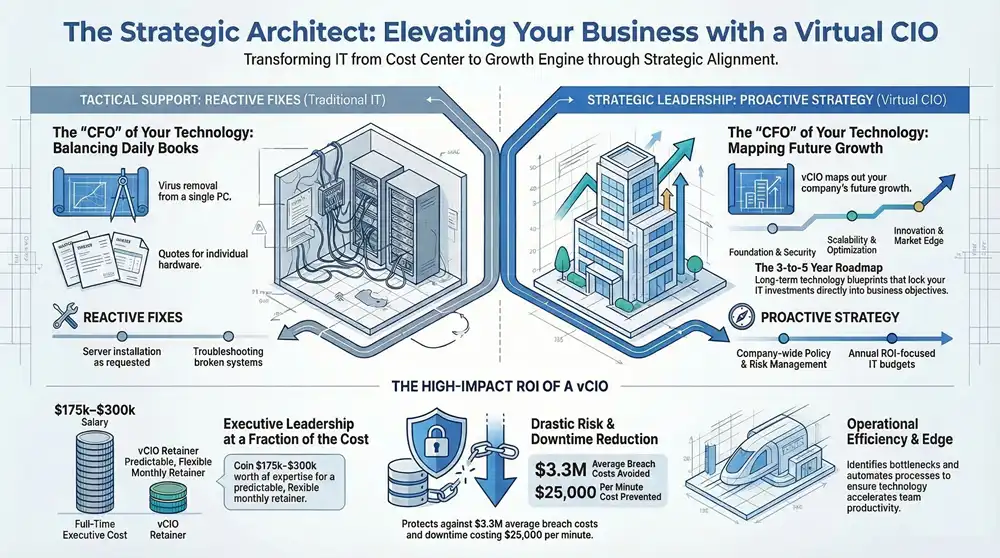
Let’s use an analogy. You have an accountant, and you might have a Chief Financial Officer (CFO). The accountant keeps the daily books balanced—essential work. But the CFO uses that financial data to map out the company’s future, create budgets, and guide long-term growth.
A vCIO does for your technology what a CFO does for your finances. While your regular IT support team handles the day-to-day tickets (the “accounting”), the vCIO is all about the big picture.
From Reactive Support To Proactive Strategy
Here’s the fundamental shift a vCIO brings to the table: you move from constantly reacting to problems to proactively planning for success. Traditional IT support is, by its nature, backward-looking. It solves problems that have already happened. A vCIO is entirely forward-looking.
Their primary mission is to align every piece of your technology with your core business objectives. This means they get deeply involved in:
- Strategic Planning: Building a long-term technology roadmap that directly supports your 3-to-5-year business plan.
- Budget Optimization: Creating and managing an IT budget that treats technology as a growth investment, not a cost center, with a laser focus on ROI.
- Future-Proofing: Actively hunting for new technologies that can boost efficiency, tighten security, or give you a leg up on the competition.
- Risk Management: Identifying and neutralizing cybersecurity and operational risks before they can hit your bottom line.
To get a clearer picture of how these roles differ, let’s compare their focus areas side-by-side.
Virtual CIO vs Traditional IT Support
| Area of Focus | Virtual CIO Responsibility (Strategic) | Traditional IT Support Task (Tactical) |
|---|---|---|
| Planning | Develops a 3-5 year technology roadmap. | Installs a new server as requested. |
| Budgeting | Creates an annual IT budget focused on ROI. | Submits a quote for 10 new laptops. |
| Security | Implements a company-wide cybersecurity policy. | Removes a virus from a user’s computer. |
| Operations | Evaluates software to improve business processes. | Resets a forgotten password. |
| Reporting | Presents IT performance metrics to the board. | Closes a help desk ticket for a printer issue. |
The table makes it obvious: one role plans the journey, and the other keeps the engine running day-to-day. You need both, but only the vCIO is steering the ship toward your ultimate destination.
A virtual CIO service transforms your IT from a cost center focused on maintenance into a strategic asset focused on growth. Their success isn’t measured by how many tickets they close, but by how effectively technology helps the business achieve its goals.
The Architect Of Your Technology Future
Ultimately, a vCIO is the architect of your company’s technology blueprint. Just as a building architect designs a home to meet a family’s needs for years to come, a vCIO designs a technology plan to meet your business’s future ambitions.
They’re the ones asking the critical questions: “Where do we want this business to be in three years?” and “What technology foundation do we need to start building today to get there?”
This approach ensures you make smarter, more informed decisions. By investing in a dedicated virtual CIO service, you gain the executive-level guidance needed to turn your IT into a powerful engine for innovation and growth.
The Core Strategic Responsibilities of a vCIO

A virtual CIO’s job isn’t about fixing printers or resetting passwords. Their role is to pull technology out of the day-to-day grind and make it a central part of your company’s future. They are deeply strategic, focused on transforming your IT from a reactive expense into a proactive engine for growth.
This shift in thinking is why the virtual CIO service market is exploding. Recent analysis shows the market rocketed from $25 billion in 2023 to an estimated $30 billion in 2024. That’s a 20% jump in just one year, driven almost entirely by small and mid-sized businesses that want C-level IT leadership without the six-figure executive salary.
So, what do you actually get for that investment? Let’s break down the core responsibilities that deliver this incredible value.
Developing a Long-Term IT Roadmap
One of the first things a vCIO does is create a multi-year IT roadmap. This isn’t just a shopping list for new computers. Think of it as a strategic blueprint that locks your technology directly into your business goals.
A vCIO starts by asking the big questions: “Where is this company headed in the next three years?” Then, they work backward, building a technology plan that paves the way. For instance, if you’re planning to expand into a new state, the roadmap would detail how to scale your cloud infrastructure, deploy the right collaboration tools, and lock down your cybersecurity to support a scattered team.
This forward-looking approach ensures every dollar you spend on technology is a calculated investment, not just a patch on a current problem. It stops you from making costly, short-sighted decisions that will only hold you back later.
Financial Planning and IT Budgeting
Another cornerstone of a vCIO’s role is mastering the IT budget. They don’t just track expenses; they build a strategic financial plan that shows a clear return on investment (ROI). This process turns the IT budget from a confusing black box of costs into a transparent, predictable plan.
A vCIO will typically:
- Analyze Your Current Spending: They’ll hunt down wasteful spending, like paying for software licenses you don’t use or propping up old, inefficient systems.
- Forecast Future Needs: They align technology spending with the IT roadmap, making sure the money is there when it’s time for critical upgrades or projects.
- Build a Business Case: They justify every significant expense with solid ROI projections, showing leadership exactly how a new system will boost revenue or improve efficiency.
This financial discipline transforms the conversation from “How much does IT cost?” to “How much value is our IT creating?”
Strategic Vendor and Technology Management
Managing all your tech vendors—internet providers, software companies, hardware suppliers—can be a massive time sink. A vCIO takes this off your plate, acting as your expert negotiator and advocate. They use their industry knowledge to make sure you’re getting the right solutions at the best possible price.
This includes everything from evaluating new technologies to negotiating contracts and holding vendors accountable. For example, when it’s time for a new CRM system, the vCIO manages the entire vetting process. Your team stays focused on their actual jobs, not on sitting through endless sales demos.
Cybersecurity and Risk Management Leadership
Finally, a vCIO acts as the strategic leader of your cybersecurity program. While a Managed Service Provider (MSP) might handle the day-to-day security alerts, the vCIO is responsible for the big-picture strategy that keeps your business safe.
A huge part of this is implementing a formal risk management process. This involves assessing your unique vulnerabilities, ensuring you meet compliance standards like HIPAA, and developing a solid plan for business continuity and disaster recovery. They ensure your security isn’t just a pile of software tools but a complete strategy that protects your company’s most valuable assets.
What’s the Real-World Payback on a vCIO?
When you bring in a virtual CIO, you’re not just hiring another IT consultant. You’re making a strategic move that delivers real, measurable results to your business’s bottom line, security, and day-to-day operations. The value isn’t some abstract concept—it shows up in dollars and cents.
By shifting your IT from a reactive “break-fix” cost center to a forward-looking business asset, a vCIO delivers a powerful return on investment (ROI). We see this impact hit across four critical areas: direct cost savings, serious risk reduction, better operational efficiency, and a sharper competitive edge.
Let’s break down what that actually looks like for your business.
Driving Down IT and Operational Costs
The quickest and easiest ROI to see comes from what you don’t have to spend. A full-time, in-house Chief Information Officer is a major investment, often pulling a salary between $175,000 to $300,000 a year once you factor in benefits and bonuses. A virtual CIO gives you that same high-level strategic thinking for a fraction of the cost, usually wrapped into a predictable monthly fee.
This flexible approach completely sidesteps the overhead that comes with a full-time executive, including:
- Hefty recruitment fees and drawn-out hiring cycles.
- Pricey benefits packages, payroll taxes, and bonuses.
- The ongoing costs of professional development and training.
But it goes beyond just the salary. A good vCIO digs into your tech budget and finds the hidden money drains. They pinpoint and cut wasteful spending on redundant software, licenses nobody is using, and old, clunky systems that are inefficient to maintain. To get a clearer picture of how these savings add up, you can see detailed breakdowns of how much managed IT services cost and where a vCIO’s strategic input adds the most value.
Reducing Financial and Reputational Risk
A modern cybersecurity threat isn’t just a nuisance; it’s an existential risk. A single data breach can trigger devastating financial losses, steep regulatory fines, and do permanent damage to your company’s good name. A vCIO’s job is to get ahead of these threats by building a smart, proactive cybersecurity strategy.
The average cost of a data breach for a business with fewer than 500 employees is a jaw-dropping $3.31 million. A vCIO’s core mission is to implement the strategic defenses that keep your company from becoming another statistic.
Instead of just reacting when something goes wrong, a vCIO builds a resilient security posture from the ground up. They ensure you’re compliant with industry rules like HIPAA, create solid disaster recovery plans so you can get back online quickly, and spearhead security awareness training for your team. This strategic oversight drastically lowers the odds of a costly incident, protecting your assets and keeping the business running.
Boosting Efficiency and Gaining a Competitive Edge
A vCIO has a direct impact on your team’s productivity by making sure your technology actually helps them do their jobs. They hunt down operational bottlenecks and roll out solutions—like process automation, better software integrations, or smart cloud services—that let your team work smarter, not harder. That translates to fewer hours wasted on clunky, frustrating tasks and more time focused on what actually grows the business.
This boost in efficiency is exactly what gives you a competitive advantage. The virtual CIO service market is on track to explode from $5.49 billion in 2025 to $15 billion by 2035. This isn’t a fluke; it’s driven by businesses realizing that strategic IT leadership is the key to innovation and staying ahead. With a vCIO guiding your tech roadmap, you can react faster to market shifts, deploy new tools before your competitors do, and use technology to build better experiences for your customers.
By making smarter technology investments, a vCIO ensures you’re not just keeping pace—you’re setting it.
Comparing a vCIO to Other IT Management Models
Picking the right IT leadership for your business is a big deal. It’s easy to get lost in the alphabet soup of options—vCIO, MSP, fractional CIO—and they all sound kind of the same. But making the wrong choice can lead to a tech strategy that doesn’t line up with your actual business goals, wastes money, and leaves you falling behind.
To make a smart decision, you first need to understand the real differences between these models. A virtual CIO service, a fractional CIO, a Managed Service Provider (MSP), and a traditional in-house team each have a very specific job to do.
Strategic Vision vs. Tactical Execution
The biggest difference comes down to strategy versus day-to-day work. Think of it like building a new office. You need an architect to draw up the blueprints, make sure the design matches your company’s vision, and oversee the whole project. You also need the builders, electricians, and plumbers to actually put up the walls and connect the wires.
A vCIO is your technology architect. Their entire focus is on creating the long-term IT blueprint that directly supports your business plan.
On the other hand, a Managed Service Provider (MSP) is the master builder. They’re the ones in the trenches, keeping your servers running, your network secure, and your team’s helpdesk tickets resolved. While an MSP’s work is absolutely essential, it’s tactical and focused on keeping the lights on today.
A vCIO is there to answer, “How can technology help us hit our five-year growth targets?” An MSP is built to answer, “How do we fix this server issue right now and keep everyone working?”
Choosing Your IT Leadership Model
Let’s put these roles side-by-side to make the differences crystal clear. Each model brings something unique to the table and is a better fit for different types of businesses. Getting this right means aligning your tech leadership with where your company is now—and where you want it to go.
| Model | Primary Focus | Typical Cost Structure | Best Suited For |
|---|---|---|---|
| Virtual CIO (vCIO) | Strategic planning, IT budgeting, risk management, and business alignment. | Fixed monthly retainer or subscription fee. | Businesses needing C-level IT strategy without the cost of a full-time executive. |
| Fractional CIO | Similar to a vCIO but often with a more limited, part-time engagement (e.g., one day a week). | Per-diem, hourly rates, or a small monthly retainer. | Companies requiring intermittent strategic oversight or leadership for a specific project. |
| Managed Service Provider (MSP) | Daily IT operations, network monitoring, helpdesk support, and system maintenance. | Per-user or per-device monthly fee. | Organizations that need to outsource day-to-day IT support and maintenance tasks. |
| In-House IT Team | Can be both strategic and tactical, depending on the team’s size and expertise. | Full-time salaries, benefits, training, and overhead costs. | Larger enterprises with the budget and need for a dedicated, on-site IT department. |
Here’s the key takeaway: these services aren’t always an either/or choice. In fact, for many small and mid-sized businesses, the most powerful setup is a partnership between a vCIO and an MSP. The vCIO sets the course, and the MSP handles the daily execution.
This combination gives you proactive, forward-thinking leadership backed by reliable, hands-on support. It ensures every dollar you spend on technology is pushing your bigger business objectives forward.
The flowchart below breaks down how a vCIO’s strategic guidance delivers a real return on your investment.
As you can see, the path from strategic planning to tangible business results—like lower costs, reduced risk, and better efficiency—is direct and measurable.
How to Choose the Right vCIO Provider
Picking a partner to steer your technology strategy is one of the most critical decisions you’ll make for your business. The right virtual CIO service feels like a natural extension of your leadership team. The wrong one? You’re stuck with generic advice and wasted investments. To get it right, you need a clear way to evaluate your options.
Your goal is to find someone who gets just as invested in your business challenges as they are in your technology stack. They need to speak your language, understand your industry, and be laser-focused on delivering real business outcomes. A truly great vCIO is a business strategist first and a technologist second.
Key Evaluation Criteria for a vCIO
As you vet potential partners, you have to look past their technical skills and really dig into their strategic chops. A true vCIO needs to be a master communicator, a sharp strategic planner, and someone who genuinely understands your market.
Here are the essential areas to investigate:
- Industry-Specific Experience: Have they actually worked with businesses like yours before? A vCIO who knows the specific quirks of your industry—from manufacturing compliance to healthcare data security—is going to give you far more relevant and effective advice.
- Strategic Planning Process: Ask them to walk you through how they build an IT roadmap. A strong partner will have a structured approach that always starts with your business goals, not with a laundry list of new technologies.
- Communication Skills: The best vCIOs are translators. They have to be able to break down complex technical topics into simple business terms that your entire leadership team can understand and act on.
- Business Acumen: Look for a partner who asks smart questions about your revenue goals, operational headaches, and what your competitors are up to. This shows they’re thinking about solving business problems, not just deploying tech.
The right vCIO isn’t just selling a service; they are entering a partnership. Their success should be measured by your success, meaning they are genuinely committed to helping you achieve your long-term business objectives through smarter technology decisions.
Why a Michigan-Based vCIO Matters
For any business operating in the Great Lakes State, partnering with a local provider like Kraft Business Systems brings some serious advantages to the table. A Michigan-based virtual CIO service has an inherent grasp of the local economic climate, regional compliance rules, and the unique challenges facing businesses in our area.
This local know-how translates directly into more personalized and effective strategic guidance. They understand the local talent pool, they’re familiar with regional vendors, and they can show up for a face-to-face meeting when a critical project needs that hands-on leadership to get it across the finish line. That proximity builds a stronger, more accountable partnership.
The demand for this kind of strategic IT leadership is exploding across the country. North America’s virtual CIO service market is on track to hit $11.8 billion by 2025, with small and medium-sized businesses driving most of that growth. Since 99.9% of U.S. businesses are SMEs, it’s no surprise they’re looking for vCIOs to help them navigate digital transformation and cybersecurity—especially when downtime can cost firms an average of $25,000 per minute. To see the full breakdown, you can read the full analysis of virtual CIO services and their economic impact.
Choosing a local expert ensures the strategic advice you get is perfectly aligned not just with your business goals, but also with the unique opportunities and challenges right here in the Michigan market.
Got Questions About Virtual CIO Services?
When you’re thinking about bringing in a strategic partner like a virtual CIO, it’s natural to have a few questions. You want to know how it works in the real world, not just on paper. Let’s tackle some of the most common things business owners ask us.
How Does a vCIO Service Usually Get Priced?
Most of the time, virtual CIO services are set up on a monthly retainer or subscription. This gives you a predictable, fixed fee for ongoing strategic advice. Think of it like having a top-tier strategist on your team for a fraction of what a full-time CIO salary would cost you, without the surprise bills.
While you can sometimes find project-based or hourly rates for specific, one-off needs, the monthly model is far more common. It makes high-level expertise affordable and keeps your budget steady, ensuring you get continuous, proactive leadership when you need it.
How Does a vCIO Fit in With My Existing Team?
A vCIO isn’t here to replace anyone; they’re here to be a collaborative partner. They work with your internal staff, your executive team, and any IT providers you already have, like a Managed Service Provider (MSP).
The vCIO is the strategic glue between your business goals and your tech execution. They build the roadmap, and your MSP or internal team handles the day-to-day work to make it happen.
This setup ensures the big-picture strategy actually gets implemented correctly by the people on the ground, creating a perfect link between leadership’s vision and daily operations.
What Happens Right After We Sign Up for a vCIO?
The first thing we do is a deep-dive discovery. Your new virtual CIO service will roll up their sleeves and get to know your business inside and out. This means a thorough review of your current technology, business processes, security setup, and where you want to be in the next few years.
From there, they’ll put together a baseline report and start crafting your strategic IT roadmap. This foundational work is critical because it ensures every piece of advice and every recommendation from that point forward is built specifically for your company’s real-world challenges and goals.
Ready to align your technology with your business goals? The experts at Kraft Business Systems can provide the strategic leadership you need to grow securely and efficiently. Explore our virtual CIO service to learn how we can build your technology roadmap for success.