


AI Overview:
In 2025, the shift from copper landlines to internet-based phone systems (VoIP) has become one of the biggest upgrades in business communications. Internet phone service (Voice over Internet Protocol) allows calls to travel over the internet instead of traditional phone lines, bringing businesses cost savings, modern features, and flexibility that legacy systems can’t match.
Why Internet Phone Service Is Changing Business Communications
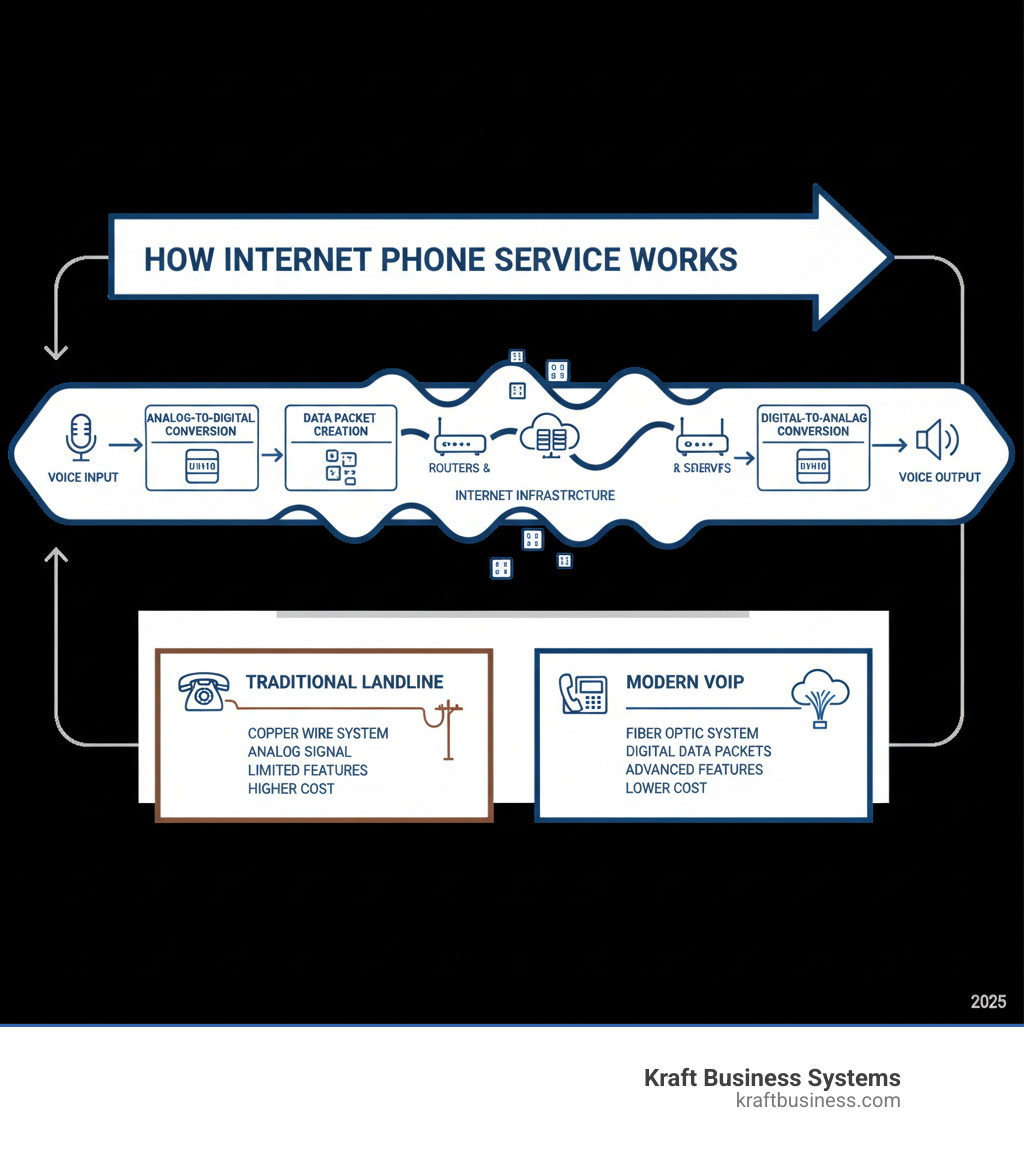
Internet phone service (also known as VoIP or Voice over Internet Protocol) lets you make and receive calls using your internet connection instead of traditional copper phone lines. This technology converts your voice into digital data packets that travel over the internet, offering businesses more features, lower costs, and greater flexibility than old-school landlines.
Quick comparison of internet phone service vs. traditional landlines:
- Cost: Up to 50% lower monthly bills, especially for long-distance calls
- Features: Advanced options like voicemail-to-email, video calling, and mobile apps
- Scalability: Add or remove lines instantly without rewiring
- Flexibility: Work from anywhere with the same business number
- Setup: Plug-and-play installation vs. complex wiring
Traditional landlines rely on decades-old copper wire infrastructure that limits your calling features and costs significantly more to maintain. As one VoIP expert puts it: “VoIP relies on fiber optics for data transmission, which allows for higher data capacity and speed compared to copper wires used by landlines.”
The shift isn’t just about saving money. Internet phone systems give growing businesses the unified communications tools they need – from conference calling and instant messaging to smartphone apps that let employees use their business number anywhere.
This guide compares the top internet phone service options to help you choose the system that keeps your business conversations crystal clear while supporting your growth plans.
Quick look at internet phone service:
How Internet Phone Service (VoIP) Stacks Up Against Landlines
Making the switch from traditional landlines to modern communication isn’t just about keeping up with technology trends—it’s about giving your business the tools it needs to thrive. Let’s break down how internet phone service compares to those old copper-wire systems that have been around since your grandfather’s time.
The Technology Behind the Magic
Think of traditional landlines as the postal service of communication. When you speak into a landline phone, your voice gets converted into analog electrical signals that travel along dedicated copper wires—one conversation, one wire, one path. It’s reliable in its simplicity, but also limited by it.
Internet phone service works more like email. Your voice gets converted into digital packets that zip across the internet alongside your web browsing, file downloads, and everything else. These packets take the most efficient route available and reassemble at their destination. This digital approach opens up possibilities that analog systems simply can’t match.
The infrastructure difference is significant too. While landlines depend on aging copper wire networks, How Do VoIP Phone Systems Work? shows us that VoIP leverages modern internet infrastructure, including fiber optics that can handle much more data at higher speeds.
Where Your Budget Will Thank You
Traditional landlines hit your wallet from multiple angles. You’ve got your base monthly fee, long-distance charges, feature add-ons (yes, they charge extra for caller ID), and maintenance costs when something inevitably breaks. It adds up faster than coffee expenses during a busy week.
Internet phone service streamlines this entire cost structure. Since calls travel over your existing internet connection, you’re essentially getting phone service as a bonus feature of your internet plan. Long-distance calls that used to cost a fortune? Often included at no extra charge. International calls? Dramatically cheaper or sometimes free to other VoIP users.
Most businesses see their phone bills shrink by up to 50% after making the switch. That’s real money you can put back into growing your business instead of maintaining outdated technology.
Features That Actually Make Your Life Easier
Here’s where traditional landlines really show their age. They offer basic calling, voicemail (if you’re lucky), and maybe call forwarding if you pay extra. Adding new features usually means buying expensive hardware or paying hefty monthly fees for each add-on.
Internet phone service flips this script entirely. Features that would cost hundreds extra on landlines come standard with most VoIP systems. Your voicemails get transcribed and emailed to you automatically. Calls can ring your desk phone, cell phone, and laptop simultaneously. Conference calling for multiple people becomes as easy as clicking a button.
The beauty is in the integration—everything works together seamlessly because it’s all running on the same digital platform.
Crystal Clear Conversations (When Done Right)
Early VoIP systems had a reputation for choppy audio and dropped calls, giving the technology a bad name in some circles. Modern internet phone service has largely solved these issues. With a good internet connection, VoIP calls often sound clearer than traditional landlines because digital transmission eliminates much of the static and interference that analog systems pick up.
The catch? Your call quality depends entirely on your internet connection. A slow or unreliable internet connection can cause audio delays, choppy sound, or dropped calls. Traditional landlines, while sometimes lower quality, provide consistent performance regardless of your internet situation.
For businesses in areas with solid internet infrastructure—like here in Grand Rapids and throughout Michigan—this dependency rarely causes problems. The result is typically superior clarity and reliability.
The Internet Connection Reality Check
This brings us to the most important consideration: bandwidth dependency. Every active VoIP call uses a portion of your internet bandwidth for both uploading and downloading data. If your business makes multiple simultaneous calls while employees are video conferencing, downloading large files, or streaming content, you might notice call quality dip during peak usage times.
The good news is that each call doesn’t use much bandwidth—typically around 100 kbps. The key is making sure your internet plan can comfortably handle your peak usage without breaking a sweat. A quick assessment of your current internet capacity versus your communication needs can prevent any surprises down the road.
For a comprehensive look at how internet phone systems fit into your overall communication strategy, check out company phone systems to see how all the pieces work together.
The bottom line? Internet phone service offers more features, lower costs, and greater flexibility than traditional landlines, with the trade-off being dependence on your internet connection. For most modern businesses, that’s a trade worth making.
Key Features to Look for in a Business Internet Phone Service
When you’re shopping for an internet phone service, you’re not just buying a way to make calls. You’re investing in a communication platform that can transform how your business operates, connects with customers, and supports your team. The right system becomes an invisible backbone that makes everything run smoother.
Think about it this way: your phone system touches every part of your business. From the first impression a customer gets when they call, to how efficiently your team collaborates on projects. That’s why choosing the right features isn’t just about checking boxes – it’s about finding tools that actually solve your daily challenges.
Core Calling Features: The Essentials and Beyond
Every business needs the basics, but with internet phone service, even the fundamentals come with intelligent upgrades. Call forwarding isn’t just about redirecting calls anymore – it’s about ensuring your mobile sales team never misses a lead, even when they’re visiting clients across town. You can set up sophisticated routing that tries your desk phone first, then your mobile, then a colleague’s extension.
Voicemail-to-email is one of those features that sounds simple but changes everything. Instead of playing phone tag or forgetting to check messages, important voicemails land right in your inbox with audio files and text transcriptions. You can prioritize callbacks while reviewing emails over your morning coffee.
Conference calling has evolved far beyond the old “dial this number and enter a code” approach. Modern systems let you start multi-party calls instantly, often with screen sharing capabilities that turn routine check-ins into productive collaboration sessions. Your team in Grand Rapids can seamlessly connect with clients in Detroit or suppliers across the country.
Unified Communications: Bringing Everything Together
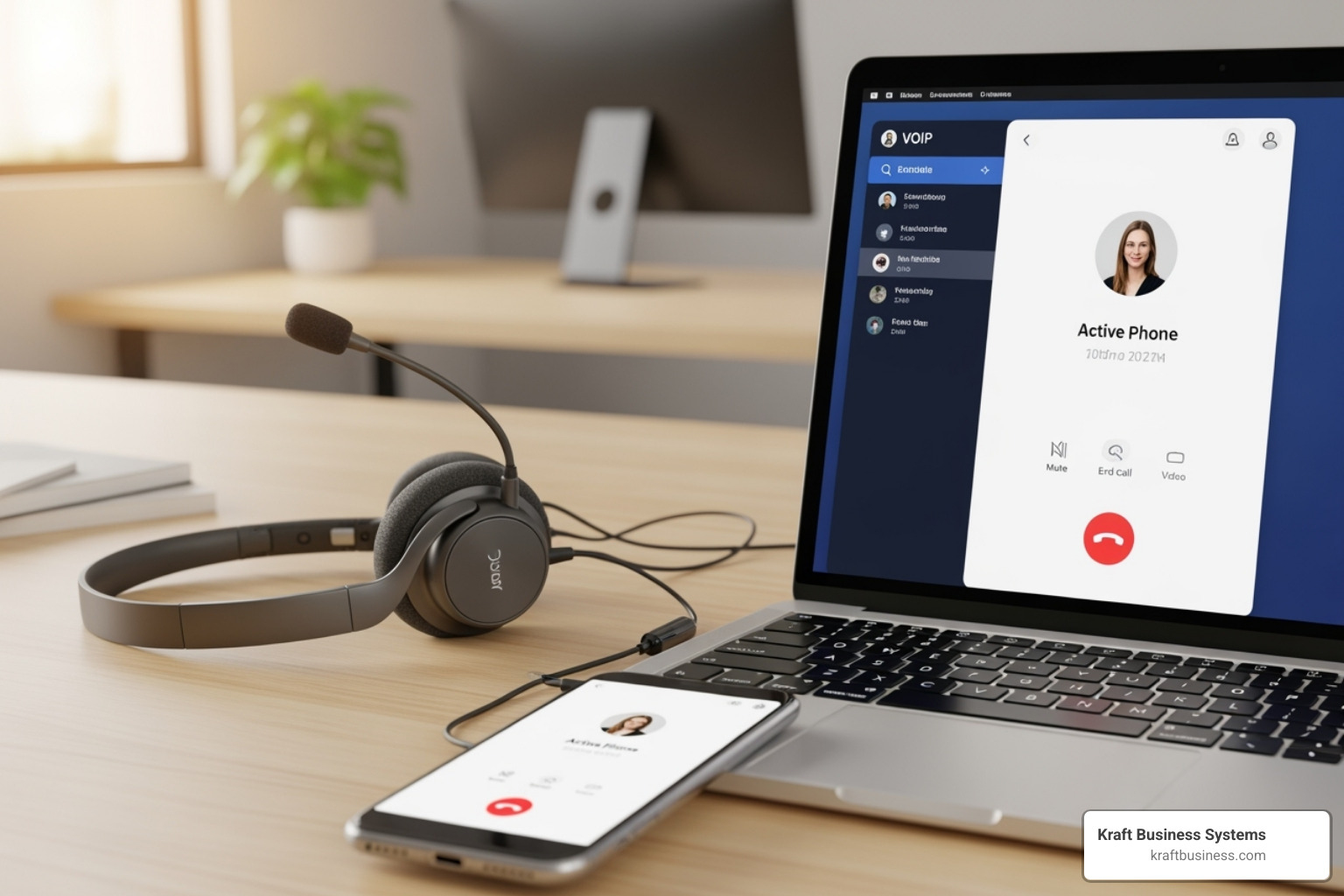
Here’s where internet phone service really shines – it doesn’t just handle phone calls. It becomes the hub for all your business communication. Softphones transform any internet-connected device into a full business phone. Your laptop, tablet, or smartphone can handle calls using your business number, complete with all your company’s features and settings.
This flexibility is a game-changer for today’s work environment. Your marketing manager can take client calls from home using the main business number. Your service technician can access the company directory while on-site at a customer location. Everyone stays connected without being chained to a desk.
Instant messaging and video conferencing integrate seamlessly with your phone system. When you see a colleague is available (thanks to presence indicators), you can quickly chat instead of interrupting them with a call. Need to show something? Click to start a video call right from the same interface.
Administrative Controls: Managing Your Communications with Ease
Running a business means staying organized, and modern phone systems help you do exactly that. An auto-attendant acts as your virtual receptionist, greeting callers professionally and routing them to the right person or department. No more “please hold while I transfer you” conversations that frustrate customers.
Call analytics give you insights you never had with traditional phones. You’ll see patterns in when customers call, which extensions are busiest, and how quickly calls get answered. This data helps you staff appropriately and identify training opportunities. Maybe you find most support calls come in Tuesday mornings, or that certain team members excel at handling difficult customers.
Number Porting: Keeping Your Identity
When you switch to a new internet phone service, keeping your existing business numbers is crucial. Your phone number is part of your brand identity – it’s on business cards, websites, and in customers’ contact lists. Number porting lets you transfer your current numbers to your new VoIP provider, ensuring business continuity without missing a beat.
Most providers handle this process smoothly, though there’s usually a small administrative fee involved. The peace of mind knowing customers can still reach you at familiar numbers makes this feature essential.
International Calling Plans: Connecting Globally
If your business reaches beyond local markets, internet phone service offers significant advantages for international communication. Instead of shocking phone bills for overseas calls, many VoIP providers include competitive international rates or even unlimited calling to select countries.
This opens doors for businesses ready to expand their reach. That potential client in Toronto or supplier in Mexico becomes much more accessible when international calls don’t break your budget.
For detailed guidance on choosing the right devices to support these features, explore our comprehensive guide on VoIP Phones for Business.
Comparing VoIP Systems: Cloud-Hosted vs. On-Premises
When you’re ready to invest in internet phone service, you’ll face one crucial decision that shapes everything else: should you go with a cloud-hosted solution or keep everything in-house with an on-premises system? It’s a bit like choosing between renting a fully-furnished apartment or buying a house – both have their place, but the right choice depends entirely on your business’s unique situation.
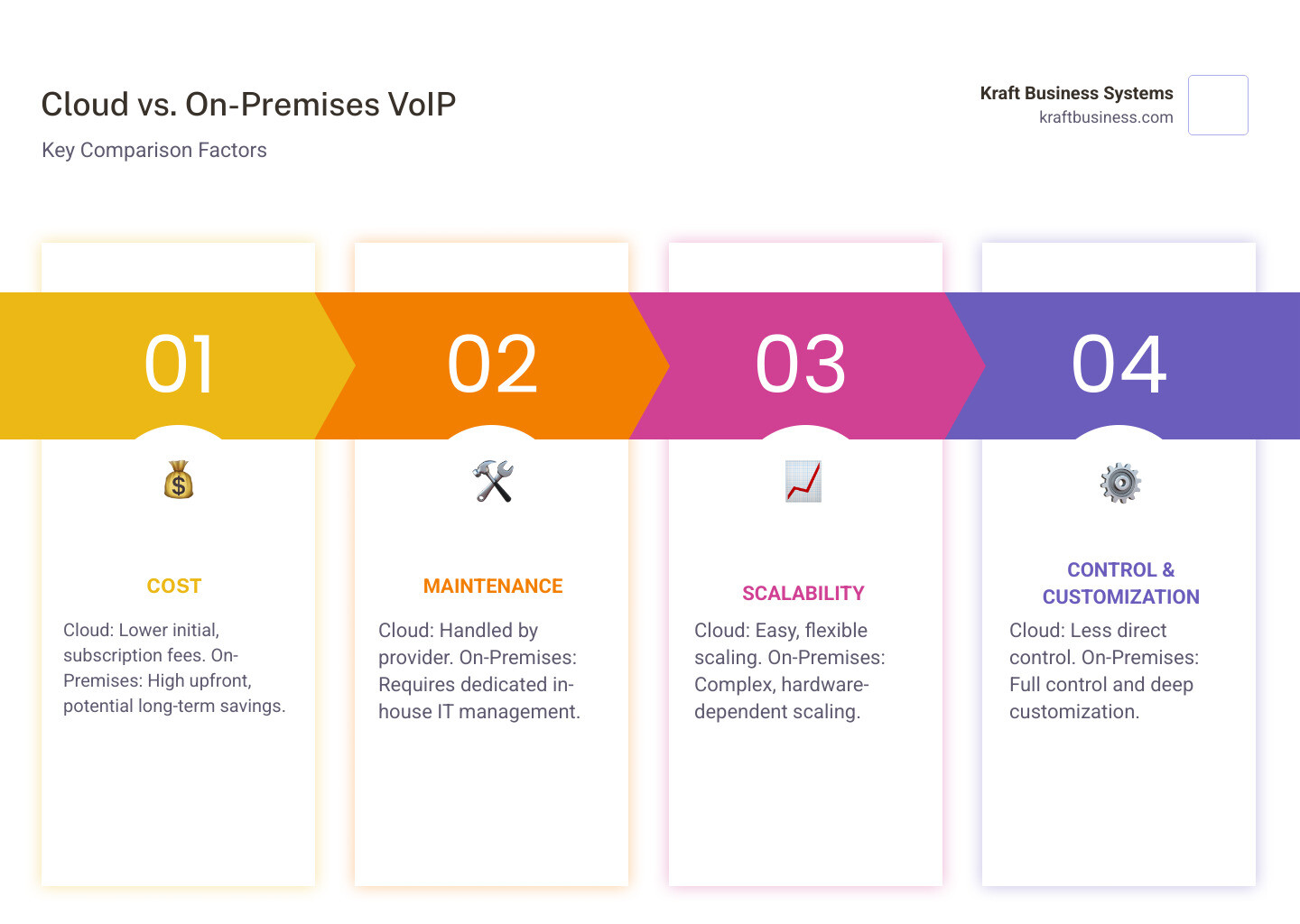
Understanding these two system types isn’t just about technology – it’s about finding the solution that aligns with how your business operates today and where you want to be tomorrow. The long-term value of your choice will depend on factors like your growth plans, IT resources, and how much control you need over your communication infrastructure.
Let’s break down what each option really means for your business and help you assess which path makes the most sense for your specific needs.
Cloud-Hosted Internet Phone Service
Think of cloud-hosted VoIP as having a world-class phone system without any of the headaches of owning one. With this approach, a third-party provider manages everything – the servers, software updates, security patches, and maintenance – while you simply access the service through your internet connection. You pay a predictable monthly fee, and they handle the technical heavy lifting.
This model has transformed how businesses think about communication systems. The lower initial cost makes it accessible to companies that couldn’t previously afford enterprise-level phone features. Instead of dropping tens of thousands on hardware upfront, you can have a sophisticated system running within days for the cost of your monthly subscription.
Easy scaling becomes almost magical with cloud systems. Need to add five new employees next week? No problem – it takes minutes through an online portal. Seasonal business that needs to scale down in the off-season? Just as simple. This flexibility has been a game-changer for growing businesses that can’t predict their exact communication needs months in advance.
The automatic updates aspect means you wake up to new features and security improvements without lifting a finger. Your provider handles everything behind the scenes, freeing your team to focus on what actually drives your business forward. For companies without dedicated IT staff, this is incredibly valuable.
Remote team support feels built into the DNA of cloud-hosted systems. Whether your employees are working from home in Grand Rapids or traveling to client sites in Lansing, they maintain full access to their business phone features through softphone apps or IP phones.
However, cloud systems do come with trade-offs. Those subscription fees add up over time, and you have less system control than you might want. As one business owner noted, customization options are often limited to predefined settings rather than the deep configuration possible with on-site systems. You’re also inherently dependent on your internet connection – if your connection goes down, so does your phone service.
Use case: Picture a growing consulting firm with offices in Grand Rapids and Ann Arbor, plus several remote employees. They need professional phone features, easy management, and the ability to add staff quickly without major IT projects. Cloud-hosted internet phone service fits perfectly, giving them enterprise capabilities with startup-friendly flexibility.
For deeper insights into this approach, explore Cloud-Based VoIP and learn more about Business Hosted Voice solutions.
On-Premises Internet Phone Service
On-premises VoIP is like owning your communication infrastructure outright. You purchase and install an IP PBX system at your location, giving you complete ownership and control over every aspect of your phone system. This approach appeals to businesses that want maximum customization and don’t mind the responsibility that comes with ownership.
The full control you gain is significant. Want complex call routing based on customer types? Custom integrations with your CRM system? Unique features that match your specific workflow? An on-premises system can be configured to meet almost any requirement, no matter how specialized.
Long-term cost savings can be substantial for larger organizations. After you’ve covered the initial investment, your ongoing costs are primarily maintenance and support rather than per-user subscription fees. For companies with 100+ employees planning to use the same system for many years, the math often works in favor of on-premises solutions.
Keeping in-house data matters more to some businesses than others. If you operate in a highly regulated industry or handle sensitive information, having complete control over where your call data lives and how it’s protected can be worth the extra complexity.
The downsides are real, though. That high upfront investment can be substantial – we’re talking about servers, specialized software licenses, and professional installation. The IT maintenance required means you need either skilled internal staff or a reliable IT partner to handle updates, troubleshooting, and security management.
Complex scalability means growth requires planning. Adding significant capacity often involves hardware purchases and configuration work rather than simple online changes. This makes on-premises systems less ideal for businesses with unpredictable growth patterns.
Use case: Consider a manufacturing company in the Detroit area with 200+ employees, strict security requirements, and a dedicated IT department. They have specific integration needs with their existing systems and prefer to maintain complete control over their infrastructure. An on-premises internet phone service gives them exactly what they need.
Learn about the technical foundation with IP PBX and SIP Trunking, and explore options for larger deployments through Enterprise IP Phone Systems.
Security, Reliability, and Compliance Considerations
When your business conversations travel over the internet, three critical questions emerge: Can you trust your calls will go through? Are they secure from prying ears? And does your system meet legal requirements? With internet phone service, these aren’t just technical concerns – they’re the foundation of professional communication.
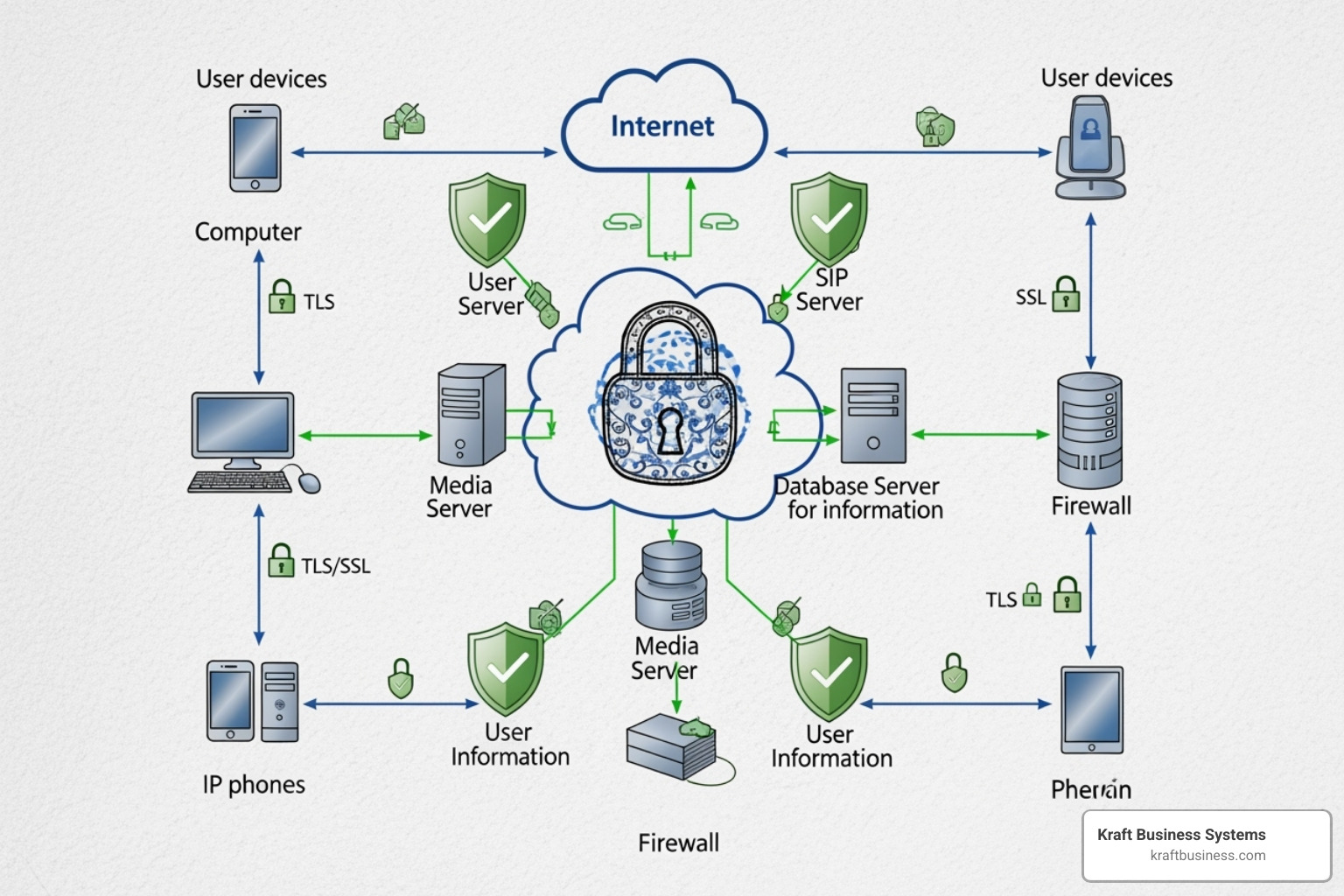
Reliability: Keeping Your Business Connected
The reliability of your internet phone service depends on two key players working together: your provider’s infrastructure and your internet connection. Think of it like a relay race – both runners need to perform for you to win.
Uptime guarantees from reputable VoIP providers typically promise 99.99% availability or higher. This isn’t just marketing speak – it represents sophisticated infrastructure with multiple servers, backup data centers, and redundant power systems. When one component fails, another seamlessly takes over.
However, your internet connection remains the critical link. Unlike traditional landlines that work independently, VoIP lives and breathes through your internet service. A slow or unstable connection can turn crystal-clear conversations into choppy, frustrating experiences.
Smart businesses plan for redundancy. Consider having a backup internet connection – perhaps a secondary cable line alongside your primary fiber connection. Some companies even use cellular failover solutions that automatically kick in when the main internet goes down.
Don’t forget about power outages either. Many modern IP phones can receive power through their network cable (called Power over Ethernet or PoE). Connect your network switches to an uninterruptible power supply (UPS), and your phones can keep working even when the lights go out.
Security Measures: Protecting Your Digital Conversations
The digital nature of internet phone service might raise security concerns, but modern VoIP systems actually offer more protection options than traditional phone lines ever could. It’s all about choosing the right provider and implementing smart practices.
Call encryption forms the first line of defense. Look for services using Secure Real-time Transport Protocol (SRTP) and Transport Layer Security (TLS). These technologies scramble your voice data as it travels across the internet, making it virtually impossible for unauthorized listeners to understand intercepted conversations.
Your provider should maintain robust network protection with enterprise-grade firewalls, intrusion detection systems, and regular security audits. But security is a team effort – your business network needs strong protection too, especially with employees working remotely.
Strong authentication methods prevent unauthorized access to your phone system. This means requiring complex passwords and, ideally, multi-factor authentication for administrative access. It’s a small step that provides enormous protection.
Some businesses worry about network vulnerabilities, asking questions like those discussed in Is VOIP secure? The reality is that like any network device, VoIP phones need proper security measures. Choose providers with strong security practices and maintain a secure internal network.
Regulatory Compliance: Meeting Your Legal Obligations
Compliance isn’t optional – it’s a legal requirement that varies by industry and location. Internet phone service providers must steer several important regulations to keep your business protected.
E911 services address a unique VoIP challenge. Traditional landlines automatically tell emergency responders exactly where you’re calling from. Since VoIP phones can work anywhere with internet, this location information isn’t automatic. Improved 911 services let you register physical addresses for each phone line, ensuring help can find you in emergencies.
This becomes especially important for remote workers. Make sure addresses stay updated when employees move or change locations. Some basic internet phone services don’t include emergency calling at all, so verify this critical feature before making your choice.
CALEA (Communications Assistance for Law Enforcement Act) requires telecommunications providers to support lawful electronic surveillance when courts order it. Your VoIP provider must comply with these federal requirements.
Industry-specific regulations add another layer. Healthcare businesses need HIPAA compliance, financial companies require PCI-DSS standards, and international operations might need GDPR protection. Your internet phone service should support these requirements through proper call recording storage, data encryption, and access controls.
The key is choosing a provider that understands your industry’s unique needs and can demonstrate how their security and compliance measures protect your business operations and sensitive information.
Frequently Asked Questions about Internet Phone Service
When businesses start exploring internet phone service, certain questions come up again and again. We’ve helped countless companies in Grand Rapids, Ann Arbor, and throughout Michigan make this transition, so let’s address the most common concerns we hear.
Conclusion: Choosing the Right System for Your Business
Making the switch to internet phone service isn’t just about upgrading your technology—it’s about changing how your business connects with customers, partners, and team members. Throughout this guide, we’ve seen how VoIP systems deliver substantial cost savings (often up to 50% compared to traditional landlines), open up powerful features like voicemail-to-email and mobile integration, and provide the flexibility that modern businesses demand.
The choice between cloud-hosted and on-premises solutions really comes down to understanding your business’s DNA. Cloud-hosted systems shine for growing companies that need to scale quickly, support remote teams, and keep IT overhead minimal. They’re perfect for businesses that want to focus on their core operations rather than managing phone infrastructure. On-premises systems, while requiring more upfront investment and technical expertise, offer the deep customization and control that larger enterprises with specific security requirements often need.
Whichever path you choose, never compromise on the fundamentals: robust security with call encryption, reliable uptime guarantees, and comprehensive E911 services. These aren’t optional extras—they’re the foundation that keeps your business communications professional and protected.
Here’s the reality: choosing the right internet phone service can feel overwhelming with all the technical considerations, feature comparisons, and deployment options. That’s exactly why partnering with experienced professionals makes all the difference.
As experts in technology solutions, Kraft Business Systems can help you assess your needs and implement the right VoIP system, from cloud-based enterprise phone systems to robust on-site hardware. We understand the unique challenges facing Michigan businesses—whether you’re a growing startup in Grand Rapids, a manufacturing company in Dearborn, or a multi-location enterprise spanning from Ann Arbor to Traverse City.
Our approach is refreshingly straightforward: we listen to how your business actually operates, assess your current setup and growth plans, then recommend solutions that fit your reality—not the other way around. Because at the end of the day, the best internet phone service is the one that makes your team more productive and your customers happier.
Contact us today to find the perfect internet phone service for your business. Let’s work together to keep your conversations crystal clear and your business connected, no matter where your team is working from.