


AI Overview:
This blog explains what an external penetration test is and why it’s essential for protecting an organization’s internet-facing systems. It shows how ethical hackers simulate real-world attacks to identify and exploit vulnerabilities before cybercriminals do, outlines how external testing differs from vulnerability scans and internal tests, and walks through the full testing lifecycle from reconnaissance to reporting. The article also covers scoping, compliance requirements, preparation steps, costs, and FAQs—highlighting how external penetration testing provides actionable insight, supports regulatory compliance, and strengthens overall cybersecurity risk management.
Think of an external penetration test as hiring a security expert to ethically break into your company from the outside, just like a real attacker would. These simulated attacks, run by ethical hackers, are designed to find and exploit security weaknesses in your internet-facing systems before the bad guys can.
Understanding Your Digital Front Door
An external penetration test is a proactive security check that simulates a real-world attack on your organization’s digital perimeter.
Let’s use an analogy. Imagine your company is a physical building. This type of test is like hiring a security specialist to check all the locks, windows, alarms, and other access points from the outside to see if they can get in. The goal is to discover vulnerabilities before a real burglar does.

In the digital world, your “building” is your network, and the “access points” are all the systems you expose to the internet. These include things like:
- Websites and Web Applications: This covers everything from customer portals and e-commerce platforms to your main marketing site.
- Servers and Networks: The core infrastructure that hosts your data and services.
- Cloud Services: Any assets you have hosted on platforms like AWS, Azure, or Google Cloud.
- APIs (Application Programming Interfaces): These are the connectors that let different software systems talk to each other.
By mimicking the tactics a real-world attacker would use, an external penetration test goes way beyond theory. It actively demonstrates how a security flaw could be exploited, giving you concrete proof of risk and showing you exactly what a cybercriminal could access or damage.
How It Differs From Other Security Tests
It’s easy to get confused by all the different security assessments out there, but their goals and methods are worlds apart. An external penetration test is not the same thing as an internal test or a simple vulnerability scan. Understanding these differences is key to building a complete security program.
An external penetration test is a critical piece of any robust cyber security risk management strategy, helping organizations find and fix digital threats before they become a real problem.
The growing reliance on this method really highlights its importance. The global penetration testing market hit $2.74 billion in 2025 and is projected to reach $6.25 billion by 2032. That reflects a compound annual growth rate of 12.5% as more organizations recognize the need for active, real-world security validation. You can find more data on these trends and explore penetration testing statistics from Zerothreat.ai.
A vulnerability scan tells you that a window might be unlocked. A penetration test tries to open the window, climb through, and see what it can find inside.
Security Assessment Methods Compared
To make the distinction crystal clear, let’s compare the three most common types of security assessments. Each one gives you a different perspective on your organization’s security posture.
| Assessment Type | Attacker Perspective | Methodology | Primary Goal |
|---|---|---|---|
| External Pen Test | Simulates an outside attacker with no prior access to the network. | Active exploitation of vulnerabilities found on internet-facing systems. | To determine if an external attacker can breach the perimeter and gain initial access. |
| Internal Pen Test | Simulates an attacker already inside the network (e.g., a malicious employee). | Attempts to escalate privileges and move laterally within the internal network. | To assess the potential damage an insider or compromised user could inflict. |
| Vulnerability Scan | An automated, high-level check for known potential weaknesses. | Uses automated tools to scan systems and create a list of potential flaws. | To quickly identify and inventory known vulnerabilities for patching. |
As you can see, each assessment plays a unique and valuable role. A vulnerability scan is great for quick, regular check-ups, while internal and external penetration tests provide a much deeper, hands-on analysis of your defenses from different attacker viewpoints.
How an External Penetration Test Works
An external penetration test isn’t a chaotic, smash-and-grab attack. Far from it. Think of it more like a meticulous inspection, where ethical hackers follow a proven game plan to systematically find and confirm security weaknesses in your internet-facing systems. Every step builds on the last, painting a complete picture of your digital defenses from an outsider’s perspective.
The whole process unfolds over five distinct phases. It starts with broad information gathering and gradually narrows down to specific, hands-on attempts to breach your defenses. Understanding these stages pulls back the curtain on what a pen test really is and helps you know exactly what to expect.
This infographic breaks down the different angles of security testing, showing how an external test fits into a wider strategy.
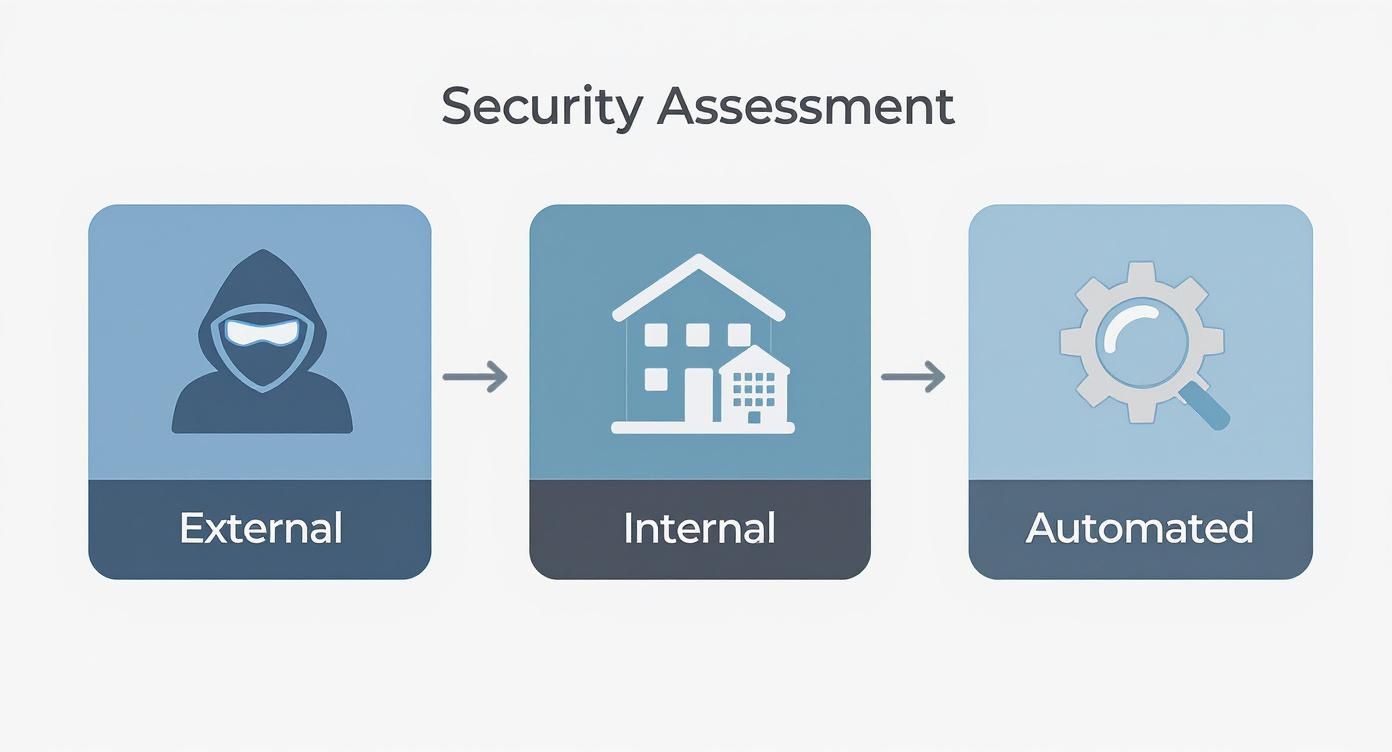
As you can see, an external test simulates an attacker from the outside. This is a totally different viewpoint from an internal test, which starts from the assumption a breach has already happened, or an automated scan, which just gives you a high-level list of potential issues.
Phase 1: Reconnaissance
The first move in any external penetration test is reconnaissance—a fancy term for information gathering. In this phase, our ethical hackers put on their detective hats. They scour publicly available information to map out your organization’s digital footprint, identifying any potential targets without actually touching your systems yet.
This intelligence gathering includes things like:
- Finding all the domain names and subdomains connected to your business.
- Identifying IP address ranges registered to your organization.
- Locating employee email addresses or tech contacts from public records.
- Sifting through social media and job postings for clues about the technology you use.
This phase is completely passive. The goal is to build a detailed map of your external attack surface, which will guide every action that follows.
Phase 2: Scanning and Enumeration
With a map of your digital property in hand, the testers move into the scanning and enumeration phase. This is where they start actively probing your systems to see what doors and windows are open. Using a mix of automated tools and manual techniques, they’ll identify live servers, open network ports, and the specific services running on them.
For example, a scan might reveal that your web server is running an older version of its software. That’s a huge find, because known vulnerabilities are often tied to specific versions. The ethical hacker is essentially knocking on every digital door to see which ones are unlocked or have a flimsy lock.
Phase 3: Vulnerability Analysis
Once the scanning phase lists out the open ports and active services, the next logical step is vulnerability analysis. Here, the testers take the information they’ve gathered and cross-reference it with massive databases of known security flaws. They’re digging into the configuration of your systems to pinpoint weaknesses an attacker could exploit.
This stage is all about connecting the dots. It’s not just about finding an open port; it’s about understanding that the specific service running on that port has a well-documented weakness that an attacker could use to get in.
Our team will investigate issues like unpatched software, weak encryption, or poorly configured security settings. This analysis results in a prioritized list of potential entry points that will get a much closer look in the next phase.
Phase 4: Exploitation
This is where the action happens. The exploitation phase is the most critical part of an external penetration test, where the ethical hackers try to actively leverage the vulnerabilities they found earlier. The goal is to gain unauthorized access to prove that a weakness isn’t just theoretical—it’s a real-world risk.
This is the key difference that separates a true pen test from a simple vulnerability scan. The tester actually tries to breach the defenses. For instance, if they discovered a web application was vulnerable to SQL injection, they would attempt to use that flaw to bypass a login screen or pull sensitive data from the database. It’s always done in a controlled and non-destructive way.
Phase 5: Post-Exploitation and Reporting
After successfully exploiting a vulnerability, the test isn’t over. The post-exploitation phase begins, where the objective is to figure out the potential business impact of a breach. Ethical hackers see what an attacker could do after getting that initial foothold. Could they escalate their privileges? Access sensitive customer data? Pivot to other systems on the network?
Finally, every single finding is compiled into a comprehensive report. This document is the ultimate deliverable of the test. It outlines each vulnerability, explains its risk level, and—most importantly—provides clear, actionable recommendations you can follow to fix the problems.
Defining Your Scope and What to Expect in the Report
A successful external penetration test lives and dies by its rules of engagement. Before any ethical hacker starts poking at your systems, you have to clearly define the scope of the test. Think of it as drawing a map for the security team, showing them exactly which digital assets are in-play and which are strictly off-limits.
It’s just like setting the boundaries for a building inspection. You’d tell the inspector to check all the doors, windows, and the roof, but not to start breaking into the neighbor’s property. In the same way, the scope for a pen test outlines every single internet-facing asset that needs to be checked out.
Getting the scope right is critical for both safety and effectiveness. It keeps the testers from accidentally disrupting your business operations and focuses their energy on your most critical systems, ensuring you get the most bang for your buck.
What Goes into the Scope
Defining your scope is all about creating an inventory of every digital asset that someone can reach from the public internet. This isn’t just a list of your websites; it’s a complete picture of your external attack surface.
Here are the usual suspects we see in an external penetration test scope:
- Web Applications: Your customer portals, e-commerce sites, and marketing websites are the front door for attackers.
- APIs (Application Programming Interfaces): These gateways for data exchange are often overlooked but can be a goldmine for vulnerabilities.
- Cloud Services: Simple misconfigurations in cloud environments like AWS or Azure are a shockingly common way for attackers to get in.
- Network Infrastructure: This covers your firewalls, routers, and any other network gear visible to the outside world.
- Remote Access Services: VPNs and other remote gateways have to be rock-solid, or they become an easy entry point for the bad guys.
This thorough approach makes sure that every potential path an attacker might take is examined, giving you a complete, real-world view of your security. This process has some overlap with broader security assessments, and you can see how it fits into a larger strategy by checking out our guide on IT security audit services.
Understanding the Final Report
While the actual testing is the exciting part, the final report is where the real value lies. This document is your roadmap to a stronger security posture. A great report translates all the complex technical findings into a clear, actionable plan that everyone from your IT team to your executive leadership can understand and act on.
Let’s be honest, a mediocre report is just a long, scary list of problems. A high-quality report, on the other hand, gives you context, prioritizes the risks, and provides crystal-clear guidance on how to fix things.
The final report is more than just a summary of findings; it’s a strategic asset that empowers you to make informed decisions about your cybersecurity investments and priorities.
Key Components of a Quality Report
A truly useful penetration test report should be built to serve different people within your organization. It has to be clear, detailed, and above all, practical. Look for these essential sections:
- Executive Summary: This is the high-level, non-technical overview written for management and decision-makers. It sums up the overall risk level, points out the most critical findings, and explains the potential business impact in plain English.
- Technical Findings Breakdown: This is the heart of the report, built for your technical team. Every vulnerability that was discovered is detailed with the following information:
- Description: What the vulnerability is and exactly where it was found.
- Risk Rating: A score (e.g., Critical, High, Medium, Low) based on how bad the impact could be and how easy it is for an attacker to exploit.
- Evidence: Screenshots, logs, or bits of code that prove the vulnerability is real.
- Actionable Remediation Steps: This is arguably the most valuable part of the whole document. For each finding, the report should give you clear, step-by-step instructions on how to fix the problem. This is what separates a good report from a great one—it doesn’t just point out problems, it gives your team a clear path to solving them.
Ultimately, the report turns the abstract idea of “risk” into a tangible work plan, empowering you to systematically beef up your defenses against the threats you’re actually facing.
Meeting Compliance and Industry-Specific Needs
For many Michigan businesses, an external penetration test isn’t just a good idea—it’s a hard requirement. It’s one of those things that moves from the “should do” to the “must do” list thanks to industry regulations and compliance standards. Not getting it done can lead to some seriously painful consequences, like steep fines, legal headaches, and a reputation that’s tough to rebuild.
These tests are your tangible proof that you’re taking your external security seriously. If you handle credit card payments, penetration testing is a non-negotiable part of the Payment Card Industry Data Security Standard (PCI DSS). For healthcare providers in our state, it’s a key piece of the puzzle for meeting HIPAA requirements and protecting patient data.
Different industries swim in different regulatory waters, and external penetration tests are designed to navigate those specific currents. The way the test is performed and how the final report is written directly lines up with the security controls demanded by major regulations, making it an indispensable tool for proving you’ve done your due diligence.
Here’s a quick look at how these tests line up with specific compliance mandates:
- Healthcare (HIPAA): The HIPAA Security Rule demands that you conduct a “risk analysis” to safeguard electronic protected health information (ePHI). An external pen test hits this requirement head-on, actively looking for weaknesses in your patient portals or telehealth platforms that could expose sensitive data.
- Finance (PCI DSS): Requirement 11.3 of PCI DSS is crystal clear: you need internal and external penetration testing at least once a year and after any big changes. This is how you verify that the systems handling cardholder data are locked down from outside threats.
- Government (NIST/CMMC): Michigan-based government contractors often have to align with frameworks like NIST or the Cybersecurity Maturity Model Certification (CMMC). These standards are rigorous, and external pen tests are exactly what you need to satisfy specific controls for finding and fixing vulnerabilities.
An external penetration test report isn’t just another document. For an auditor, it’s concrete evidence that your security program is proactive, not just a series of checked boxes. It shows you’ve gone beyond theory and simulated real-world attacks to validate your defenses.
Addressing Unique Industry Challenges
Compliance is one thing, but every industry has its own unique set of security headaches. An external penetration test helps you focus your defenses on the threats that are most likely to target your specific operations.
Think about a Michigan manufacturing firm with internet-connected machinery on the factory floor. Their risks are worlds apart from a local law firm’s. A pen test can uncover if those critical production systems are accidentally visible online, stopping an attack that could bring their entire operation to a grinding halt.
It’s the same for our educational institutions. From K-12 school districts to universities, they’re sitting on mountains of student data, research, and other sensitive information. External testing is vital for securing the online learning systems and web applications that hackers love to target. To learn more about building a security plan that meets these demands, our guide to https://kraftbusiness.com/blog/cybersecurity-compliance/ is a great place to start.
While a pen test secures your digital perimeter, don’t forget about the physical side of data protection. When it’s time to retire old IT equipment, solid secure data destruction practices are critical. It’s all part of a complete strategy to prevent data leaks and stay compliant.
At the end of the day, whether you’re protecting patient records, payment data, or proprietary designs, external penetration tests give you the industry-specific proof you need to secure your digital front door and meet your obligations.
How to Prepare for Your First Pen Test
Getting the most out of an external penetration test really comes down to what you do before the test even starts. Think of it like prepping for a detailed home inspection; the more organized you are beforehand, the smoother the process will be, and the more valuable the final report becomes.

A little planning goes a long way. Taking a few key steps before the engagement kicks off removes a lot of the guesswork and helps your security partner zero in on what truly matters to your business. It’s all about getting everyone on the same page.
Assemble Your Internal Team
Before you even think about signing a contract, you need to figure out who in your company needs to be in the loop. This isn’t just a job for the IT department. To do this right, you’ll need input from different parts of your business. Getting this team together from day one ensures everyone’s concerns are heard and communication flows smoothly.
Your core team should probably include:
- A Technical Lead: This is your go-to person—usually a senior IT manager or network admin who knows your infrastructure inside and out. They’ll work directly with the pen testers to hash out the technical details.
- Business or Application Owners: These are the managers in charge of the systems being tested. Their input is gold because they understand the real-world business impact of any potential vulnerabilities.
- An Executive Sponsor: You need a leader who gets the big picture—someone who understands why this test is important and has the authority to greenlight resources for fixing things later.
Getting these folks involved early ensures the test is grounded in both technical reality and your actual business goals.
Define Your Objectives and Rules of Engagement
With your team in place, the next step is to get crystal clear on what you’re trying to accomplish. Are you doing this to check a box for a compliance requirement like PCI DSS? Or is the main goal to kick the tires on a new web application before it goes live? Your objectives will guide the entire engagement.
This is also when you’ll establish the Rules of Engagement with your testing provider. This is a formal document that lays out the specific dos and don’ts of the entire test.
Think of the Rules of Engagement as a safety net. It protects your business by setting clear boundaries for the ethical hackers, specifying testing hours, and defining emergency contact procedures to prevent any accidental disruption to your operations.
This document is critical. It makes sure the test is conducted safely and ethically, focusing the testers’ efforts on your biggest worries without putting your live business operations at risk.
Prepare Your Systems and Personnel
The final piece of the puzzle is getting your tech and your team ready. First things first: make sure your backups are current and you know how to access them. While professional pen testers are incredibly careful, having a recent backup is just smart practice before any security assessment.
Next, you need a solid communication plan.
- Notify Key Personnel: Give your IT and support teams a heads-up about the testing window. This keeps them from mistaking the simulated attack for a real one and kicking off a full-blown incident response.
- Whitelist Tester IPs: You’ll get a list of IP addresses from the testing firm. Make sure you give these to your internet service provider or firewall admin so their traffic doesn’t get automatically blocked.
- Review Your Incident Response Plan: Have your plan ready to go. It’s unlikely you’ll need it, but if the test uncovers a critical vulnerability that’s being actively exploited, you’ll want to be prepared to act fast.
Choosing the Right Provider and Understanding Costs
Picking the right security partner for an external penetration test is a huge decision. This isn’t just about hiring a vendor; you’re bringing in a trusted advisor to stress-test your digital front door. The quality of their work directly impacts how well you can actually secure your business.
Start by looking for a team with a proven track record. Their methodology should be clear and based on established industry frameworks, not some “secret sauce” they can’t explain. Don’t be shy about asking for solid client references, especially from other Michigan businesses in your field. You want to hear firsthand about their professionalism and results.
Vetting Your Potential Security Partner
When you’re comparing pentesting firms, a few key things will help you separate the real experts from the crowd. The best partners are always happy to show off their qualifications and give you a crystal-clear picture of what you’ll get.
Here’s what you should absolutely demand during your vetting process:
- Industry Certifications: Look for credentials like the Offensive Security Certified Professional (OSCP) or Certified Ethical Hacker (CEH). These aren’t just fancy acronyms; they prove a tester has the hands-on, practical skills needed to dig deep into your systems.
- A Sample Report: This is non-negotiable. Asking for a sanitized sample report is the single best way to see the quality of their work. A good report is detailed, easy to understand, and gives you actionable steps for fixing things—not just a long list of problems.
- Transparent Methodology: The provider should be able to walk you through their entire process, from the initial scoping call to the final report delivery. This ensures there are no surprises and you know exactly what’s happening at every stage of the external penetration test.
A great security partner will also provide strategic advice. If you need help building a bigger security plan, it might be worth looking into cybersecurity consulting services to make sure your testing program aligns with your long-term business goals.
Deconstructing the Cost of a Pen Test
Trying to understand the cost of an external penetration test is a bit like asking “how much does a car cost?” It really depends on what you’re getting. There’s no one-size-fits-all price because every test is scoped to the unique digital footprint of the business.
Several key factors will influence the final price tag:
- Scope Complexity: This is the biggest driver. The size of your external attack surface—everything a hacker could see from the outside—determines the workload. A company with one simple website will have a much lower cost than one with multiple web apps, APIs, and cloud services.
- Methodology Depth: How deep do you want them to go? A basic automated scan followed by some manual checks will cost less than a deep-dive assessment where testers spend significant time trying to manually exploit vulnerabilities.
- Experience Level: You get what you pay for. Highly experienced testers with advanced certs command higher rates, but their expertise often means they find the subtle, more critical vulnerabilities that automated tools miss.
For a small to mid-sized Michigan business, a typical external penetration test can range anywhere from $5,000 to over $20,000, depending on these factors. Think of it as an investment that gives you a clear, prioritized roadmap for shoring up your defenses against real-world attacks.
As a general rule, you should plan for an external penetration test at least once a year. It’s also smart to schedule one after any major changes to your environment, like launching a new application or moving systems to the cloud. This consistent rhythm is what builds a strong, sustainable security strategy that keeps your business protected.
Frequently Asked Questions About External Pen Tests
When you start digging into external penetration tests, a few key questions always come up. We get these all the time from Michigan businesses, so let’s clear up the most common points to help you understand what to expect.
How Long Does an External Penetration Test Take?
The timeline really depends on the size and complexity of what we're testing. For a typical small or mid-sized business, the entire process—from our first kickoff call to you holding the final report—usually takes about one to two weeks.
Now, if you're a larger organization or have some seriously intricate web applications and cloud services, we might need a longer engagement. Think more in the range of three to four weeks. No matter what, your provider should give you a clear, realistic timeline right upfront before any testing kicks off.
Will a Penetration Test Disrupt Our Business Operations?
This is a big one, and the short answer is no—a professionally run pen test should cause zero disruption to your daily business. Ethical hackers aren't trying to break things; we use controlled, non-destructive methods and stick strictly to the Rules of Engagement we agree on beforehand.
The secret to a smooth test is simple: communication. We'll work with you to set specific testing windows and establish emergency contacts. This way, the testing team can do their job safely and effectively without ever impacting your live systems.
What Is the Difference Between a Black-Box and Grey-Box Test?
These are just fancy terms for how much information the testing team gets before they start. Each one simulates a different kind of real-world attacker.
Black-Box Test: We start with almost nothing—maybe just your company name. This is the classic "hacker" scenario, where we have to discover everything about your digital footprint from public sources, just like a real external attacker would.
Grey-Box Test: We get a little bit of inside info, like a set of user-level login credentials for one of your web apps. This helps us model an attack from someone who already has some level of access, like a customer or a low-level employee.
Both are common for external tests. The right one for you just depends on what specific security questions you're trying to answer with the assessment.
What Happens After the Test Is Over?
Once the testing wraps up, the real work begins: fixing the problems we found. You'll get a detailed report that breaks down every single vulnerability we identified. It will show you the risk level for each one and give you clear, step-by-step instructions for your team to patch the holes.
Your team's next move is to prioritize those findings and start working on the fixes. Any good provider will schedule a follow-up call to walk you through the report and answer all your questions. Many, including us, also offer re-testing to confirm that your fixes have actually closed the security gaps for good.
Ready to secure your digital front door with a comprehensive external penetration test? The experts at Kraft Business Systems provide the clarity and expertise Michigan organizations need to identify vulnerabilities and build a stronger defense. Get in touch with us today!