

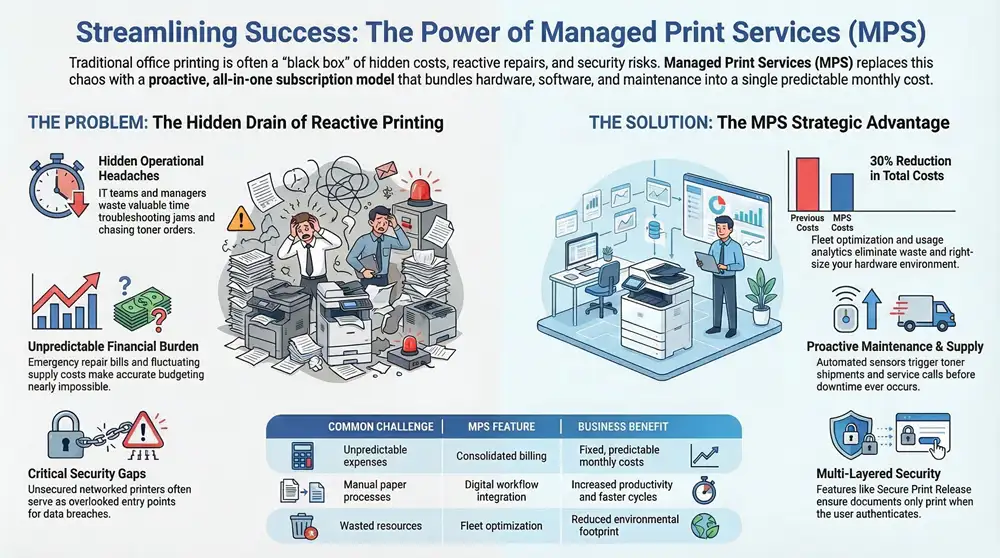
At its core, Managed Print Services (MPS) is a program that takes complete control of your company’s entire printing world. Instead of buying printers and scrambling for supplies whenever something runs out, you’re essentially subscribing to an all-in-one service. This approach bundles hardware, software, supplies, and proactive service into one strategy for a predictable monthly cost.
Understanding Managed Print Services Solutions
Think about your current printing situation. Chances are, your IT team spends way too much time troubleshooting paper jams. Your office manager is probably chasing down toner orders for a dozen different printer models. And then there are the surprise repair bills that always seem to pop up at the worst possible time.
Each of these little headaches represents a hidden cost, pulling valuable people and resources away from what they should be doing. A managed print services solution fundamentally changes this entire dynamic.

Instead of a chaotic collection of devices and unpredictable expenses, MPS turns your print operations into a well-oiled machine. A dedicated partner takes full responsibility for every single piece of your print infrastructure. This single point of contact handles it all—from setting up new devices and performing maintenance to automating supply orders and monitoring security. This frees up your team to focus on what actually grows the business.
The Shift from Reactive to Proactive
The way most offices have traditionally handled printing is almost entirely reactive. A printer breaks, you call for a repair. A toner cartridge runs dry, someone places an order. It’s an inefficient, costly cycle that leads to unexpected downtime and frustrated employees.
Managed print services completely flips this model on its head. By using advanced monitoring software, an MPS provider can anticipate your needs before they even become problems.
- Predictive Maintenance: The system can detect when a printer part is nearing the end of its life and schedule a service call before it fails. This prevents that critical downtime right when you’re trying to print a big proposal.
- Automated Supply Fulfillment: Your printers and copiers automatically report low toner or ink levels, which triggers a new shipment sent directly to your office. You’ll never run out of supplies in the middle of a job again.
- Usage Analytics: Your provider analyzes print volumes and patterns across the whole organization. This helps identify opportunities to consolidate devices or redirect high-volume jobs to more cost-effective machines, saving you money.
This proactive management is the real cornerstone of effective managed print services solutions. It turns a constant source of administrative headaches into a smoothly running, optimized utility.
A Growing Trend for Smart Businesses
The business world is catching on to just how valuable this strategic shift is. The global managed print services market is growing at a robust 9.25% compound annual growth rate (CAGR). This impressive expansion shows that organizations worldwide are turning to MPS to finally get control over their sprawling print environments, cut expenses, and improve efficiency. You can discover more insights about the MPS market growth on mordorintelligence.com.
A managed print services solution isn’t just about outsourcing printer repairs; it’s about adopting a holistic strategy that aligns your printing infrastructure with your broader business objectives, from budget control to data security.
By centralizing everything, an MPS partner gives you a clear, comprehensive view of your entire print ecosystem. This visibility allows for data-driven decisions that reduce waste, secure sensitive documents, and support your company’s growth. For Michigan businesses, this means gaining a real competitive edge through smarter, more efficient operations.
The Core Components of a Modern MPS Solution
A truly effective managed print services solution isn’t just one thing; it’s a combination of interconnected parts all working together. Think of it like a high-performance vehicle—you need the engine, electronics, fuel system, and a skilled mechanic to keep it running smoothly. In the same way, MPS integrates five distinct pillars to create a single, efficient system for your business.
This map shows how hardware, software, and services form the foundation of a modern MPS solution.
It’s the seamless integration of physical devices, intelligent software, and expert human support that makes the whole thing work. Each component feeds into the others to deliver the cost control, security, and efficiency that define a successful partnership.
Hardware Fleet Management
The first step is figuring out what you actually have. An MPS provider kicks things off with a thorough assessment of every single printer, copier, scanner, and multifunction device across your organization. This audit quickly uncovers the old, inefficient machines, the dust-collecting underused devices, and the obvious opportunities to consolidate.
Armed with this data, the provider develops a strategy to optimize your fleet. This usually means replacing outdated equipment with modern, energy-efficient models that are a better fit for how your team really works. The end goal is a standardized, streamlined hardware environment that’s just plain easier to manage and more cost-effective to run.
Print Software and Security
With the right hardware in place, specialized software becomes the brains of the operation. This is a critical piece of modern managed print services solutions, adding layers of control and intelligence that your devices don’t have on their own.
This software is what enables powerful security features and gives you deep insights into who is printing what. Key functions include:
- Secure Print Release: Documents only get printed when a user physically authenticates at the device with a PIN or badge. No more sensitive information sitting forgotten in the output tray.
- Usage Tracking: The software monitors who is printing, what they’re printing, and from which devices, which allows for dead-accurate cost allocation back to specific departments.
- Rule-Based Printing: You can set up automatic rules to enforce cost-saving policies, like routing huge jobs to the most efficient printer or making double-sided printing the default.
By integrating advanced software, managed print services transform standard printers into secure, intelligent network endpoints. This control is fundamental to protecting data and managing expenses effectively.
Proactive Monitoring and Maintenance
One of the biggest shifts with MPS is moving from a reactive “it broke, now fix it” model to a proactive one. Modern printing devices are equipped with monitoring agents that constantly report their status back to the provider.
These agents automatically generate alerts for potential issues, like low toner or an upcoming maintenance cycle. This allows a technician to be dispatched to solve a problem before it actually causes a device to fail and brings your workflow to a grinding halt. This predictive approach is all about minimizing downtime and keeping your team productive.
Automated Supplies Replenishment
We’ve all been there: running out of toner right in the middle of printing a critical report. MPS makes that frustration a thing of the past. The same proactive monitoring system that tracks device health also manages all your consumables.
When a printer’s toner or ink cartridge hits a set low level, the system automatically triggers an order. The correct replacement is then shipped directly to your office, often arriving before the old one is even empty. You never have to think about manually ordering or stocking supplies again. A modern MPS solution can even handle specialized needs, like ensuring you have everything for mastering shipping labels printing to keep your logistics humming.
Dedicated Service and Support
Finally, the whole solution is wrapped in a layer of human expertise. This pillar covers everything from the initial strategic consultation to ongoing help desk support. For Michigan-based businesses, having a local support team that can provide fast, on-site assistance is a huge advantage.
It ensures that when issues do pop up, you have a reliable partner ready to get you back online quickly. It’s the peace of mind that guarantees uptime.
Key Business Benefits of Adopting MPS
Switching to a managed print services solution brings real, tangible results that reach far beyond the supply closet. It’s a strategic move that turns a historically chaotic expense into a genuine asset for your business. We’re talking measurable improvements in how you control costs, secure your data, boost productivity, and even hit your sustainability targets.
This isn’t just about printers; it’s about shifting from a reactive “fix-it-when-it-breaks” mindset to proactively managing your entire print environment for peak performance and security. Let’s break down exactly what that looks like.
Gaining Control Over Your Print Costs
For most businesses, printing costs are a total black box. One month it’s an emergency toner order, the next it’s an unexpected repair bill for a critical machine. Trying to budget for it feels like a guessing game you can’t win. A managed print services solution cuts through that fog, replacing financial guesswork with clear, predictable operational spending.
An MPS provider rolls all those scattered print-related expenses—toner, parts, service, you name it—into a single, fixed monthly invoice. It’s usually based on a simple cost-per-page model, so you only pay for what your team actually prints. Budgeting just became a whole lot easier.
Better yet, the initial assessment almost always uncovers shocking amounts of waste. By analyzing who’s printing what and where, a provider can spot opportunities to consolidate devices, set smarter defaults, and right-size your fleet. It’s not uncommon for businesses to slash their printing costs by as much as 30% once they have a real strategy in place.
Strengthening Document and Data Security
Here’s a scary truth: your networked printers and copiers are often the most overlooked security holes in your entire office. If it’s connected to your network but not secured, that multifunction device is an open door for anyone looking to access sensitive company data. MPS slams that door shut by implementing multiple layers of protection.
Key security measures immediately put in place include:
- User Authentication: No more sensitive documents sitting forgotten on the printer tray. Employees have to verify their identity at the device with a PIN, ID card, or even a mobile app before their job is released.
- Data Encryption: Information is scrambled both on its way to the printer and while it’s stored on the device’s hard drive, making it useless to anyone who might try to intercept it.
- Activity Monitoring: Every print, scan, and copy job is logged. This creates a crystal-clear audit trail that’s essential for meeting compliance standards and deterring any misuse from the inside.
These aren’t just bells and whistles; they’re crucial protections for everything from financial reports and HR records to your most sensitive client information. Suddenly, your print fleet becomes a secure, managed part of your IT infrastructure.
Boosting Productivity with Automated Workflows
Modern multifunction printers are so much more than just printers. They’re powerful on-ramps to your digital world, but most businesses never tap into their full potential. An MPS partner helps you connect these devices to your core business systems, letting you automate the manual, paper-shuffling tasks that bog your team down.
Imagine someone in accounting scanning a stack of invoices. Instead of saving them to a folder and emailing them one by one, the device kicks off a workflow that automatically sends them to the right person for approval. This simple change eliminates manual data entry, crushes the risk of human error, and gets vendors paid faster. Want to learn more? You can explore the top benefits of managed print services in our in-depth guide.
By integrating print devices with digital systems, MPS bridges the gap between your physical and digital worlds. This connection streamlines processes, reduces manual effort, and frees up your employees to focus on higher-value work.
Advancing Your Sustainability Goals
A well-managed print environment is a greener one, period. An MPS strategy directly supports your company’s environmental goals in a few powerful ways. First, that initial fleet assessment gets rid of old, energy-guzzling machines and replaces them with modern, efficient models that use far less power.
On top of that, things like automated toner replenishment and proactive maintenance ensure you use every last drop in a cartridge, which dramatically cuts down on plastic waste. By setting smart defaults like duplex (double-sided) printing and using analytics to curb wasteful habits, you can seriously reduce your paper consumption. It all adds up to a smaller carbon footprint and a stronger corporate culture of sustainability.
From Cost Center to Strategic Asset
To see these benefits in action, let’s connect common business frustrations to the specific solutions an MPS program provides. It’s about turning everyday problems into measurable wins.
| Common Business Challenge | Relevant MPS Feature | Resulting Business Benefit |
|---|---|---|
| Unpredictable and high printing expenses | Consolidated billing & usage analytics | Predictable monthly costs and up to 30% savings. |
| Risk of data breaches from unsecured devices | User authentication & data encryption | Enhanced security and compliance with regulations like HIPAA. |
| Slow, manual paper-based processes | Digital workflow integration | Increased employee productivity and faster business cycles. |
| Wasted paper, toner, and energy | Fleet optimization & print policies | Reduced environmental impact and support for sustainability goals. |
As you can see, a managed print strategy isn’t just a service—it’s a solution that tackles core operational challenges head-on, delivering improvements across the entire organization.
How MPS Soloves Industry-Specific Challenges
Managed print services aren’t some generic, one-size-fits-all fix. Their real power shines through when they’re shaped to meet the intense compliance, security, and day-to-day operational needs of specific industries. For any Michigan organization in healthcare, manufacturing, education, or government, a properly adapted managed print services solution is the key to handling unique regulatory and workflow pressures.
A standard approach that works for a corporate office just won’t cut it for a hospital network or a noisy factory floor. Every environment has its own rulebook, its own risks, and its own set of demands that directly affect how documents are printed, handled, and locked down.
This is where a true MPS partner proves their worth, moving past simple device management to deliver industry-focused value that solves real-world headaches.
Healthcare: HIPAA Compliance and Security
For hospitals, clinics, and really any healthcare provider, protecting patient information isn’t just a good idea—it’s the law. The Health Insurance Portability and Accountability Act (HIPAA) has incredibly strict rules about managing Protected Health Information (PHI), and believe it or not, printers are one of the most common weak spots.
MPS tackles these challenges head-on by building in critical security controls. Think about features like secure print release, where a nurse or doctor has to physically swipe a badge or enter a PIN at the printer. This simple step prevents sensitive patient records from being left forgotten in an output tray for anyone to see.
The demand for these robust solutions is driving massive growth in the sector. In fact, healthcare has become the fastest-growing vertical for managed print services, with the market projected to rocket from USD 27,500 million in 2017 to almost USD 59,709 million by 2025. This explosion is fueled by the absolute necessity of securing high-volume printing across thousands of devices. You can dig into the complete findings on MPS market trends at Allied Market Research.
In healthcare, a managed print services solution acts as a critical layer of your compliance strategy, transforming every printer and copier from a potential liability into a secure, auditable endpoint for managing patient data.
Manufacturing: Durability and Uptime
The factory floor is a tough place for equipment. Dust, temperature swings, and constant use will destroy standard office gear in no time. An MPS provider who actually understands manufacturing will deploy rugged, durable devices specifically built to withstand the rigors of a production environment.
Even more critical, downtime is simply not an option when production schedules are on the line. A proactive maintenance plan ensures that the label printers for shipping, the devices cranking out work orders, and the machines handling compliance paperwork are always running. With support that spans multiple sites, a manufacturer can keep print operations consistent and reliable, from the front office straight to the plant floor.
Education: Cost Control and Accessibility
Schools, from K-12 districts to sprawling universities, have a uniquely complex job: managing a diverse fleet of devices scattered across classrooms, libraries, and administrative buildings. A major headache is figuring out how to accurately allocate print costs to different departments or even individual students.
An effective MPS program gives them the tools for that fine-grained control:
- Departmental Billing: Specialized software tracks usage right down to the department level, which makes budget allocation and accountability a breeze.
- Secure Student Printing: Students can be given print quotas or use pay-for-print systems, all managed through secure logins that protect their documents from being picked up by the wrong person.
- Fleet Optimization: A proper MPS assessment quickly spots the underused printer in the faculty lounge or the over-burdened machine in the student lab, allowing for smart redeployment to better serve the entire campus.
Government: Regulation and Transparency
For local and state government agencies, sticking to public records acts and tight state regulations is non-negotiable. Managed print services provide the security and audit trails needed to prove they’re following the rules. Every single print, copy, and scan can be logged, creating an undeniable record of document activity.
On top of that, public sector budgeting demands absolute transparency and predictability. MPS delivers consolidated, clear billing that makes financial oversight simple. Instead of getting hit with dozens of small, random invoices for toner and repairs, the agency gets a single, predictable monthly cost. This makes budgeting straightforward and defensible—something essential for any government operation.
How to Choose the Right MPS Partner
Picking the right partner for your managed print services is probably the single most important decision you’ll make in this entire process. A great provider feels like an extension of your own team, finding ways to make you more efficient and secure. The wrong one just adds another layer of frustration you don’t have time for.
To make a smart choice, you need to look past the sales pitch and have a solid framework for evaluating potential partners. It’s all about finding a company whose skills and services line up perfectly with what your business is trying to accomplish.
Scrutinize Service Level Agreements
Your first deep dive should be into the Service Level Agreement (SLA). This is the contract that spells out exactly what the provider promises to deliver. Vague promises are a major red flag; you want to see specific, measurable guarantees that they’ll be held accountable for.
Here’s what to look for in an SLA:
- Guaranteed Response Times: When a machine goes down, how fast will a technician show up? For businesses here in Michigan, having a local partner with a guaranteed 4-hour on-site response time can be the difference between a minor hiccup and a full day of lost productivity.
- Uptime Guarantees: Look for a real commitment to keeping your fleet running, often shown as a percentage like 98% uptime. This tells you the provider is confident in their proactive maintenance and has their act together.
- First-Call Resolution Rate: This number shows how often they fix an issue on the very first visit. A high rate means they’re sending skilled techs with the right parts, saving you from the headache of repeat service calls.
Verify Security Credentials and Compliance Expertise
Amid constant cyber threats, your printers and copiers can be a huge security blind spot. Your MPS partner needs to be a security expert, not just someone who sells toner. You have to ask direct questions about how they plan to protect your network and your data.
A provider’s approach to security tells you everything you need to know about their real value. They should be able to explain precisely how their managed print solution will tighten your defenses, enforce user policies, and help you meet tough industry rules like HIPAA.
Don’t just take their word for it—ask for proof. Do they have security certifications? Can they show you case studies of how they’ve secured businesses like yours, especially in regulated fields like healthcare or government? Their answers will tell you if they’re truly ready to protect your most sensitive information.
Evaluate Technology Integration and Scalability
Your printers don’t exist in a bubble. A forward-thinking MPS provider makes sure their solutions plug right into the rest of your IT world, whether that’s your Document Management System (DMS) or your cloud services. This is what unlocks true workflow automation and gives you the best return on your investment.
Just as important is how they’ll handle the future. Your business is going to change, and your MPS partner needs to be ready to change with you. Ask them about their process for re-evaluating your needs and scaling your services up or down. A real partner helps you future-proof your operations, not just put a bandage on today’s problems. Making the right choice from the start is crucial, and you can learn more by exploring how to pick the best managed print service companies for your needs. This ensures a long-term, successful relationship that grows with your business.
What to Expect During MPS Implementation
Switching over to managed print services isn’t like flipping a switch. A good provider won’t just show up and start swapping out machines. Instead, they’ll walk you through a clear, phased rollout designed to make the whole process smooth and predictable, with as little disruption to your team as possible.
The whole point is to build your new print setup on a solid foundation of real data, perfectly aligned with what your business actually needs.
Think of it as a partnership. It all kicks off with a deep dive into how your office works right now, then moves into strategic planning, the physical setup, and finally, ongoing fine-tuning.
The Four Phases of Implementation
A structured rollout usually happens in four distinct stages, each one building on the last. This step-by-step method keeps everyone on the same page and avoids any last-minute surprises.
- Assessment and Discovery: This is where everything begins. Your MPS partner needs to get a complete picture of your current print world. They’ll analyze it all—where your printers are, who prints what, how much you’re printing, and what it’s costing you. To get a better feel for this crucial first step, explore the details of a comprehensive managed print services assessment and see how it sets the stage for everything that follows.
- Solution Design: Armed with all that data, the provider gets to work designing a custom solution. This isn’t some cookie-cutter plan; it’s a strategic blueprint showing which old devices are getting replaced or consolidated, where the new gear will live, and what software and security rules will be put in place to solve your specific problems.
- Deployment and Training: Once you approve the plan, the physical rollout starts. Technicians will install new hardware, set up the software, and haul away the old equipment, all while trying to stay out of your team’s way. A huge part of this phase is user training. It’s critical that everyone knows how to use the new features, like secure print release or scanning directly to a cloud folder.
- Ongoing Management and Optimization: The job isn’t done just because the new printers are plugged in. Your provider will now continuously monitor the entire system, manage your toner and supplies, provide helpdesk support, and schedule regular check-ins to find new ways to save money or make your workflows even better.
A great MPS partner focuses as much on people as they do on technology. True success is achieved only when your team feels comfortable, confident, and fully supported in the new environment.
Ensuring a Smooth Transition with Change Management
Let’s be honest, people don’t always love change. Introducing new technology, even when it’s better, can sometimes be met with a bit of resistance. That’s why effective change management is so important for getting your team on board and excited about the benefits of your new managed print services solutions.
A good provider will help you create a communication plan that highlights how these changes will actually make your employees’ jobs easier—no more toner emergencies or waiting around for a repair guy. They’ll offer hands-on training sessions for different groups, from basic printing to advanced scanning workflows.
Most importantly, they’ll set up a simple, clear process for getting help. When your team knows exactly who to call for support, the transition feels a whole lot smoother.
Answering Your Top Questions About Managed Print Services
Making a big move like bringing in a managed print services partner is bound to bring up some questions. It’s a smart business decision, and you need clear, straight-up answers to feel confident you’re on the right track. Let’s tackle some of the most common things we hear from business owners during this process.
One of the first things everyone wants to know is, “How does the pricing actually work?” Most MPS providers, including us, use a cost-per-page (CPP) model. It’s beautifully simple. You pay a set rate for every black-and-white page and another for every color page that comes out of your printers.
That single price wraps up everything: toner, parts, maintenance, and service calls. This completely changes the game for your budget, turning unpredictable printing costs into one stable, easy-to-plan operational expense.
Timelines and Security
“Okay, so how long does this all take?” is another question that comes up right away. The timeline can shift a bit depending on how big and complex your company is, but a typical rollout takes about four to eight weeks. That window covers everything from the initial deep-dive assessment and custom solution design to getting the new equipment installed and your team trained up.
Security is, without a doubt, a massive priority. And this is an area where a solid MPS program really shines, beefing up your document security in several key ways:
- Secure Print Release: This feature requires your employees to authenticate themselves right at the printer—with a PIN or a badge—before their documents are released. No more sensitive reports sitting forgotten in the output tray for anyone to see.
- Data Encryption: We make sure your data is protected as it zips across the network to the printer and while it’s resting on the device’s hard drive.
- Audit Trails: You get a full record of who printed, copied, or scanned what, and when. This is huge for compliance and keeping everyone accountable.
One of the biggest myths we hear is that you’ll be stuck using only one brand of printer. The best managed print services solutions are completely brand-agnostic. A good partner will recommend the right devices for each specific job, mixing and matching brands to build a fleet that’s truly optimized for your needs.
This flexibility is crucial. It means your hardware strategy is driven by what your business actually needs to succeed, not by what a single manufacturer wants to sell you.
Ready to stop guessing about your print costs and start seeing real savings? The experts at Kraft Business Systems are here to build a managed print services solution that fits your unique goals. Let’s start the conversation today.