

For businesses in Grand Rapids, managed IT services aren’t just about fixing broken computers. Think of it as a strategic partnership designed to keep your technology running smoothly, your data locked down tight, and your IT strategy perfectly aligned with your business goals. Instead of just waiting for something to break, a Managed Service Provider (MSP) becomes your dedicated tech team, actively preventing problems before they can cause expensive downtime.
What Are Managed IT Services, Really?
Let’s be honest, most businesses treat their IT like a car. The traditional support model, often called “break-fix,” is like calling a mechanic only after your car has sputtered to a halt on the side of I-96 during rush hour. It’s always reactive, always stressful, and it always happens at the worst possible moment.
Managed IT services flips that entire model on its head. It’s like having a dedicated pit crew for your business. This team isn’t just waiting for a breakdown; they’re constantly fine-tuning performance, monitoring for wear and tear, and making sure every single component is running at peak efficiency. This proactive approach turns your technology from a frustrating, unpredictable expense into a reliable, strategic asset.
The Shift from Reactive to Proactive IT
For Grand Rapids businesses—especially those in competitive fields like manufacturing, healthcare, and professional services—this shift is a game-changer. Instead of constantly dealing with the fallout from IT failures, you can finally focus on what you do best: running your business.
This proactive management model is built on a few core ideas:
- Preventing Downtime: We’re talking about continuous, round-the-clock monitoring that identifies potential issues—like a server that’s about to fail or a new security vulnerability—and resolves them before they ever disrupt your workday.
- Securing Critical Data: Your MSP doesn’t just install antivirus software. They implement and manage layers of robust security measures to protect your sensitive information from the constant barrage of cyber threats.
- Strategic Alignment: A true MSP partner helps make sure your technology investments directly support your business objectives, helping you scale efficiently and keep your competitive edge.
This fundamental change in how IT is managed is why the market is exploding. Globally, managed services are projected to hit $642.57 billion by 2030. That growth is being fueled by businesses just like yours, all looking for smarter, more cost-effective ways to handle complex technology, fight back against cybercrime, and optimize their operations.
The core value of managed services is simple: It turns your technology into a predictable, high-performing tool for growth rather than an unpredictable source of problems and costs.
Ultimately, choosing managed IT services in Grand Rapids is an investment in stability, security, and strategy. It’s about having a local partner who is genuinely dedicated to keeping your technology—and by extension, your business—running at full speed. By handing your IT over to the experts, you free up your team’s time and resources to concentrate on what really matters. If you want to dive deeper into the basics, check out our detailed article explaining what managed IT services cover.
What’s Actually Included in a Managed IT Service Plan?
Alright, let’s get past the high-level ideas and dig into what you actually get when you partner with a managed IT provider here in Grand Rapids. These aren’t just line items on an invoice; they’re the practical, day-in-and-day-out services that keep your business humming, your data safe, and your tech strategy sharp.
Think of it like this: You wouldn’t build a new office without a solid blueprint, a reliable security system, and a skilled maintenance crew on call. Managed IT services are the digital equivalent for your entire technology infrastructure. It’s about shifting from fixing things after they break to preventing them from breaking in the first place.
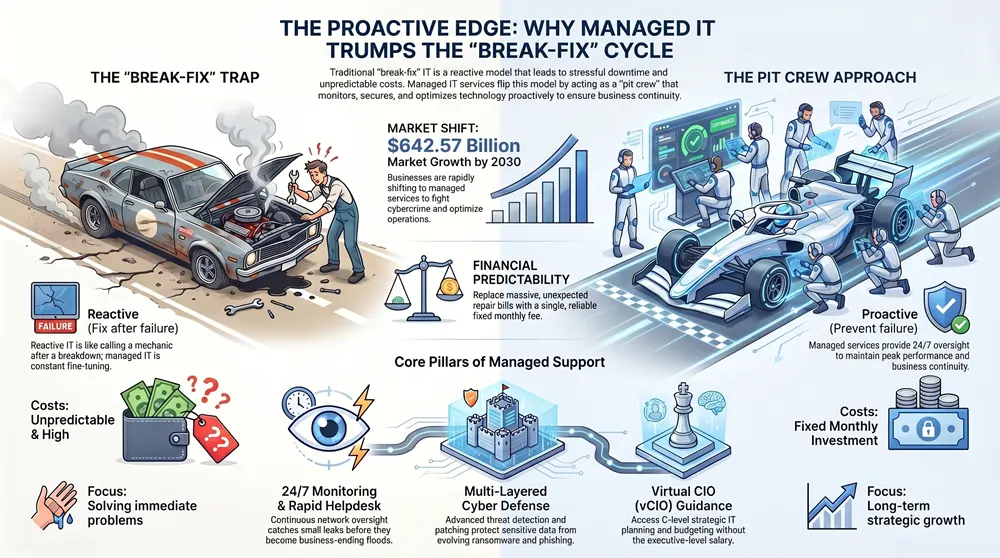
This image really drives home that core difference in philosophy.
On one side, you have the chaotic, unpredictable “break-fix” cycle. On the other, you have the stability and security that come from a truly proactive strategy.
To give you a clearer picture, here’s a quick breakdown of the most common services you’ll find in a managed IT plan and what they mean for your business.
A Quick Look at Common Managed IT Services
This table sums up the core services, their main job, and the real-world value they bring to your bottom line.
| Service Component | Primary Function | Key Business Benefit |
|---|---|---|
| 24/7 Monitoring | Continuously watches network health and performance. | Catches small issues before they become major downtime events. |
| Helpdesk Support | Provides fast, expert assistance for employee tech issues. | Minimizes productivity loss and employee frustration. |
| Virtual CIO (vCIO) | Offers high-level strategic IT planning and budgeting. | Ensures your tech investments align with business goals. |
| Cybersecurity | Implements multi-layered defense against digital threats. | Protects sensitive data, reputation, and finances. |
| Business Continuity (BDR) | Backs up data and creates a rapid recovery plan. | Gets you back online quickly after a disaster, minimizing loss. |
Each of these components plays a critical role in building a resilient and efficient technology foundation for your company. Let’s look a little closer at what each one involves.
24/7 Proactive Network Monitoring
Imagine a digital security guard for your network that never sleeps, never takes a coffee break, and never gets distracted. That’s 24/7 proactive monitoring in a nutshell. Your managed service provider (MSP) uses sophisticated software to keep a constant eye on everything—your servers, workstations, firewalls, and other critical gear.
This constant watch allows them to spot trouble on the horizon, like a server running out of space or unusual traffic that could signal an attack, long before it causes a crash. It’s the difference between patching a tiny leak in a pipe and calling in the flood restoration crew.
Responsive Helpdesk Support
Even with the best monitoring, tech issues will pop up. When they do, your team needs a fast, effective way to get help and get back to work. Responsive helpdesk support is your direct line to IT experts who can troubleshoot problems over the phone or by connecting to a user’s computer remotely.
Whether an employee suddenly can’t print a critical proposal or gets locked out of their email, the helpdesk is their first call. This service is absolutely vital for keeping your team productive and cutting down on the frustrating tech roadblocks that can bring a workday to a screeching halt.
The real measure of a great MSP is how they balance proactive prevention with lightning-fast support. The ultimate goal is to reduce the number of helpdesk calls needed, but when a call is necessary, it gets resolved with speed and expertise.
Strategic vCIO Guidance
Most small and mid-sized businesses don’t have the budget for a full-time Chief Information Officer (CIO). A virtual CIO (vCIO) from your MSP fills that crucial leadership gap, giving you C-level strategic guidance without the executive-level salary.
Your vCIO is the person who helps you build a technology roadmap that actually supports your business goals. They’ll help you manage the IT budget, advise on smart investments, and plan for the future. For example, they might map out a cloud migration to better support a remote team or help you schedule a hardware refresh to avoid performance bottlenecks, ensuring every dollar you spend on tech is a wise one.
Robust Cybersecurity and Business Continuity
Protecting your business from digital threats is simply not optional in the modern world. A core managed services plan includes a multi-layered security strategy that goes way beyond just installing antivirus software. This typically includes:
- Advanced Threat Protection: Tools designed to detect and block modern threats like malware, ransomware, and sophisticated phishing attacks.
- Firewall Management: Properly configuring and actively monitoring your network’s front door to keep intruders out.
- Security Patching: Making sure all your software and operating systems are consistently updated to close the security holes hackers love to exploit.
A critical piece of this puzzle is making sure your provider is following established best practices. This includes things like adherence to global information security standards like ISO 27001, which provides a framework for ensuring your data is protected according to recognized protocols.
But it doesn’t stop at prevention. A solid plan must also include business continuity and disaster recovery (BDR). This service ensures that if a disaster strikes—whether it’s a server failure, a fire, or a major cyberattack—your critical business data is backed up and can be restored quickly. This is what minimizes downtime and prevents a bad day from turning into a business-ending event. For a deeper look at how all these pieces form a complete strategy, you can explore our overview of complete managed IT support.
Why a Local Grand Rapids IT Partner Matters
Let’s be honest, choosing an IT provider feels like a huge decision. It is. It’s not just a technical choice; it’s a business partnership. While a big, national firm might look impressive on their website, there’s a world of difference when you partner with a local team for managed IT services in Grand Rapids. The advantages are real, and they go way beyond just having someone down the street to fix a server.

It all starts with a shared understanding of our local business scene. A Grand Rapids partner just gets it. They know the unique challenges and opportunities that West Michigan companies face, from the specific compliance headaches in our healthcare systems to the intense operational demands of our manufacturing sector. That common ground creates a smoother, more effective relationship from the get-go.
Financial Predictability and Enhanced Security
One of the first things our clients notice is the relief that comes with cost predictability. The old “break-fix” model is a recipe for anxiety, leaving you exposed to massive, unexpected bills when a critical system fails or you get hit with a data breach. A managed services agreement swaps that chaos for a single, fixed monthly fee that covers everything from routine check-ups to emergency support.
Suddenly, budgeting becomes simple and reliable. You’re not guessing what your IT spend will be anymore; you have a clear, predictable number to plan around. This stability frees up cash, letting you invest back into growing your business instead of hoarding it for the next tech disaster.
But it’s not just about the budget. A local MSP gives you access to enterprise-grade security tools that would be incredibly expensive for most small or mid-sized businesses to buy and manage on their own. It levels the playing field, giving you a serious defense against cyber threats.
- Advanced Threat Detection: We’re talking about sophisticated tools that are constantly hunting for and neutralizing malware, ransomware, and phishing attacks.
- Proactive Patch Management: This means ensuring all your software is consistently updated to seal off security holes before attackers can find them.
- Security Expertise: You get direct access to a team of cybersecurity pros who live and breathe this stuff, staying on top of the latest threats and defense strategies.
Increased Efficiency and Faster On-Site Response
Nothing grinds productivity to a halt faster than technology roadblocks. When your team is stuck fighting slow computers, spotty Wi-Fi, or glitchy software, they aren’t focused on their real jobs. A huge part of your Grand Rapids IT partner’s role is to make those friction points disappear.
By proactively maintaining your systems, they make sure your technology is a tool that helps your team, not a hurdle they have to overcome. The result is smoother workflows, less frustration, and more time spent on work that actually brings in revenue. But what about when a problem can’t be fixed with a phone call?
This is where a local partner truly shines. When a server crashes or a network switch dies, you need boots on the ground, fast. A provider with a physical presence in Grand Rapids can get a technician to your office in minutes or hours, not days.
That rapid response is everything when it comes to minimizing costly downtime. A national provider, no matter how big, simply can’t compete with the speed and accountability of a local team that can be at your door when you need them most. Businesses are catching on, which is why the managed services market in the U.S. is projected to hit $116.25 billion by 2030. Companies are actively seeking out reliable, expert partners to handle their security and infrastructure. You can learn more about the growth of the managed services industry on infrascale.com.
Ultimately, a local Grand Rapids IT partner offers more than just tech support. You get a real relationship with a team that’s invested in your success and the prosperity of our shared community. They’re not just another vendor on a spreadsheet; they’re your neighbor.
Understanding Managed IT Pricing and Contracts
Let’s talk about the money side of managed IT services in Grand Rapids. Sifting through quotes and contracts can feel like trying to read a foreign language, but getting a handle on the terms is the most important step in building a partnership that actually works for your business.
The real goal isn’t to snag the cheapest deal. It’s about finding a pricing model that gives you predictable costs and real value. A good, clear agreement means no surprise bills, and the services you pay for are exactly what you expected.
Common Pricing Models in the Grand Rapids Market
When you start gathering quotes from local providers, you’ll probably run into a few standard ways they charge for their services. Each one is built for different kinds of businesses, so let’s break them down.
- Per-User Pricing: This one is straightforward and scales beautifully. You pay a flat monthly fee for every employee who uses IT services. It makes budgeting a breeze because your costs grow predictably right alongside your team.
- Per-Device Pricing: Just like the per-user model, but you pay a flat fee for each piece of hardware being managed—think desktops, servers, laptops, and so on. This works well if you have more machines than people, like in a manufacturing facility.
- All-Inclusive (or “All-You-Can-Eat”) Pricing: This model is all about maximum predictability. For one fixed monthly payment, you get access to a full suite of services, from unlimited helpdesk support and constant monitoring to high-level strategic advice. It’s designed to cover just about any IT issue you could run into.
If you want to dig deeper into what these models look like in terms of actual dollars, our guide on what to expect for managed IT services cost gives a much more detailed breakdown.
A transparent pricing model is one of the biggest signs of a trustworthy IT partner. The contract should spell out exactly what’s included, what costs extra, and how fees will adjust as your business grows.
What to Look for in Your Service Agreement
That managed services contract is way more than just a piece of paper; it’s the blueprint for your entire relationship with your IT provider. A solid agreement protects everyone by setting crystal-clear expectations from the get-go. If you see vague language, that’s a huge red flag.
Make sure you pay close attention to these key parts of the agreement:
- Scope of Work (SOW): This section needs to be incredibly detailed, listing every single service included in your plan. You should see specifics on things like 24/7 monitoring, helpdesk availability, how often data is backed up, and what cybersecurity measures are in place.
- Service Level Agreement (SLA): The SLA is where your provider makes concrete promises about performance and response times. It should state exactly how fast they’ll acknowledge an issue and the target timeframe for getting it fixed.
- Term Length and Flexibility: Contracts are usually for one to three years. A good agreement will include clauses that let you scale your services up or down if your business needs change.
A big piece of smart IT budgeting involves managing your cloud resources effectively. Taking the time to understand strategies for cloud cost optimization can have a major impact on your overall IT spending, and a good MSP will help you navigate this. At the end of the day, a strong contract is built on total clarity, ensuring you know exactly what you’re paying for and the level of service you’re guaranteed to receive.
How to Choose the Right Grand Rapids IT Provider
Picking a partner for your managed IT services in Grand Rapids is one of those critical decisions that goes way beyond the tech. You aren’t just hiring someone to fix computers. You’re bringing in a strategic partner who will be responsible for your company’s security, efficiency, and future growth.
Get it right, and you’ll propel your business forward. Get it wrong, and you’re in for a world of constant frustration, finger-pointing, and costly downtime.
To make the right call, you have to dig deeper than a simple features list. The best IT providers in West Michigan separate themselves through their processes, their people, and a proactive mindset. It’s all about figuring out how they handle real-world situations, from a simple password reset to a full-blown emergency. That means you have to ask the right questions—the kind that cut through the polished sales pitch.
Moving Beyond the Technical Checklist
Sure, every provider you talk to will promise fast response times and solid security. The real story isn’t in what they promise, but how they deliver. To get to the truth, you need to grill them on their client onboarding process, their emergency response plan, and their day-to-day customer service philosophy.
A great partner won’t just have an answer; they’ll have a documented, repeatable process for every scenario. That’s how you get consistent, reliable service.
Think of it like this: a good chef follows a recipe. A great chef understands the science behind the recipe, which lets them adapt and nail it even when the kitchen is on fire. Your IT provider needs to be that great chef, with systems that guarantee top-notch service even when things go sideways.
A provider’s true value isn’t just in the tools they use, but in the clarity and reliability of their service delivery process. Vague answers about response times or onboarding are a significant red flag.
Verifying Industry-Specific Expertise
Grand Rapids is a hub for all sorts of industries, and each one has its own unique tech and compliance headaches. A one-size-fits-all IT approach just doesn’t cut it here. You have to make sure any potential provider has real, hands-on experience in your specific field.
- For Healthcare Practices: Do they live and breathe HIPAA? Ask them for specific examples of how they manage the required technical safeguards to protect patient data (ePHI). Don’t let them off with a simple “yes.”
- For Manufacturing Firms: Can they talk intelligently about operational technology (OT) and standards like CMMC? They should be able to explain how they secure the front office network and the systems running on the production floor.
A provider who already knows your industry gets your workflows, understands your compliance pressures, and can anticipate your challenges. That specialized knowledge saves you a ton of time and helps you dodge expensive mistakes a generalist provider might make.
Essential Questions for Vetting IT Providers
When you’re meeting with potential IT providers, it’s easy to get lost in the technical details. This table is your cheat sheet to cut through the noise and ask questions that reveal what it’s really like to work with them. Use this checklist to compare your options and see who is truly ready to be a strategic partner.
| Category | Question to Ask | What to Listen For in an Answer |
|---|---|---|
| Onboarding & Process | “Can you walk me through your exact client onboarding timeline and process?” | A detailed, multi-stage plan that includes discovery, documentation, tool deployment, and a clear communication schedule. Vagueness suggests a disorganized process. |
| Emergency Response | “What is your documented protocol for a critical after-hours emergency, like a server failure or ransomware attack?” | A clear chain of command, defined response time SLAs, and a specific escalation path. They should confidently explain who responds and how quickly. |
| Client Relationships | “Can you provide 3-4 local Grand Rapids references in a similar industry to ours?” | An immediate “yes” and a willingness to connect you with current clients. Hesitation is a warning sign that they may lack a strong local track record. |
| Cultural Fit | “How would you describe your company culture and approach to customer service?” | Answers that emphasize partnership, proactive communication, and business alignment over just fixing technical issues. Look for a team that feels like an extension of your own. |
Finally, don’t underestimate the power of a good cultural fit. Your managed IT provider becomes an extension of your own team, deeply plugged into your daily operations. You need a partner whose communication style, values, and commitment to service line up with yours. That’s the foundation for a productive relationship that actually lasts.
Why Grand Rapids Businesses Choose Us
When you’re looking for managed IT services in Grand Rapids, you’re doing more than just hiring a tech company. You’re choosing a partner whose performance directly impacts your security, your team’s productivity, and your ability to grow. It’s about finding a team that does more than fix what’s broken; it’s about building a real relationship with a local expert who is genuinely invested in seeing you succeed.
That’s where we come in. At Kraft Business Systems, we bridge the gap between world-class IT strategy and the dedicated, on-the-ground support that West Michigan businesses deserve.
We’re not just in this community; we’re a part of it. Being local means we get the specific challenges and opportunities unique to our region’s industries—from the factory floors in manufacturing to the sensitive data in healthcare. It also means that when you need hands-on help, we’re right down the road, not hours away on a map.
A Partnership Built on Results
Our entire approach is built to deliver results you can actually see and feel in your day-to-day operations. We don’t just react to problems as they pop up. We work proactively to stop them from ever happening in the first place.
This mindset shifts your technology from a frustrating, unpredictable expense into a powerful strategic asset. Our proactive security measures guard your critical data around the clock, while our strategic vCIO guidance ensures every dollar you invest in technology is directly fueling your business goals.
We believe a true IT partnership is defined by trust, transparency, and a relentless focus on helping your business achieve its goals. Our success is measured by your success.
This shift toward genuine partnership is a big reason the managed services industry has grown so much. The global market expanded from USD 223 billion in 2020 to an estimated USD 329.1 billion by 2025, as more businesses realized they needed scalable and cost-effective solutions. You can explore more insights on the managed IT services market growth on businessresearchinsights.com.
Let’s Build Your Technology Roadmap
Every business is different. You have unique goals, unique frustrations, and a unique vision for the future. That’s why we always start with a conversation, not a sales pitch. We invite you to schedule a no-obligation consultation with our team right here in Grand Rapids.
Here’s what you can expect when we talk:
- We’ll listen to understand your specific business objectives and pain points.
- We’ll take a look at your current technology setup to identify opportunities for improvement.
- We’ll show you exactly how our solutions can bolster security, boost productivity, and support your long-term growth.
Let us show you the difference a dedicated, local partner can make. We’re committed to providing the strategic guidance and reliable support your business needs to thrive.
Your Top Questions About Grand Rapids Managed IT
Deciding to bring in a managed IT partner is a big move. It’s totally normal to have a few questions about how it all works, what it costs, and if it’s even the right fit for your business. We get these questions all the time from local business owners, so let’s clear the air with some straight answers.
This quick rundown is designed to tackle that uncertainty and help you feel confident about your next steps.
Is My Business Too Small for Managed IT Services?
Not a chance. In fact, managed IT is built to scale and often delivers the biggest bang for your buck to small and medium-sized businesses. An MSP gives you the expertise of an entire IT department—cybersecurity pros, cloud specialists, network engineers—all for one predictable monthly fee.
Think of it this way: you get enterprise-level security and know-how without the enterprise-level cost of hiring a full internal team.
What’s the Real Difference Between Break-Fix and Managed IT?
It all comes down to being proactive versus reactive. Your typical break-fix shop waits for something to break. When it does, you’re hit with downtime and a surprisingly high, unpredictable bill. Frankly, they make money when you have problems.
A managed services provider flips that model on its head. We’re constantly monitoring and maintaining your systems to stop problems before they even start. Our whole goal is to maximize your uptime and keep things running smoothly, because our success is tied directly to yours.
How Long Does It Take to Get Onboarded?
The exact timeline always depends on how complex your current IT setup is, but a professional Grand Rapids MSP will walk you through a clear, structured process. It usually kicks off with a deep-dive audit to understand your environment, which might take a week or two.
After that, we’ll start rolling out the essential monitoring and security tools. A smooth, non-disruptive onboarding process generally takes anywhere from 30 to 90 days. We take our time to make sure the transition is seamless and doesn’t get in the way of your day-to-day operations.
Can You Help Us with Industry Compliance like HIPAA?
Absolutely. A good MSP is one of your most important partners when it comes to navigating tricky compliance rules. We’re the ones who implement the technical safeguards, run the risk assessments, and maintain the robust security needed for regulations like HIPAA in healthcare or CMMC for manufacturers.
When you’re talking to potential providers, make sure you ask about their specific, hands-on experience with the compliance standards that matter to your industry. A real partner will have a proven history of helping businesses just like yours stay compliant and sail through audits.
Ready to see how a proactive IT strategy can change the game for your business? The team at Kraft Business Systems is here with the local expertise and reliable support you need to succeed. Let’s start a conversation about where you want your technology to go.