

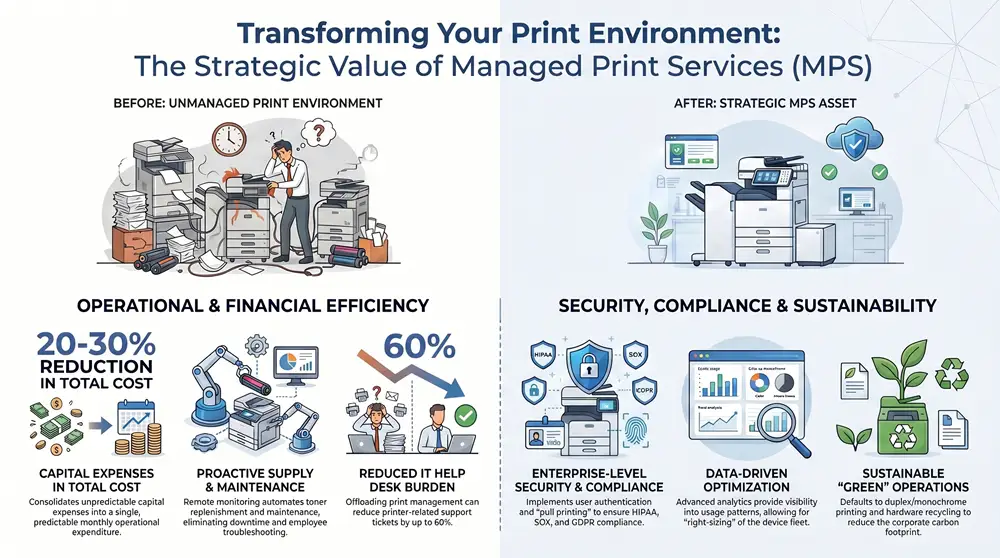
Organizations often view printing as a simple operational cost, but a strategic approach reveals significant opportunities for optimization, security enhancement, and efficiency gains. Managed Print Services (MPS) offer a comprehensive framework for transforming your entire print environment from a scattered cost center into a streamlined, secure, and predictable asset.
An effective MPS program centralizes control over your entire printer fleet, including devices, supplies, and maintenance, under a single, expert provider. This shift not only reduces direct costs but also liberates valuable IT resources, strengthens data security, and aligns your operations with sustainability goals. Before we explore the specific managed print services benefits, it’s crucial to understand that this is not just about leasing copiers; it’s about re-engineering a fundamental business process for peak performance and resilience.
This roundup details eight critical advantages that a well-implemented MPS strategy can deliver, supported by actionable data and practical examples. We will explore how these services provide more than just ink and toner, offering a clear path to:
- Significant cost reduction and predictable, transparent budgeting.
- Enhanced security protocols to protect sensitive information and ensure compliance.
- Improved operational efficiency by minimizing downtime and automating workflows.
- Reduced administrative burden on your internal IT team, allowing them to focus on core strategic initiatives.
Each point is designed to provide you with a clear understanding of the tangible value MPS brings to organizations, from Michigan-based healthcare providers needing HIPAA-compliant solutions to manufacturing firms managing complex multi-site operations. Let’s dive into the specific benefits you can expect.
1. Drastic Cost Reduction & Predictable Budgeting

One of the most immediate and impactful managed print services benefits is the significant reduction in operational costs coupled with newfound budget predictability. Unmanaged print environments are notorious for hidden and volatile expenses. Think of emergency toner purchases at retail prices, unexpected repair bills for aging devices, and the administrative overhead of managing multiple vendors and invoices.
Managed Print Services (MPS) eliminate this financial chaos by consolidating every print-related expense into a single, predictable monthly invoice. This covers everything from hardware and maintenance to supplies and support. This strategic shift transforms your printing costs from a reactive, unpredictable capital expenditure (CapEx) to a stable, manageable operational expenditure (OpEx).
From Financial Volatility to Strategic Forecasting
The core of this benefit lies in a comprehensive initial assessment. An MPS provider analyzes your entire print infrastructure, identifying underutilized devices, high-cost consumables, and inefficient workflows. This data-driven approach allows them to “right-size” your fleet, ensuring you only have the equipment you truly need.
This optimization directly translates into tangible savings, often reducing an organization’s total cost of ownership by 20-30%.
Real-World Scenario: A mid-sized law firm was spending thousands annually on various toner cartridges from different suppliers and frequently paid for expensive one-off technician visits. After switching to an MPS provider, they received a single monthly bill based on their actual print volume. Automated toner replenishment ended last-minute purchases, and all maintenance was included, saving them an estimated 25% in the first year and providing a clear, fixed cost for their annual budget.
Actionable Steps for Implementation:
- Gather Current Invoices: Before engaging a provider, collect all print-related invoices from the past 6-12 months (toner, paper, repair services, device leases). This gives you a baseline to measure potential savings against.
- Track Print Volume: If possible, use device counters to understand your current monthly print volume. This data is crucial for an accurate MPS quote.
- Focus on Total Cost: Look beyond the cost-per-page. A good MPS plan reduces waste, minimizes downtime, and frees up IT staff time, all of which contribute to your total savings.
By implementing MPS, you gain precise control over your printing budget. To further optimize your print environment and maximize savings, explore these actionable tips to boost printing efficiency and reduce costs. This predictable financial model allows for more accurate forecasting and strategic allocation of resources to other critical business areas.
2. Increased Operational Efficiency and Productivity
A core benefit of managed print services is the significant boost to organizational efficiency and employee productivity. In a typical office, print-related problems are a constant source of disruption. Employees are frequently pulled away from their primary responsibilities to troubleshoot paper jams, decipher cryptic error codes, or hunt down the right toner cartridge. These small interruptions accumulate, creating a substantial drain on valuable work hours.
Managed Print Services (MPS) directly address this inefficiency by offloading the entire burden of print management. Through proactive monitoring, automated supply replenishment, and expert technical support, an MPS provider ensures your print fleet runs smoothly and reliably. This transforms printers from a source of frustration into a seamless tool that supports business operations, allowing your team to focus on revenue-generating activities.
From Reactive Firefighting to Proactive Support
The key to this productivity gain is the shift from a reactive to a proactive support model. Instead of waiting for a device to fail, an MPS provider uses remote monitoring tools to anticipate issues before they occur. Low toner levels automatically trigger a new shipment, and potential hardware faults are flagged for preventative maintenance, drastically reducing unexpected downtime.
This streamlined approach minimizes disruptions and liberates your IT department from the endless cycle of printer-related support tickets.
Real-World Scenario: An educational institution found its IT help desk was overwhelmed, with nearly 60% of support calls related to printer issues across its various campuses. By implementing an MPS solution, they gained proactive monitoring and centralized management. Automated alerts and rapid on-site service freed up their IT staff to focus on critical network and classroom technology projects, while faculty and staff enjoyed higher printer uptime.
Actionable Steps for Implementation:
- Establish Clear SLAs: When choosing a provider, define strict Service Level Agreements (SLAs) for technician response times and issue resolution to guarantee minimal disruption.
- Utilize Analytics: Leverage the reporting and analytics dashboards provided by your MPS partner to identify departmental workflow bottlenecks and opportunities for process improvement.
- Train Your Team: Ensure employees receive basic training on the new devices and features, such as secure print release or mobile printing, to maximize their use and prevent common user errors.
By strategically managing your print environment, you unlock latent productivity across your entire organization. To understand how a tailored strategy can remove these operational hurdles, you can explore how managed print solutions boost efficiency. This proactive system ensures your technology empowers your employees rather than hindering them.
3. Enhanced Security and Compliance Management
Beyond cost savings, one of the most critical managed print services benefits is the fortification of your organization’s security posture. Networked printers and multifunction devices are often overlooked endpoints, yet they represent significant vulnerabilities. These devices store, process, and transmit sensitive data, making them prime targets for cyberattacks if left unmanaged.
Managed Print Services (MPS) address these risks by implementing a multi-layered security strategy directly into your print infrastructure. This includes device hardening, user authentication protocols, data encryption, and continuous monitoring. An MPS provider transforms your print fleet from a potential liability into a secure, centrally managed component of your IT ecosystem, ensuring sensitive information remains protected from unauthorized access.
From Vulnerable Endpoints to Compliant Assets
The strength of MPS security lies in its proactive, comprehensive approach. Providers enforce consistent security policies across every device, closing gaps that often exist in self-managed environments. This is crucial for organizations in regulated industries, where data protection isn’t just a best practice but a legal requirement.
This systematic management helps organizations meet strict regulatory standards like HIPAA, SOX, and GDPR by providing audit trails, secure document release, and access controls.
Real-World Scenario: A healthcare network was struggling to ensure HIPAA compliance across its dozens of clinics, each with different printer models and security settings. By partnering with an MPS provider, they implemented a standardized “pull printing” system. Staff had to authenticate with an ID badge at the device to release their print jobs, eliminating the risk of confidential patient records being left unattended and creating a complete audit log for compliance reporting.
Actionable Steps for Implementation:
- Conduct a Security Assessment: Before deploying MPS, work with the provider to perform a thorough assessment of your current print environment to identify existing vulnerabilities and compliance gaps.
- Implement User Authentication: Require users to authenticate at the device using a PIN, ID card, or multi-factor authentication before they can print, scan, or copy documents.
- Enable Data Encryption: Ensure all data, whether in transit to the printer or at rest on its hard drive, is encrypted to prevent interception or unauthorized access.
By leveraging an MPS provider, you shift the complex burden of print security and compliance to experts. This ensures your document workflows are not only efficient but also aligned with rigorous industry regulations. To delve deeper into this topic, you can read more about how managed print services bolster security. This expert management significantly reduces the risk of data breaches originating from your print fleet.
4. Scalability and Flexibility for Growing Organizations
A key advantage among managed print services benefits is the inherent scalability and flexibility it offers. For any organization with growth ambitions, the ability to adapt its infrastructure without massive capital outlay or disruptive projects is critical. An unmanaged print environment quickly becomes a bottleneck, where expanding to a new office or onboarding a large team requires complex procurement, installation, and support processes.
Managed Print Services (MPS) are designed to grow and shrink alongside your business needs. This model transforms your print infrastructure from a rigid, fixed asset into a dynamic, on-demand service. Adding devices for a new department, deploying printers to a new regional office, or even scaling down during seasonal lulls becomes a simple service request rather than a significant capital project.
From Static Infrastructure to Dynamic Growth
The foundation of this flexibility is the service-based agreement. An MPS provider maintains ownership and responsibility for the hardware, allowing you to adjust your fleet based on real-time business requirements. Whether you’re a startup poised for rapid expansion or a retail chain opening new locations, MPS ensures your print capabilities match your operational footprint precisely.
This prevents over-provisioning (buying too much equipment in anticipation of growth) and under-provisioning (scrambling to add devices after growth has already occurred), optimizing cash flow and operational readiness.
Real-World Scenario: A tech startup grew from 50 to nearly 500 employees in two years. By leveraging MPS, they avoided an estimated $200,000 in upfront equipment purchases. Their provider seamlessly deployed and managed devices across three new office floors as needed, all under a single, predictable monthly cost-per-page model that scaled with their headcount.
Actionable Steps for Implementation:
- Document Growth Projections: Share your 1-year, 3-year, and 5-year business growth plans with a potential MPS provider. This allows them to design a scalable framework from day one.
- Negotiate Scalability Terms: Ensure your service agreement clearly outlines the process and costs for adding or removing devices, as well as adjusting service levels for new locations.
- Leverage MPS Analytics: Use the data and reporting from your provider to forecast future capacity needs, ensuring you can proactively adjust your print environment before demands outpace your resources.
By partnering with an MPS provider, you gain an infrastructure that supports, rather than hinders, your growth. This agility allows you to focus on strategic business expansion, confident that your print environment can keep pace with every new milestone.
5. Sustainability and Environmental Responsibility
A key managed print services benefit that aligns with modern corporate values is the significant boost to environmental sustainability. Unmanaged print environments often contribute to excessive waste, from unnecessary paper and toner consumption to premature device disposal. This creates a substantial environmental footprint and can conflict with an organization’s Corporate Social Responsibility (CSR) and Environmental, Social, and Governance (ESG) objectives.
Managed Print Services (MPS) directly address these issues by implementing a strategic, eco-conscious approach to your entire print infrastructure. By optimizing device placement, managing supply chains efficiently, and promoting mindful printing habits, MPS helps organizations dramatically reduce their environmental impact. This transforms printing from a source of waste into a measurable part of your sustainability strategy.
From Wasteful Practices to Green Operations
The foundation of this benefit is rooted in data and control. An MPS provider analyzes device usage to identify areas of high consumption and waste. They can then implement rules-based printing, such as defaulting all jobs to double-sided (duplex) and black-and-white, which immediately cuts paper and color toner usage.
Furthermore, MPS includes responsible lifecycle management. Providers ensure that old devices are recycled or disposed of according to environmental regulations, preventing harmful e-waste from entering landfills. This holistic approach makes sustainability an achievable and reportable metric.
Real-World Scenario: Unilever integrated MPS into its corporate sustainability strategy to tackle its global print footprint. Through device consolidation, setting duplex printing defaults, and leveraging analytics to monitor progress, the company successfully reduced its print-related carbon footprint by 25%, demonstrating a powerful commitment to its environmental goals.
Actionable Steps for Implementation:
- Set Clear ESG Targets: Before implementation, define specific sustainability goals for your print environment, such as a 20% reduction in paper consumption or a 15% decrease in energy usage.
- Enable Eco-Friendly Defaults: Work with your provider to configure all networked devices to default to duplex and monochrome printing. This is one of the quickest ways to see an immediate impact.
- Leverage Print Analytics: Use the data from your MPS provider to identify departments or individuals with high print volumes. Use this information to offer targeted training on more sustainable printing habits.
- Participate in Recycling Programs: Ensure your MPS agreement includes participation in manufacturer take-back and recycling programs like HP Planet Partners or Xerox Green World Alliance for both toner cartridges and end-of-life hardware.
By making sustainability a core component of your print strategy through MPS, you not only reduce your environmental impact but also enhance your brand’s reputation. This commitment resonates with environmentally conscious clients, employees, and stakeholders, turning a standard business function into a powerful statement of corporate responsibility.
6. Reduced IT Administration Burden and Technical Support
A significant, yet often underestimated, managed print services benefit is the massive reduction in the administrative and technical burden placed on your internal IT department. In a typical office, IT teams spend an inordinate amount of time on low-value, reactive tasks like troubleshooting printer offline errors, installing drivers, managing firmware updates, and ordering toner. This diverts skilled resources from strategic, revenue-generating projects.
Managed Print Services (MPS) fundamentally shift this dynamic by outsourcing the entire print ecosystem to a dedicated specialist. This transfer of responsibility means your IT staff is no longer the first line of defense for a jammed paper tray or a cryptic error code. The MPS provider handles all proactive maintenance, help desk support, and supply chain logistics, liberating your technical team to focus on core business objectives.
From Printer Problems to Strategic Projects
The transition begins with the MPS provider taking complete ownership of your print fleet. They proactively monitor device health, automate supply replenishment, and manage all service calls. This eliminates the constant stream of support tickets related to printing that plague most IT help desks. The time recovered is substantial and can be reinvested into critical areas like cybersecurity, network infrastructure upgrades, or cloud migration.
This focused approach allows your IT professionals to work on projects that drive innovation and competitive advantage, rather than simply keeping the printers running.
Real-World Scenario: A multi-campus educational institution found its lean IT team was inundated with print-related support calls, averaging a 60% ticket volume from printers alone. By implementing an MPS solution, they offloaded all device management and user support. This freed up two full-time IT staff members to spearhead a critical network security overhaul and a new student information system deployment, projects that had been on hold for over a year.
Actionable Steps for Implementation:
- Define Clear SLAs: Before signing an agreement, work with the provider to establish strict Service Level Agreements (SLAs) that detail guaranteed response times and resolution targets for different issue severities.
- Establish Escalation Paths: Document a clear escalation procedure for critical device failures or widespread outages to ensure major issues are addressed with the appropriate urgency.
- Train Staff on New Procedures: Conduct a brief training session for your staff on how to contact the MPS provider’s help desk directly, bypassing your internal IT team for all print-related issues.
By offloading printer management, you not only improve operational efficiency but also boost the morale and effectiveness of your IT department. As you streamline operations, it’s also important to consider the full lifecycle of your technology. Understanding the secure and responsible recycling process for retired electronics ensures that your old printers and other devices are disposed of in an environmentally sound and data-secure manner.
7. Advanced Analytics and Data-Driven Decision Making
Beyond simply managing devices and supplies, a key managed print services benefit is the access to powerful analytics and reporting. Traditional print setups operate in a data black hole, making it impossible to understand usage patterns, identify waste, or strategically plan for the future. You might know what you spend, but you don’t know why or how.
Managed Print Services (MPS) transform your print environment into a source of valuable business intelligence. Modern solutions like Xerox ConnectKey Analytics or HP Page Wide Analytics provide comprehensive dashboards that track every aspect of your print ecosystem. This data gives you a clear, granular view of usage trends, device performance, and departmental costs, turning guesswork into informed strategy.
From Opaque Spending to Actionable Intelligence
The value of this benefit is in converting raw data into strategic business decisions. An MPS provider doesn’t just give you a report; they help you interpret the information to uncover hidden inefficiencies and opportunities for optimization. This data-driven approach allows you to right-size your device fleet, implement cost-saving print policies, and align your infrastructure with actual business needs.
This level of insight empowers organizations to make proactive, evidence-based improvements rather than reactive, costly fixes.
Real-World Scenario: A university system used MPS analytics to track device usage across its multiple campuses. The data revealed that several high-capacity, expensive-to-run printers in administrative buildings were severely underutilized, while smaller, less efficient desktop printers in faculty offices were overused. By reallocating devices based on this data, they consolidated their fleet, reduced hardware costs, and saved significantly on consumables.
Actionable Steps for Implementation:
- Establish a Baseline: Before full implementation, work with your provider to capture 30-60 days of usage data. This baseline is critical for measuring the impact of any changes you make.
- Schedule Regular Reviews: Set up quarterly business reviews with your MPS provider and internal department heads to analyze the analytics. Use these meetings to identify trends and set new optimization goals.
- Create Custom Reports: Ask your provider to create department-specific reports. This helps allocate costs accurately and encourages accountability, allowing a legal department to bill print costs to specific clients or a school to track faculty printing budgets.
By leveraging the advanced analytics included with MPS, you gain the visibility needed to continuously refine your print environment. This data-driven decision-making is fundamental to maximizing your return on investment and ensuring your print infrastructure actively supports your organization’s goals.
8. Improved User Experience and Accessible Printing Solutions
Beyond cost savings and security, a significant managed print services benefit is the dramatic improvement in the day-to-day user experience. Clunky, unreliable, and inaccessible printing processes create constant frustration for employees, leading to lost productivity and an increase in IT support tickets. Traditional print setups often fail to accommodate modern, flexible work environments.
Managed Print Services directly address these pain points by deploying modern, intuitive printing technologies. This includes features like secure mobile printing from any device, cloud integration for remote employees, and user-friendly touchscreen interfaces. By simplifying the entire printing process, MPS makes it more accessible and efficient for everyone in the organization, boosting satisfaction and reducing common printing-related frustrations.
From Printing Problems to Productive People
The core of this benefit is a user-centric approach to technology. An MPS provider evaluates how your employees actually work and implements solutions that fit their needs. This could mean enabling a sales agent to print a contract directly from their smartphone while on the road or allowing a remote worker to securely send a document to the office printer for a colleague to retrieve.
This focus on accessibility and ease-of-use ensures that printing becomes a seamless part of the workflow rather than a recurring obstacle.
Real-World Scenario: A rapidly growing tech company with a remote-first policy struggled with document workflows. Employees couldn’t easily print materials when visiting the main office. By implementing an MPS solution with cloud-based pull printing, employees could send print jobs from anywhere and securely release them at any office printer using their ID badge, drastically improving convenience and document security.
Actionable Steps for Implementation:
- Survey Your Users: Before implementation, ask employees about their biggest printing frustrations. This feedback is invaluable for tailoring the new system to solve real problems.
- Prioritize Mobile and Cloud: Ensure your chosen MPS provider offers robust mobile and cloud printing capabilities to support a flexible, modern workforce.
- Customize Device Interfaces: Work with your provider to customize the on-device touchscreens with shortcuts for common tasks or department-specific workflows, such as “Scan to Accounting Folder.”
By implementing an MPS plan focused on the user, you not only enhance productivity but also reduce the burden on your IT help desk. This allows your technical staff to concentrate on high-value strategic initiatives instead of troubleshooting printer driver issues, which is a key advantage of adopting a managed services model.
Taking the Next Step Toward a Smarter Print Strategy

Transitioning to a managed print services model is a strategic pivot, not just a procurement decision. We’ve explored the extensive list of managed print services benefits, moving far beyond the obvious ink and toner savings. From creating a predictable, transparent budget and reducing capital expenditures to fortifying your network against security breaches, the impact is comprehensive. You’re not simply outsourcing device maintenance; you’re implementing a holistic strategy to enhance how information moves through your organization.
The true value emerges when you consider the compounding returns. Improved operational efficiency means your team spends less time troubleshooting printer errors and more time on revenue-generating activities. Enhanced security and compliance, particularly critical for healthcare and government clients, mitigate significant financial and reputational risks. Gaining access to advanced analytics transforms your print environment from a cost center into a source of actionable data, enabling smarter decisions about device placement, usage policies, and workflow automation.
Recapping the Core Advantages
The journey toward a streamlined print infrastructure delivers value at every level of your operation. To recap, the most critical takeaways revolve around transforming a decentralized, chaotic function into a centralized, strategic asset.
- Financial Control: You move from reactive, unpredictable spending on supplies and repairs to a fixed, per-page cost that simplifies budgeting and forecasting. This financial clarity is a foundational benefit of managed print services.
- Operational Excellence: By reducing the administrative burden on your IT team and providing proactive support, MPS eliminates a significant source of distraction and downtime, directly boosting employee productivity.
- Strategic Security: A managed approach introduces robust security protocols, including user authentication, secure print release, and device hardening, which are essential for protecting sensitive data and meeting compliance mandates like HIPAA.
- Data-Driven Optimization: Instead of guessing, you gain visibility into your entire print fleet. This data allows for continuous optimization, ensuring you have the right devices in the right places, configured for maximum efficiency and minimal waste.
Your Action Plan for Evaluation
Embarking on this change requires a clear, methodical approach. The most successful transitions begin not with a sales call, but with an internal assessment. Understanding your current state is the first step toward defining your desired future state.
- Conduct a Preliminary Internal Audit: Start by gathering basic data. Tally your invoices for toner, paper, maintenance kits, and third-party repair services over the last six to twelve months. Ask your IT staff to estimate the time they spend per week on printer-related support tickets. This initial snapshot provides a baseline for your current total cost of ownership (TCO).
- Identify Key Pain Points: What are the most common printing-related complaints you hear? Is it device downtime? Inconvenient printer locations? The high cost of color printing? Compile a list of these operational frustrations, as they represent clear opportunities for improvement.
- Engage a Partner for a Professional Assessment: Once you have your baseline data, the next logical step is to schedule a professional print assessment. An experienced provider will go deeper, analyzing device usage patterns, mapping workflows, and identifying security vulnerabilities. This assessment is crucial for building a data-backed business case that demonstrates the potential ROI and highlights the tangible managed print services benefits for your specific environment.
Investing the time to properly evaluate and implement an MPS strategy is one of the most impactful decisions you can make to improve operational efficiency, strengthen security, and gain control over a notoriously unmanaged expense. It is the definitive step toward a smarter, more secure, and cost-effective print infrastructure.
Ready to uncover the hidden costs in your print environment and build a strategy for success? The team at Kraft Business Systems specializes in conducting comprehensive print assessments for Michigan businesses, healthcare providers, and government agencies to deliver tailored managed print solutions. Connect with us to schedule your no-obligation assessment and discover the benefits of a truly optimized print strategy.