

So, what exactly is printer and copier leasing? Think of it less like buying a piece of office furniture and more like leasing a company car. It’s a straightforward financial agreement where your business pays a predictable monthly fee to use the equipment for a set amount of time.
This approach lets you sidestep the hefty upfront cost of buying a new machine, freeing up cash for things that actually grow your business. Essentially, you’re turning a major capital expense into a manageable operating expense.
Understanding Printer Copier Leasing
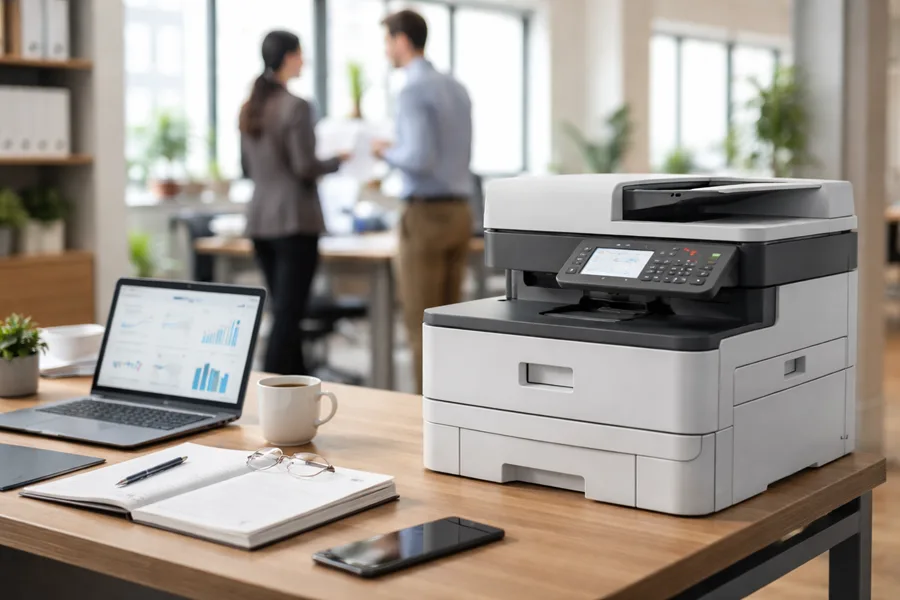
At its core, printer and copier leasing is a long-term rental that often bundles the machine, maintenance, and sometimes even supplies into one simple monthly payment. Instead of dropping thousands of dollars on a device that starts losing value the second it’s plugged in, leasing gives you flexibility. You get the exact functionality you need for a specific term, usually somewhere between three to five years.
But this is more than just a way to avoid a big purchase. It’s a smart financial strategy for managing cash flow. By converting a large, one-time capital expense into a smaller, recurring operational cost, you can budget with far more accuracy. That means more money for marketing, hiring, or developing your next big idea.
A Smarter Way to Manage Technology
The whole idea behind leasing is to pay for what the equipment does for you, not for the burden of owning a depreciating asset. A brand-new multifunction printer is a lot like a new car—it loses a chunk of its value the moment it rolls off the delivery truck and into your office. Leasing shields your business from that depreciation hit.
This way of thinking brings a few key advantages to the table for any modern business:
- Preservation of Capital: Keep your cash in the bank for revenue-generating activities instead of sinking it into office hardware.
- Access to Modern Equipment: When your lease is up, you can easily upgrade to newer, faster, and more secure devices. No more getting stuck with obsolete technology.
- Predictable Budgeting: One fixed monthly payment covers the machine, service calls, and repairs, making your financial planning a whole lot simpler.
Leasing is fundamentally a strategic decision to invest in operational efficiency rather than asset ownership. It allows businesses to stay agile, equipped with the latest tools without the financial drag of outdated, owned hardware.
The Growing Trend Toward Leasing
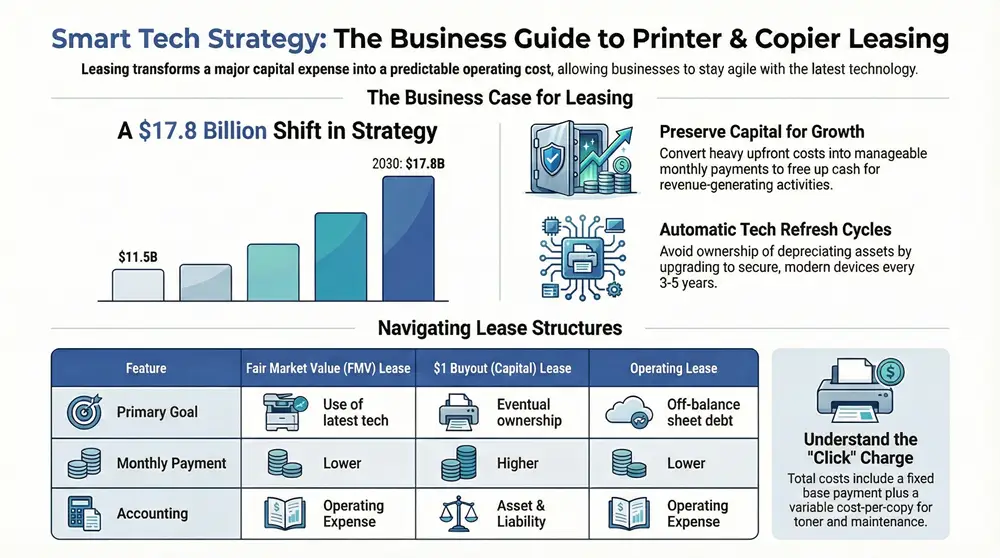
This move from buying to leasing isn’t just a niche strategy; it’s a major trend in how offices are run today. The global copier market was valued at around $15 billion in 2022, and the printer leasing slice of that pie hit $11.5 billion all by itself.
Experts project that number will climb to $17.8 billion by 2030. This reflects a huge shift in thinking, with over 65% of offices worldwide now relying on multifunction printers that handle copying, scanning, and printing in one device. You can explore more data on this market expansion and see for yourself how businesses are adapting.
Comparing the Different Types of Copier Leases
Picking a copier lease is a lot like choosing a new cell phone plan. The best option isn’t one-size-fits-all; it really depends on how you’ll use the equipment and what you want to happen when the contract is up. Getting a handle on the different lease structures is the first step toward making a smart call that fits both your budget and your tech goals.
Not every lease is built the same. The agreement you sign locks in your monthly payment, your options at the end of the term, and even how the copier shows up on your company’s balance sheet.
The Fair Market Value (FMV) Lease
A Fair Market Value (FMV) lease is hands-down the most popular choice for businesses that want to stay on top of the latest technology. Think of it as a pure rental agreement. You get lower monthly payments because you’re only paying for the machine’s depreciation during your lease term, not its entire sticker price.
When your FMV lease wraps up, you’ve got options:
- Upgrade your equipment to the newest model under a fresh lease.
- Purchase the device for whatever its current fair market value is.
- Return the equipment and walk away with no further strings attached.
This structure is perfect for companies looking to dodge the bullet of outdated tech while keeping operational expenses low and predictable.
An FMV lease is designed for businesses that see office technology as a service, not an asset. The primary benefit is financial flexibility and the ability to stay current without the burden of ownership.
The $1 Buyout or Capital Lease
On the other side of the coin, you have the $1 Buyout lease, which is often called a capital lease. This is structured for businesses that fully intend to own the equipment when all is said and done. The monthly payments are higher than an FMV lease because you’re financing the machine’s full cost over the lease period.
At the end of the term, you can buy the copier for a token amount—usually just $1. For accounting, a capital lease is treated just like a purchase. The equipment gets recorded as an asset on your balance sheet, and you can depreciate it over time. It’s a great fit if you know you’ll need that specific device for the long haul and want the perks of ownership without the huge upfront cash drain.
This visual shows how leasing lines up with core business needs like managing capital, accessing current technology, and ensuring maintenance is covered.
It highlights that leasing isn’t just about getting a machine; it’s a strategic approach to managing your finances, staying technologically competitive, and guaranteeing your office workflow doesn’t grind to a halt.
The Operating Lease
An Operating Lease is a close cousin to the FMV lease but has some key accounting differences. It’s treated purely as an operating expense, meaning it doesn’t appear on your balance sheet as an asset or a liability. This can be a big plus for businesses that need to keep their debt-to-equity ratio looking healthy.
Just like an FMV lease, it comes with lower monthly payments and the option to return or upgrade the equipment at the end of the term. It’s a straightforward rental perfect for businesses focused on short-term needs and simple, off-balance-sheet financing.
Choosing Your Lease: Fair Market Value vs. $1 Buyout
To make this even clearer, let’s break down the most common lease structures side-by-side. Seeing the key differences laid out like this can really help you pinpoint which approach aligns best with your business strategy.
| Feature | Fair Market Value (FMV) Lease | $1 Buyout (Capital) Lease | Operating Lease |
|---|---|---|---|
| Primary Goal | Use of technology; lowest payment | Eventual ownership of the equipment | Short-term use; off-balance sheet |
| Monthly Payment | Lower | Higher | Lower |
| End of Term | Return, upgrade, or buy at FMV | Own the machine for $1 | Return, upgrade, or buy at FMV |
| Accounting | Operating Expense | Asset & Liability | Operating Expense |
| Ownership | Lessor retains ownership | Lessee effectively owns it | Lessor retains ownership |
| Best For… | Companies wanting the latest tech | Companies with long-term equipment needs | Businesses focused on low debt ratios |
Ultimately, the choice between an FMV, $1 Buyout, or Operating lease comes down to your financial priorities and technology roadmap. Do you see the copier as a temporary tool or a long-term asset? Answering that one question will point you in the right direction.
Breaking Down Your Monthly Leasing Costs
When you’re looking at a printer or copier lease, that main monthly payment is just the tip of the iceberg. A great deal can turn sour fast if you’re not paying attention to the other charges that will inevitably show up on your bill. It’s a lot like your cell phone plan—the advertised price is just where the conversation starts.
To really get a handle on your budget, you need to see the whole picture. That means dissecting the base fee for the machine, figuring out how you’re charged for every page you print, and knowing what other little fees might pop up. Any vendor worth their salt will have no problem walking you through every single line item.
Core Payment Components
Your monthly invoice really boils down to two main parts. The first is the base monthly payment. This is a simple, fixed cost that covers the physical hardware—the printer or copier itself. It’s predictable and won’t change for the entire lease term.
The second piece is the cost-per-copy (or cost-per-click) charge. This is the variable part of your bill, tied directly to how much you use the machine. It covers all the consumables like toner, as well as parts and any maintenance service. Your agreement will usually include a set volume, like 5,000 black and white prints and 1,000 color prints per month. If you go over that, you’ll be charged an overage rate, which is almost always higher than your regular rate.
Your lease agreement should clearly spell out the cost for both black & white and color prints. Pay close attention to these numbers. Even a fraction of a cent difference can balloon into significant costs when you’re printing thousands of pages.
Uncovering Potential Hidden Fees
Beyond those two core costs, a few other charges can sneak onto your invoice. These so-called “hidden” fees are often buried deep in the fine print, so it’s critical to root them out before you sign anything. Knowing what to look for is your best defense against budget surprises.
Here are some of the usual suspects to watch for:
- Insurance Costs: Leasing companies want their expensive equipment protected. If you don’t provide your own proof of business insurance covering the machine, they’ll happily add their own policy to your bill, often at a premium.
- Property Taxes: In many places, business equipment is subject to property tax. The leasing company pays this tax upfront and then passes the cost right back to you, sometimes tacking on an administrative fee for their trouble.
- Late Payment Penalties: This is standard stuff, but the fees can vary wildly. Make sure you understand the grace period and what the exact penalty is if a payment is late.
- Installation and Delivery Fees: While you can often get these waived during negotiations, some vendors will try to charge for the initial delivery, setup, and network configuration. Always confirm if these services are baked into the base price.
A thorough review of every potential charge is a non-negotiable step for anyone considering a lease. For a deeper look, you can learn more about how to calculate your total printer leasing costs and what a typical agreement looks like. Getting these details straight from the start ensures your monthly payment is predictable and stays on budget.
Why Leasing Beats Buying for Most Businesses
The old debate: should you buy your office copier or lease it? It feels like a major financial decision, and honestly, it is. While the idea of owning your equipment sounds appealing—it’s yours, after all—leasing is almost always the smarter strategic move for businesses that care about cash flow, modern tech, and flexibility.
Let’s get right to the biggest hurdle with buying: the massive upfront cost. A high-end multifunction printer can easily run into the thousands, tying up a huge chunk of cash. That’s money you could be putting into marketing, hiring that next key employee, or developing a new product. Leasing flips that model on its head, turning a giant one-time capital expense into a predictable, manageable monthly payment. Budgeting becomes simpler, and your financial forecasting gets a whole lot more accurate.
Gaining a Competitive Edge with Modern Technology
Office technology moves fast. A printer you buy today might feel ancient in just three years, lacking the speed, security features, or cloud integrations your business needs to stay competitive. When you own that machine, you’re stuck with a depreciating asset that’s quickly becoming a bottleneck for your team.
This is where leasing really shines. A typical lease runs for three to five years, which lines up perfectly with the natural technology refresh cycle. When your agreement is up, you just trade in the old for the new. Your team always has the latest and greatest tools without you having to shell out another huge sum of cash.
The market backs this up. The global printer rental market was valued at $3.63 billion and is expected to climb to $5.5 billion over the next decade. This isn’t a fluke; it’s a worldwide trend of businesses choosing flexibility to protect their cash and avoid getting stuck with outdated gear. Discover more insights about the printer rental market if you want to dig into the numbers.
The core benefit of leasing isn’t just about saving money—it’s about strategic agility. It gives a business the power to scale its tools up or down, perfectly matching equipment to its current needs without being anchored by decisions made years ago.
Built-in Flexibility for Business Growth
Maybe the single biggest win for leasing is how it handles growth. As your business expands, so do your document needs. You might need to add a few more devices for a new department or upgrade to a workhorse machine that can handle a much higher volume.
With a lease, making those adjustments is straightforward. Most agreements are designed to allow for mid-term upgrades or adding new equipment to the plan. Ownership offers zero flexibility here. If you own your printer fleet, scaling up means another big purchase. Scaling down? You’re left with an expensive paperweight collecting dust in a corner. Printer copier leasing makes sure your technology infrastructure grows right alongside your business, step for step.
How to Choose the Right Leasing Vendor
Picking a vendor for your printer and copier lease is a lot more than just chasing the lowest monthly payment. Think of it as forging a long-term partnership. The right provider becomes a true extension of your IT team, making sure your office workflow never skips a beat.
But a poor choice? That can lead to infuriating downtime, a blizzard of surprise fees, and a constant drag on your team’s productivity.
To make a smart decision, you need a clear framework for vetting potential partners. The quality of their service, the clarity of their billing, and their commitment to your security should be right at the top of your list. These are the things that separate a simple equipment supplier from a genuine technology partner.
Evaluating Service Level Agreements and Support
Your first focus should be the Service Level Agreement (SLA). This is the part of your contract where a vendor’s promises are put into writing, guaranteeing their performance. A rock-solid SLA is your best defense against equipment failures that can bring your business to a grinding halt.
When you’re comparing vendors, get granular with these specific service commitments:
- Guaranteed Response Times: How quickly will a technician actually be on-site after you report a problem? A four-hour response time is a strong industry benchmark you should look for.
- First-Call Fix Rate: What percentage of their service calls are completely resolved on the very first visit? A high rate—ideally over 85%—is a great sign they have skilled technicians who show up prepared with the right parts.
- Proactive Maintenance: Does the vendor offer remote monitoring to spot and fix potential issues before they cause downtime? This is a key feature of any modern managed print service worth its salt.
Transparency in Billing and Contracts
An honest vendor isn’t afraid to make their billing practices crystal clear and easy to follow. Hidden fees and confusing invoices are major red flags that often signal a difficult partnership is on the horizon. You should demand total transparency on every potential cost tied to your printer copier leasing agreement.
Before you sign anything, ask them direct questions about how they handle billing for toner, overages, and any other “extra” fees. A reputable partner will have no problem walking you through a sample invoice and explaining every single line item. For a deeper dive on what to look for, checking out a guide to understanding printer lease agreements can give you some valuable clarity.
When evaluating leasing vendors, it’s crucial to integrate your decision with broader IT procurement best practices to maximize value and minimize risk. This ensures your choice aligns with your company’s larger technology and financial strategies.
Security and Compliance Expertise
Finally, in an age of non-stop cyber threats, remember that your printer is a potential front door to your entire network. You need to verify that any potential vendor has deep expertise in data security. This becomes absolutely critical for industries like healthcare or finance that are bound by strict regulations like HIPAA.
Your vendor should be able to clearly explain their security protocols. Ask them how they secure devices on your network, manage firmware updates, and ensure your data is handled safely when the lease term ends. Choosing a partner who makes security a top priority is a non-negotiable step in protecting your business.
Pairing Your Lease with Managed Print Services
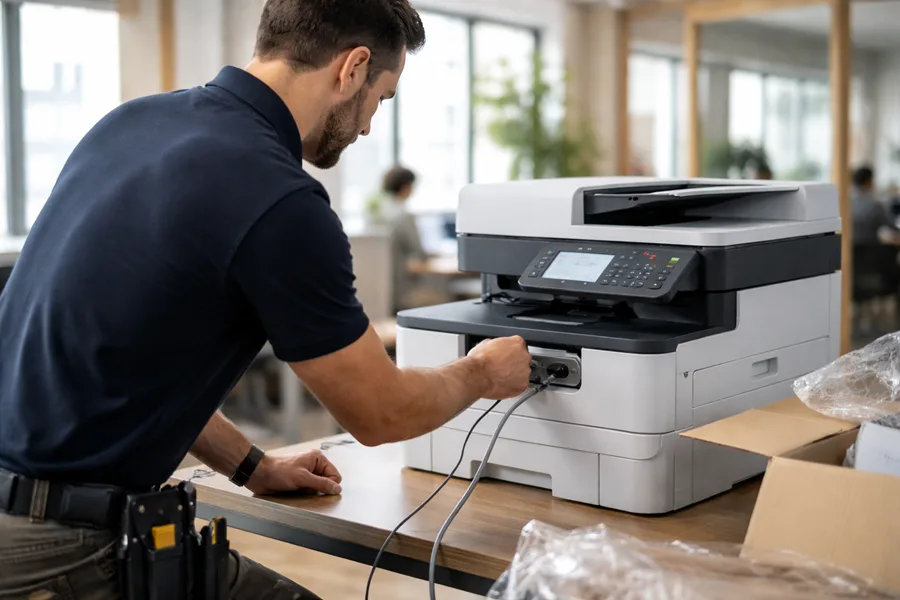
Thinking of a printer lease as just a way to rent equipment is like seeing an iceberg and ignoring the massive part hidden underwater. The lease agreement itself is often just the starting point for a much smarter strategy called Managed Print Services (MPS). This approach completely changes the game, shifting the focus from simply having a machine to optimizing your entire printing environment for less cost and fewer headaches.
A lease gets the hardware in your office, but MPS is what makes it work for you. Instead of waiting for something to break, an MPS provider is already working in the background to keep things running smoothly. It’s a comprehensive service that bundles everything related to your office printing into one simple, predictable package.
Beyond the Machine Itself
The real magic happens when you combine your lease with MPS. This is where the partnership goes far beyond the physical device, transforming how your office actually functions by automating the annoying, time-consuming tasks and giving you real data to work with.
Here’s what that looks like in the real world:
- Automated Supply Deliveries: The system keeps an eye on your toner levels and automatically ships new cartridges right before you run out. No more last-minute scrambles to the office supply store.
- Proactive Maintenance Alerts: Your provider can spot potential issues remotely and schedule a technician before a small glitch turns into a full-blown office meltdown.
- Enhanced Print Security: MPS isn’t just about convenience; it includes security protocols to lock down your devices and protect sensitive documents from ending up in the wrong hands.
- Detailed Analytics: You get crystal-clear reports showing who is printing what and how much it’s costing you, broken down by user or department. This is how you find those hidden opportunities to save money.
Combining a lease with Managed Print Services evolves the relationship from a simple transaction to a full-service partnership. It takes the administrative burden off your IT team, letting them focus on big-picture projects instead of wrestling with printer jams.
A Growing Global Strategy
More and more businesses are catching on to the value of outsourcing their entire print ecosystem. The global market for managed print services is on track to become a $53 billion industry by 2026 as companies everywhere push for greater efficiency and cost control.
This trend is directly linked to the printer rental market, which is projected to climb from $9.7 million to $13.56 million by 2034. It’s a clear signal that smart businesses are moving away from just buying equipment and toward strategic management. Dive into our detailed guide to learn more about how businesses leverage MPS for significant benefits.
Common Questions About Printer Copier Leasing
Even when leasing makes perfect sense on paper, it’s natural to have a few lingering questions before you sign on the dotted line. Diving into a printer copier leasing agreement is a big decision, and getting these final details straight is just smart business. Think of it as the final check before committing.
We’ve helped hundreds of businesses navigate this process, and the same questions pop up time and time again. Let’s tackle them head-on so you can move forward with total confidence.
Answering Your Key Concerns
One of the biggest worries we hear is, “What happens if our business needs change halfway through the lease?” It’s a great question, especially for growing companies. Business isn’t static. Any reputable leasing partner gets this and builds flexibility right into their agreements, making it straightforward to upgrade your machine or add more devices to your contract before the term is up.
Another frequent point of confusion is who handles maintenance and supplies. When that machine inevitably beeps for more toner or flashes an error code, who’s on the hook? A standard lease almost always bundles in a service package that covers all maintenance, repairs, and parts. This is designed to protect you from surprise repair bills and keep things predictable.
Here are a few other questions that are probably on your mind:
- Can I end my lease early? While it’s sometimes possible, pulling out of a contract early usually comes with a penalty fee. This is a critical point to discuss with your vendor upfront so there are no misunderstandings.
- Is my data secure when I return the machine? Absolutely. A professional vendor will follow strict, documented data-wiping protocols to completely erase the copier’s hard drive. Your sensitive business information is protected.
- What if we don’t print as much as we thought? This is more common than you’d think. Some agreements allow for periodic reviews to adjust your included print volume, which keeps you from paying for pages you simply don’t use.
The best leasing partners operate with complete transparency. They should give you clear, straightforward answers to every single question, ensuring there are no surprises waiting for you down the road.
Ultimately, the goal is to find a partner, not just a vendor—someone who makes the entire process feel simple and predictable from start to finish.
Ready to explore a leasing solution that simplifies your technology and supports your business growth? The experts at Kraft Business Systems are here to build a secure, cost-effective plan tailored for your Michigan-based organization. Learn more at Kraft Business Systems.