

A vulnerability assessment is a systematic process for finding, classifying, and reporting security weaknesses in your company’s technology. It’s like a proactive security check-up designed to spot flaws in your systems, applications, and networks before a hacker does.
What Is a Vulnerability Assessment in Simple Terms?
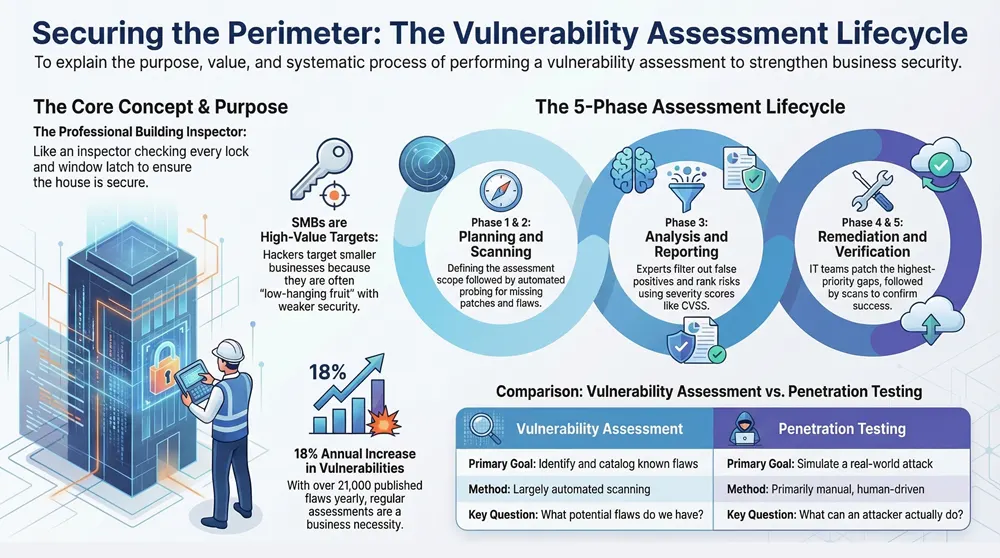
Think of your business as a house. You’ve got doors, windows, maybe even a doggy door—all potential ways for someone to get in. A vulnerability assessment is like hiring a professional security inspector to walk the perimeter and check every single one of those entry points.

They aren’t trying to break in. Instead, they’re methodically checking the locks, jiggling the door handles, and inspecting the window latches. The goal is to create a detailed report of every potential weakness they find.
This process gives you a clear, prioritized list of what needs fixing, like a loose window latch in the back or a front door lock that’s easy to pick. The idea is to understand these security gaps so you can patch them up before a real burglar shows up. If you want to dive a bit deeper into the basics, this guide explains in detail What Is Vulnerability Assessment.
For a quick reference, here’s a simple breakdown of the core ideas.
Vulnerability Assessment at a Glance
| Concept | Simple Explanation |
|---|---|
| Purpose | To find and catalog security weaknesses before they can be exploited. |
| Method | Uses automated scanning tools and manual checks to identify known vulnerabilities. |
| Analogy | Like an inspector checking all the locks and windows on a house. |
| Outcome | A prioritized report of security flaws with recommendations for fixing them. |
| Scope | Covers networks, systems, applications, and devices. |
This table sums it up nicely: a vulnerability assessment is your roadmap for improving security.
The Core Idea: Identify, Analyze, and Report
The entire assessment follows a simple, repeatable cycle. It’s not just about running a tool and getting a huge list of alerts; it’s about turning that raw data into real-world intelligence that strengthens your defenses. This process goes beyond just finding flaws and gets into understanding how they could actually impact your business.
A vulnerability assessment provides a detailed view of the security risks an organization may face, enabling them to better protect their information technology and sensitive data from cyber threats.
The cycle is straightforward but incredibly powerful:
- Identify: First, we use specialized tools to scan systems and uncover potential security holes.
- Analyze: Next, we evaluate each weakness to figure out how severe it is, what the potential damage could be, and how likely it is that someone could exploit it.
- Report: Finally, we document everything in a clear report that prioritizes the vulnerabilities and gives you actionable steps to fix them.
This structured approach transforms a vague sense of insecurity into a concrete action plan. And with the pace of new threats, this process is more critical than ever. A recent mid-year snapshot revealed a staggering 21,528 published vulnerabilities—that’s an 18% jump from the previous year—and over 38% of them were classified as critical or high severity. This constant flood of new risks is precisely why regular assessments are a fundamental part of any modern business defense strategy.
Why Every Modern Business Needs Vulnerability Assessments
It’s a huge mistake to think cyberattacks are just a “big company” problem. In reality, small and mid-sized businesses are often the most attractive targets. Why? Because hackers know they’re less likely to have fortress-like security, making them low-hanging fruit. Failing to find your digital weak spots isn’t just a technical oversight—it’s a massive business risk.
Every single undiscovered vulnerability is like leaving a door unlocked in your office overnight. You might get lucky for a while, but eventually, someone’s going to walk right in. The fallout can be devastating, from crippling data breaches and operational downtime to the kind of reputational damage that takes years to repair. It’s always, always cheaper to find and fix these issues proactively than to clean up the mess after a security incident.
The Real-World Costs of Ignoring Security Flaws
These risks aren’t just abstract concepts on a whiteboard; they translate into real, tangible damage that can hit your bottom line hard. An exploited vulnerability can quickly snowball from a minor issue into a full-blown crisis that touches every part of your organization.
Just think about the potential outcomes:
- Costly Data Breaches: The price tag for a breach goes way beyond the initial attack. You’re looking at regulatory fines, legal fees, the cost of notifying customers, and credit monitoring services. For many small businesses, these expenses are enough to put them under.
- Operational Downtime: If a critical system gets compromised, your business can grind to a screeching halt. That means lost revenue, missed deadlines, and frustrated customers who will gladly take their business down the street.
- Reputational Damage: Trust is the bedrock of any business. A public data breach can shatter that trust overnight, making it incredibly difficult to keep the clients you have and almost impossible to attract new ones.
Proactive defense is an investment in business continuity. A vulnerability assessment provides the intelligence needed to prevent minor security gaps from becoming major business disasters.
Staying Ahead of Compliance Mandates
Beyond the immediate threat of a cyberattack, regular vulnerability assessments are often a non-negotiable requirement for regulatory compliance. Many industries have strict rules about protecting customer and patient data, and failing to comply comes with severe penalties. This is where security shifts from a “good idea” to a legal necessity.
For example, healthcare providers right here in Michigan have to follow the Health Insurance Portability and Accountability Act (HIPAA), which explicitly requires regular risk analysis to safeguard patient information. In the same way, any business that takes credit card payments must comply with the Payment Card Industry Data Security Standard (PCI DSS), which mandates routine vulnerability scans. Getting a handle on the common cybersecurity threats and solutions is the first step toward building a secure and compliant operation.
This focus on systematic security is plain to see in the market itself. The global demand for vulnerability management was already pegged at USD 15–19 billion in the mid-2020s and is expected to grow by up to 9.6% every year for the next decade. You can read the full research on the security and vulnerability management market to see just how seriously businesses are taking this. The message is loud and clear: investing in a vulnerability assessment program is no longer optional—it’s a core part of any modern business strategy.
The Different Types of Vulnerability Assessments
Okay, so you get what a vulnerability assessment is and why you need one. The next logical question is: what actually happens during an assessment? The truth is, there isn’t just one single type. A good security strategy uses a few different kinds of scans to get a complete picture of your defenses.
Think of it like a general contractor inspecting a house. They don’t just walk around the outside and call it a day. They have a specialist check the foundation, another for the plumbing, and a third for the electrical system. It’s the same idea in cybersecurity. We use different tools to examine your network, your servers, and your software, because each one has its own unique set of potential problems. Combining these views is the only way to make sure no stone is left unturned.
Authenticated vs. Unauthenticated Scans: The Insider and Outsider View
Before we get into the specific assessment types, there’s a key concept you need to grasp: the difference between an authenticated and unauthenticated scan. This one distinction dramatically changes what an assessment can see and find.
Let’s stick with our building inspector analogy.
- An unauthenticated scan is like the inspector walking around the outside of your office. They can jiggle doorknobs, check for unlocked windows, and spot any obvious weak points visible from the street. This gives you a fantastic attacker’s-eye view of your perimeter.
- An authenticated scan is like giving that same inspector the keys and an access badge. Now they can walk the halls, check if the server room door is propped open, and see if individual office computers are missing critical security updates. It’s a much deeper, more detailed “insider” view.
Both are incredibly valuable. The unauthenticated scan tells you what any random attacker on the internet might find. The authenticated scan reveals the hidden weaknesses that could be exploited if someone manages to get past that first line of defense.
The Core Assessment Types Your Business Will Encounter
Most organizations will use a mix of three main assessment types to cover their entire tech footprint. Each one zeroes in on a different layer of your IT environment, from the big-picture network down to the nitty-gritty of a single application.
Here’s how they break down:
- Network-Based Assessments: This is the 30,000-foot view of your digital perimeter. The scan looks for weaknesses in your network infrastructure itself, both on the inside and the outside. It’s hunting for things like open ports that shouldn’t be, poorly configured firewalls, and vulnerable network services that are just begging for an attacker to poke at them. A classic find here is an old, forgotten server that’s still running a service with a well-known critical flaw, making it an easy target.
- Host-Based Assessments: This one gets personal, drilling down into individual machines like your servers, laptops, and workstations. Using login credentials (this is an authenticated scan), it examines each system from the inside out. It’s looking for missing security patches, weak password policies, and software that’s been configured improperly. For example, a host-based scan could reveal that half your sales team missed a critical Windows update, leaving them wide open to the latest ransomware strain.
A comprehensive strategy doesn’t choose one assessment type over another; it integrates them. A network scan finds the open door, while a host-based scan checks if the valuables are locked up inside.
- Application Assessments: These scans are hyper-focused on the software you use and build, especially web and mobile apps. They’re designed to find flaws in the actual code and configuration. The scan will probe for common vulnerabilities like SQL injection or cross-site scripting (XSS) that attackers love to use to steal customer data or hijack accounts. If your business runs an e-commerce site, an application assessment is non-negotiable—it’s what ensures your customers’ payment info can’t be siphoned out through a loophole in your shopping cart code.
Your Guide to the Vulnerability Assessment Process

A vulnerability assessment isn’t just a one-and-done scan; it’s a structured, repeating process. Think of it as a clear roadmap that guides you from discovering what’s broken all the way to building a stronger, more resilient security posture. When you know the workflow, you know exactly what to expect when you bring in a security partner.
It’s best to view it as a five-phase project. Each step builds on the last, delivering a clear, actionable outcome that ensures nothing gets missed.
Phase 1: Planning and Scoping
Before a single scan is run, the most critical phase is planning. This is where we sit down and define the “rules of engagement.” We’ll figure out exactly which assets—like your servers, websites, or office networks—are in scope for the assessment and, just as importantly, which ones are out.
This step is all about getting everyone on the same page. We identify the key stakeholders, set up communication channels, and establish clear goals for the assessment. A well-defined scope prevents surprises later and guarantees the final report is relevant to your organization’s real-world needs. A vulnerability assessment is a critical first step within the larger process of conducting a comprehensive risk assessment.
Phase 2: Information Gathering and Scanning
With a solid plan in place, the technical work begins. We start by gathering information, using various techniques to map out the target environment. Once we have a clear picture, the actual vulnerability scanning kicks off, where automated tools probe your systems for thousands of known weaknesses.
These scanners are looking for common security flaws, such as:
- Missing Patches: Pinpointing software that hasn’t received critical security updates.
- Default Configurations: Finding systems still using weak, factory-set passwords or settings.
- Known Exploits: Detecting vulnerabilities that have a publicly known and documented method of attack.
This is where we layer different types of assessments—Network, Host, and Application—to get comprehensive coverage of your entire IT infrastructure.
Phase 3: Analysis and Reporting
Raw scan data is mostly just noise. The real value comes from expert analysis. A seasoned security professional digs into the automated findings, weeds out the false positives, and puts the results into context for your specific business. This human oversight is what turns a long list of alerts into meaningful, actionable intelligence.
The main deliverable from this phase is the vulnerability assessment report. This document is your blueprint for fixing things and usually includes:
- An executive summary explaining your overall risk posture in plain English.
- Detailed descriptions of every vulnerability we found.
- A severity score for each finding, typically using the Common Vulnerability Scoring System (CVSS).
- Proof of the vulnerability (like screenshots or scanner output).
- Clear, actionable recommendations for how to fix each problem.
Phase 4: Remediation and Follow-Up
With the report in hand, your IT team can start the real work of remediation. This means applying patches, reconfiguring systems, and implementing the security controls we recommended. Prioritization is everything here; you’ll want to tackle the most critical vulnerabilities first, based on their CVSS scores and potential business impact.
This is also where having the right expertise makes a huge difference. Industries with strict compliance rules, like healthcare and finance, often partner with managed security providers for this. The potential cost of a breach makes proactive, expert-led remediation an economic no-brainer.
The goal of a vulnerability assessment isn’t just to find flaws—it’s to get them fixed. A brilliant report is useless if it just sits on a shelf collecting dust.
Phase 5: Verification
After your team has done the hard work of fixing the issues, we perform a follow-up scan. This final step confirms that the fixes were successful and, crucially, didn’t introduce any new problems. It closes the loop on the process, proving that your organization’s attack surface has been reduced and your security posture has genuinely improved.
This cycle of continuous improvement is fundamental to modern cybersecurity and is a core part of our expert IT security audit services.
Vulnerability Assessment vs. Penetration Testing
It’s easy to get “vulnerability assessment” and “penetration testing” mixed up. People often use them interchangeably, but they are two totally different—though complementary—security activities. Getting the distinction right is key to building a defense strategy that actually works.
Think of it this way. A vulnerability assessment is like hiring a building inspector to walk through your office. They’ll check every door and window, test the alarm system, and give you a detailed checklist of every potential weakness—unlocked windows, flimsy door frames, you name it. It’s a comprehensive inventory of what needs fixing.
A penetration test, on the other hand, is like hiring a team to simulate a real break-in. They aren’t just going to list the unlocked windows; they’re going to climb through one and see how far they can get. Can they reach the CEO’s office? Can they bypass the internal keycard system? Their goal is to show you what a real attacker could actually do.
Different Goals Mean Different Approaches
The main goal of a vulnerability assessment is breadth. The idea is to cast a wide net and identify as many known vulnerabilities as possible across all your systems. This process relies heavily on automated scanning tools to create a comprehensive catalog of potential security gaps.
In contrast, a penetration test is all about depth. Its goal is to actively exploit a few key vulnerabilities to see just how bad the damage could be from a real-world attack. This takes a ton of manual effort, creativity, and the kind-of mindset a real hacker would have.
How Their Methods and Outcomes Contrast
Because their goals are so different, the way they work and the reports they produce are worlds apart. An assessment gives you a clear roadmap for what to fix, while a penetration test shows you the tangible, often painful, consequences of not fixing it.
A vulnerability assessment asks, “What are our weaknesses?” A penetration test asks, “Can an attacker use these weaknesses to compromise our organization?” You absolutely need the answers to both questions.
This table breaks down the core differences between these two critical security functions.
Vulnerability Assessment vs. Penetration Testing
| Aspect | Vulnerability Assessment | Penetration Testing |
|---|---|---|
| Primary Goal | To identify and catalog a wide range of known security vulnerabilities. | To simulate an attack by actively exploiting vulnerabilities to assess impact. |
| Typical Method | Largely automated scanning tools with some manual verification. | Primarily manual, human-driven testing that mimics an attacker’s actions. |
| Scope | Broad; aims for comprehensive coverage of all systems and applications. | Narrow and focused; targets specific systems or objectives. |
| Frequency | Often performed regularly (e.g., quarterly or continuously) to maintain security hygiene. | Typically performed less frequently (e.g., annually or after major changes). |
| Outcome | A prioritized list of vulnerabilities with recommended fixes. | A detailed report on successful exploits and the business impact of a breach. |
| Key Question | What potential security flaws do we have? | What can an attacker actually do with these flaws? |
Working Together for Stronger Security
At the end of the day, you don’t choose one or the other. Vulnerability assessments and penetration tests are two sides of the same security coin.
An assessment gives you the “what”—that exhaustive list of issues to work on. A penetration test provides the “so what”—the proof of how those issues could lead to a breach that ruins your day.
Regularly performing a what is vulnerability assessment process helps you stay on top of your security posture by systematically patching known flaws. Then, periodically bringing in a team for a penetration test validates that your defenses hold up under the pressure of a real-world attack. By making both a part of your security program, you build a much tougher, multi-layered defense.
Choosing the Right Tools or a Security Partner
So, you’re ready to start assessing for vulnerabilities. The big question is: how? The market is flooded with tools, from powerful open-source options like OpenVAS to commercial heavyweights like Tenable or Qualys. These scanners are fantastic at automatically finding known security weaknesses across your network.
But here’s the catch. Simply buying and running a scanner is like getting a state-of-the-art MRI machine but having no radiologist to read the scans. The raw report is often a firehose of technical jargon, confusing scores, and potential false alarms. A scanner can tell you a vulnerability exists, but it has zero understanding of your business or which flaw is the real ticking time bomb for your specific operations.
The Limits of a Tools-Only Approach
Relying just on automated scanners leaves you with some serious blind spots. The real work of a vulnerability assessment doesn’t end when the scan finishes—that’s where it begins. Without an expert to interpret the findings, you risk pouring time and money into fixing the wrong things.
A DIY approach usually runs into a few common walls:
- Drowning in False Positives: Automated tools are notorious for flagging issues that aren’t actually there. It takes an experienced analyst to manually verify each finding, separating the genuine threats from the noise. Otherwise, your team will waste cycles chasing ghosts.
- No Business Context: A scanner might slap a “critical” score on a flaw found on a forgotten test server while flagging a “medium” risk on your main customer database. An expert, on the other hand, prioritizes based on which systems would bring your business to its knees if they went down.
- Vague Remediation Guidance: Tools are great at pointing out problems, but they often give generic, one-size-fits-all advice on how to fix them. A security partner provides step-by-step guidance tailored to your environment, ensuring fixes are implemented correctly without accidentally breaking something else.
The real value isn’t in the automated report. It’s in the human intelligence that turns that raw data into a strategic, risk-based action plan.
When to Partner with a Managed Security Expert
For most small and mid-sized organizations, the expertise gap is the single biggest reason to bring in a security partner. Let’s be realistic: if your team is already juggling daily IT fires, adding the complex job of vulnerability management is a tough ask. A managed security partner brings the specialized skills and dedicated focus you need to do it right.
This isn’t just about buying a service; it’s about having a fully managed security process. It ensures your assessments are run correctly, the results are interpreted accurately, and your remediation efforts actually make you safer. This is especially true when you’re dealing with complex systems like databases—understanding the nuances of different database vulnerability assessment tools is a specialized skill all on its own.
Questions to Ask a Potential Security Partner
Choosing the right partner is a critical decision. To help you sort the pros from the pretenders, here’s a simple checklist of questions. Their answers will tell you a lot about their process, their expertise, and how much they care about your business’s security.
- What’s your process for validating findings and weeding out false positives?
- How do you customize your reports and recommendations to fit our specific business risks?
- What kind of support can we expect from you during the remediation phase?
- Can you tell me about your team’s certifications and experience with our industry (e.g., HIPAA for healthcare)?
- How do you make sure the assessment itself won’t disrupt our daily operations?
Common Questions About Vulnerability Assessment
When businesses first start digging into vulnerability assessments, the same handful of questions always pop up. Getting straight answers on these is the best way to cut through the jargon, see the real-world value, and feel confident before you kick off your first scan.
Let’s clear up the most common questions we hear from Michigan businesses just like yours.
How Often Should My Business Perform a Vulnerability Assessment?
There’s no single magic number here; the right rhythm depends on your business. Your industry, risk tolerance, and how often your tech stack changes all play a part. For most companies, running network scans quarterly is a fantastic starting point. But for your most critical assets—think customer databases or financial systems—continuous scanning is quickly becoming the new baseline.
The non-negotiable rule? Run a full assessment after any significant IT change. That means every time you spin up a new server, launch a new website, or roll out a major application update. Beyond that, an annual assessment is pretty much table stakes to meet compliance mandates like PCI DSS.
What Is a False Positive in a Vulnerability Scan?
A false positive is when an automated scanner screams “fire!” but there isn’t even any smoke. It’s a flagged vulnerability that, upon closer inspection, doesn’t actually exist. This happens all the time due to custom system configurations, an outdated scanner, or other quirks in your environment. It’s also precisely why you can’t just rely on an automated report.
A vulnerability report is only as valuable as its accuracy. You need an experienced security analyst to meticulously review every single finding, separating the real threats from the distracting noise of false positives. This ensures your team’s time and energy are spent fixing actual risks.
Without that crucial human validation step, your IT team could waste days—or weeks—chasing down ghosts and trying to patch problems that were never there to begin with.
Can a Vulnerability Assessment Disrupt Our Business Operations?
A professionally managed assessment should have virtually zero impact on your day-to-day business. Think of it like a doctor using a stethoscope—it’s designed to listen and gather information without being invasive. Modern scanning tools are built to be light-touch, sending carefully constructed network packets to identify software versions and services without bogging down your systems.
Now, could a poorly configured or overly aggressive scan cause a hiccup? Theoretically, yes. That’s why working with a reputable security partner is so important. They know how to schedule scans during off-peak hours and use proven, safe scanning policies to gather intelligence without interrupting the vital services your business depends on.
Navigating cybersecurity complexities is easier with a trusted partner in your corner. Kraft Business Systems provides Michigan-based organizations with expert-led vulnerability assessments that deliver clear, actionable insights to genuinely strengthen your security. Secure your business by visiting us at https://kraftbusiness.com.