

The way we communicate in business has changed dramatically over the past decade. Gone are the days when your office was tied down to bulky phone systems with tangled copper wires. Today’s smart businesses are making the switch to VoIP phone systems – and for good reason.
Voice over Internet Protocol technology has transformed from a tech novelty into the backbone of modern business communication. Whether you’re running a small startup in Grand Rapids or managing a growing company across Michigan, understanding how VoIP works can save you money and boost your team’s productivity.
This guide will walk you through everything you need to know about VoIP phone systems. We’ll explore how they work, why they’re better than traditional landlines, and most importantly, how to choose and implement the right solution for your business. By the end, you’ll have a clear roadmap for upgrading your communication system.
Think of this as your friendly introduction to the future of business phones – no technical jargon, just practical advice from the experts at Kraft Business Systems who’ve been helping Michigan businesses since 1992.
Why VoIP Phone Systems Are Changing Business Communications
A voip phone system represents a fundamental shift in how businesses communicate, using your existing internet connection to handle all your voice calls instead of relying on outdated copper phone lines. Think of it as upgrading from a flip phone to a smartphone – the basic function is the same, but the possibilities become endless.
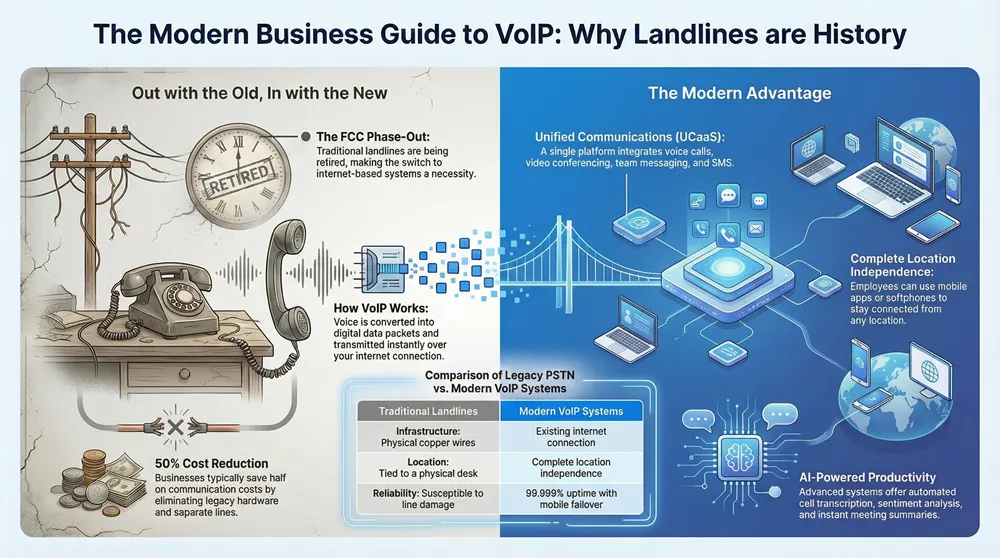
Here’s what makes VoIP technology so powerful: it converts your voice into tiny digital data packets that zip across the internet faster than you can say “hello.” This simple change open ups dramatic cost savings – often up to 50% compared to traditional phone systems – while delivering features that would make Alexander Graham Bell’s head spin.

The writing is on the wall for traditional phone systems. The FCC has already begun phasing out legacy landline services, which means businesses clinging to their old copper-wire systems will eventually be left without options. Smart companies are making the switch now, on their own terms.
Modern voip phone systems don’t just make calls cheaper – they make your entire team more productive. Picture this: your sales manager takes a client call on her desk phone, seamlessly transfers it to her mobile app when she heads to lunch, and the client never knows the difference. Meanwhile, that same call gets automatically recorded, transcribed, and filed in your CRM system.
The three game-changing advantages that make VoIP irresistible are cost efficiency (no more expensive hardware installations or maintenance nightmares), advanced functionality (HD voice quality that makes conversations crystal clear, plus unified messaging that brings everything together), and complete location independence (your phone system follows you wherever there’s an internet connection).
What really sets VoIP apart is how it transforms your phone system from a simple communication tool into the central hub of your business operations. It integrates with your email, your customer database, your video conferencing – essentially becoming the digital backbone that keeps your team connected and your customers happy.
Whether your employees work from a traditional office, their kitchen tables, or a combination of both, a voip phone system ensures everyone stays seamlessly connected. This guide will walk you through everything you need to understand about this technology – from the technical basics that make it work to the advanced security features that keep your conversations private.
Understanding key terms like business voip system provider and voip server provider will help you steer the selection process with confidence, ensuring you choose a solution that grows with your business rather than holding it back.
What is a VoIP Phone System and How Does It Work?
Imagine if your voice could travel the same way your emails do – broken into tiny pieces, zipped across the internet, and reassembled perfectly at the other end. That’s exactly what a voip phone system does, and it’s revolutionizing how businesses communicate.
Instead of relying on those old copper wires that have been carrying phone calls for decades, VoIP (Voice over Internet Protocol) uses your existing internet connection to handle all your business calls. It’s like upgrading from sending letters by horseback to using email – same purpose, completely different (and much better) technology.
When you speak into a VoIP phone, something fascinating happens behind the scenes. Your voice – which starts as an analog sound wave – gets instantly converted into digital information. Think of it like translating your words into computer language. This digital signal then gets chopped up into tiny pieces called data packets, each one labeled with where it needs to go, just like addressing individual envelopes.
These packets then travel across the internet using the same pathways as your emails, web browsing, and video streaming. The magic happens when they reach their destination – the VoIP system on the other end collects all these packets, puts them back together in the right order, and converts them back into sound so the person you’re calling can hear you clearly.
The whole process relies on specialized software called codecs (short for coder-decoder) that compress and decompress your voice data to make sure it travels efficiently. There’s also something called the Session Initiation Protocol (SIP) – think of it as the traffic controller that sets up, manages, and ends your calls. SIP is basically the language that all VoIP devices use to communicate with each other.
The best part? This entire digital dance happens in milliseconds, making your conversations feel completely natural and immediate. You’d never know your voice just took a lightning-fast trip through cyberspace.
The Great Divide: VoIP vs. Traditional Phone Lines
Here’s where things get interesting. Traditional landlines operate on the Public Switched Telephone Network (PSTN) – basically a massive web of copper wires and dedicated circuits that’s expensive to maintain and limited in what it can do. It’s like comparing a horse and buggy to a modern car – they’ll both get you there, but one is clearly better equipped for today’s world.
The writing is literally on the wall for traditional phone systems. The FCC has announced plans to phase out traditional landline services, urging businesses to make the switch to internet-based alternatives. This isn’t just a suggestion – it’s the future of business communications.
VoIP systems bypass the PSTN entirely, routing everything over the internet instead. This means no bulky hardware taking up space in your office, no expensive maintenance contracts, and access to features that would make traditional phone systems weep with envy.
At Kraft Business Systems, we’ve seen how different VoIP solutions can transform businesses. Cloud-based VoIP is our most popular option because it’s hosted and managed entirely by your provider – maximum flexibility with minimal headaches for your IT team. For businesses that want more control, on-premises VoIP lets you host and manage your own system right in your office.
But here’s where VoIP really shines: softphones turn any computer or mobile device into a business phone, letting your team make calls from anywhere with internet. Our mobile apps extend this even further, putting your entire business phone system right in your pocket. Suddenly, “being in the office” becomes less about location and more about staying connected.
The reliability factor is crucial too. Modern VoIP systems offer 99.999% uptime SLAs and smart features like automatic call routing during outages – if your internet goes down, calls can automatically forward to mobile devices or backup locations.
Want to dive deeper into the technical details? Check out our resources on How Do VoIP Phone Systems Work?, Cloud-Based VoIP, and IP PBX and SIP Trunking.
The bottom line? VoIP isn’t just an upgrade – it’s a complete reimagining of how business communications should work in the modern world.
Core Advantages of a Business VoIP Phone System
Making the switch to a voip phone system isn’t just about staying current with technology—it’s about making a smart business decision that pays dividends every month. We’ve watched countless businesses in Grand Rapids and across Michigan find just how transformative this change can be.
Your Bottom Line Will Thank You
The cost savings alone make VoIP worth considering. Traditional phone systems hit you with installation fees, expensive hardware purchases, and those per-minute charges that seem to multiply when you’re not looking. A voip phone system flips this model on its head.
Lower monthly bills become the new normal because you’re using your existing internet connection instead of paying for separate phone lines. Reduced hardware costs mean less upfront investment—many businesses find they can use softphones on computers or mobile apps instead of buying desk phones for every employee.
International calls become surprisingly affordable, which is fantastic news if you work with global clients or have team members scattered around the world. And here’s something that really makes business owners smile: simplified maintenance means no more service calls or complex on-site equipment repairs.
The numbers back this up too. According to VoIP statistics on business cost savings, businesses consistently see significant reductions in their communication expenses after making the switch.
Freedom to Work from Anywhere
Today’s workforce expects flexibility, and a voip phone system delivers it beautifully. Your business phone number isn’t tied to a desk anymore—it follows your employees wherever they go.
Remote work support means your team can take business calls from their home office, a coffee shop, or even while traveling. The caller never knows the difference, but your employees gain the freedom to work where they’re most productive.
Geographic independence opens up exciting possibilities. Want to hire that perfect candidate who lives three states away? No problem. Planning to open a satellite office? Your phone system is ready to go wherever you are.
The beauty lies in device versatility—employees can choose what works best for them, whether that’s a traditional desk phone, their laptop, or a mobile app on their smartphone.
Features That Actually Make a Difference
Traditional phone systems feel pretty limited once you experience what modern VoIP can do. These aren’t just bells and whistles—they’re tools that make your business run smoother and look more professional.
Scalability means growing your team doesn’t require a major IT project. Add new users with a few clicks, remove them just as easily when circumstances change. Your phone system grows and shrinks with your business needs.
Professional image gets a boost from features like auto-attendants that greet callers professionally, customized hold music, and voicemail-to-email that ensures you never miss an important message. HD voice quality makes every conversation crystal clear, reducing misunderstandings and making communication more effective.
High reliability is where modern VoIP really shines. Many providers offer 99.999% uptime guarantees, which is actually better than many traditional phone systems. And here’s something really clever: automatic call routing during outages means if your internet goes down, calls can automatically forward to mobile phones or backup locations. Your customers keep reaching you even when technology hiccups.
Modern voip phone systems also bundle in unified communication tools like video conferencing, team messaging, and SMS texting—all in one platform. Instead of juggling multiple communication apps, everything works together seamlessly.
These advantages add up to something powerful: a communication system that works as hard as you do. To explore how these benefits apply specifically to different business structures, take a look at our guide on Company Phone Systems.
Key Features to Look for in a Modern VoIP Solution
When you’re shopping for a voip phone system, think beyond just making calls over the internet. Today’s VoIP solutions are like Swiss Army knives for business communication – packed with features that can genuinely transform how your team works together and serves customers.

Comprehensive Call Management
The foundation of any great voip phone system is rock-solid call management. These aren’t just fancy bells and whistles – they’re the features that make your business look and sound professional while keeping things running smoothly.
Auto-attendant functionality acts like your very own virtual receptionist. When customers call, they hear a polished greeting and can press numbers to reach the right department or person. No more playing phone tag or having important calls go to the wrong place. It’s like having a friendly, never-tired receptionist who works 24/7.
Call forwarding means you’ll never have to say “sorry, I missed your call” again. Whether you’re stepping out for lunch or working from home, calls can automatically redirect to your mobile phone, another extension, or straight to voicemail. Your customers get through, and you stay connected.
Call recording isn’t just for big corporations anymore. Whether you need it for training new team members, ensuring quality customer service, or meeting compliance requirements, having the ability to record and store conversations gives you peace of mind and valuable insights.
The voicemail-to-email feature is a real time-saver. Instead of dialing into a voicemail box and listening to messages one by one, you get audio files (and sometimes even text transcriptions) delivered right to your inbox. You can listen while reviewing emails or quickly scan transcriptions to prioritize callbacks.
Unified Communications as a Service (UCaaS)
Here’s where modern VoIP systems really shine. Instead of juggling separate apps for calls, video meetings, and messaging, Unified Communications brings everything together in one place. Think of it as your communication command center.
Video conferencing is built right in, so you don’t need separate software for face-to-face meetings. Whether you’re collaborating with your team or presenting to clients, everything works seamlessly within your phone system. No more “can you hear me now?” moments when switching between different platforms.
Team messaging keeps quick conversations flowing without cluttering up email inboxes. Need to ask a quick question or share an update? Send a chat message that gets answered in seconds, not hours. Group chats work great for project teams or departments that need to stay in sync.
SMS and MMS texting from your business number opens up new ways to connect with customers. Send appointment confirmations, quick updates, or even photos when needed. It’s especially handy for service businesses or retail operations where customers appreciate quick, convenient communication.
Our Business Hosted Voice solutions are built around this unified approach, giving your team one platform that handles all their communication needs.
AI-Powered Improvements
Artificial intelligence isn’t just sci-fi anymore – it’s making voip phone systems smarter and more helpful every day. These AI features handle the tedious stuff so your team can focus on what really matters.
Call transcription turns your conversations into searchable text automatically. Instead of trying to remember what was discussed in last week’s client call, you can quickly search through transcripts to find specific details or commitments. It’s like having a perfect memory for every conversation.
Sentiment analysis goes deeper, analyzing how conversations feel. Is a customer getting frustrated? Is a prospect excited about your proposal? AI can pick up on these emotional cues and alert you to opportunities or potential issues before they become problems.
Meeting summaries and action items are game-changers for busy teams. AI listens to your calls and video meetings, then creates clean summaries with clear next steps. No more arguing about who’s supposed to do what – everything is documented automatically.
CRM Integrations and Productivity Tools
A truly smart voip phone system plays well with your other business software. When a customer calls, their information should pop up automatically on your screen. When you make a call, it should log in your CRM without extra steps.
CRM integration means your sales and service teams have customer history at their fingertips the moment a call connects. They can see previous purchases, support tickets, or ongoing projects, making every conversation more personal and productive. It’s the difference between treating someone like a stranger and greeting them like the valued customer they are.
Productivity tool connections with platforms like Microsoft 365 or Google Workspace mean your communication flows naturally into your daily work. Schedule calls from your calendar, share files during video meetings, or automatically save call recordings to your project folders.
Essential VoIP Hardware
While mobile apps and computer software offer incredible flexibility, sometimes you just want a good old-fashioned desk phone that works perfectly every time. Kraft Business Systems offers professional IP phones designed specifically for business use:
The Z-23GE IP Phone and ZIP 45G IP Phone deliver crystal-clear HD voice quality with the reliability your team depends on. Paired with professional headsets, these devices ensure every conversation sounds professional and clear.
These hardware options integrate seamlessly with your voip phone system, giving you the best of both worlds – modern features with the familiar feel of traditional desk phones.
How to Choose and Implement the Right VoIP Phone System
Choosing the perfect voip phone system for your business doesn’t have to feel overwhelming. After helping hundreds of Michigan businesses make this transition over the years, we’ve learned that success comes down to understanding your unique needs, preparing your infrastructure, and partnering with the right provider.
Assessing Your Business Needs
Every business is different, and your voip phone system should reflect that uniqueness. Start by taking an honest look at how your team communicates today and where you want to be tomorrow.
Company size matters more than you might think. A five-person startup has vastly different needs than a 50-person manufacturing company. Consider not just your current headcount, but where you realistically expect to be in the next few years. The beauty of VoIP is its scalability, but choosing a system that can grow with you from day one saves headaches later.
Call patterns tell a story about your business. Do you field dozens of customer service calls each morning? Are your sales reps constantly on outbound calls? Maybe your team spends more time in video meetings than traditional phone calls. Understanding these patterns helps determine the features you actually need versus the ones that sound impressive in a sales presentation.
Remote work changes everything. If half your team works from home offices or travels frequently, mobile apps and softphone capabilities become essential, not optional. The pandemic taught us that flexibility isn’t just nice to have—it’s business-critical.
For smaller operations navigating these decisions, our VoIP Phone System for Small Office Guide walks through the specific considerations that matter most when you’re working with a lean team and budget.
Network and Infrastructure Readiness
Here’s where many businesses stumble: assuming their current internet connection can handle voice traffic without any preparation. Your network is the foundation of your entire voip phone system, and even the best VoIP service can’t overcome poor network conditions.
Bandwidth is just the starting point. While you need sufficient capacity for your expected call volume (roughly 100 Kbps per simultaneous call), the quality of that connection matters even more. Latency, jitter, and packet loss can turn crystal-clear conversations into frustrating experiences filled with delays, echoes, and choppy audio.
Quality of Service (QoS) configuration is where the magic happens. By prioritizing voice traffic over other data on your network, QoS ensures that even when someone’s streaming a training video or downloading large files, your phone calls remain clear and uninterrupted. Think of it as creating a dedicated express lane for your voice traffic.
Don’t forget about your remote workers’ home networks. That reliable internet connection for email and web browsing might struggle with real-time voice communication. A thorough network assessment before implementation can identify potential issues and save you from frustrated employees and embarrassing dropped calls with clients.
Security and Privacy Considerations
When your business conversations travel over the internet, security isn’t optional—it’s essential. The good news is that modern VoIP systems can actually be more secure than traditional phone lines, but only if they’re properly configured.
Encryption standards like TLS and SRTP ensure your calls are scrambled during transmission, making them useless to anyone who might intercept them. Multi-factor authentication adds another layer of protection, preventing unauthorized access to your system even if passwords are compromised.
Industry compliance becomes crucial depending on your business. Healthcare practices need HIPAA-compliant systems, while companies handling European data must consider GDPR requirements. These aren’t just checkboxes—they’re legal necessities that protect both your business and your clients.
At Kraft Business Systems, our approach to Secure Business Communications means we prioritize solutions with end-to-end encryption and robust data protection from day one.
Choosing a VoIP Provider
With your needs mapped out and infrastructure ready, selecting the right provider becomes the final—and perhaps most important—piece of the puzzle. Reliability should top your list of priorities. Look for providers offering 99.999% uptime SLAs, because when your phone system goes down, your business effectively goes silent.
Customer support quality varies dramatically between providers. You want a team that understands both the technology and your business needs. Local support often means faster response times and technicians who understand your market and challenges.
Ease of use matters for everyone from your receptionist to your IT administrator. The daily user interface should be intuitive enough that employees can focus on their work, not wrestling with their phone system. Meanwhile, the admin portal should make managing users and features straightforward, not a weekend project.
Pricing models range from simple per-user monthly fees to complex usage-based structures. The key is finding a model that aligns with your budget and growth plans without hidden surprises.
As your trusted VoIP Server Provider, we’ve built our reputation on matching Michigan businesses with solutions that are reliable, secure, and genuinely easy to manage. Because at the end of the day, your voip phone system should make communication easier, not more complicated.
Frequently Asked Questions about VoIP Phone Systems
When businesses start exploring a voip phone system, we hear the same thoughtful questions again and again. After helping countless Michigan companies make the switch, we’ve learned that these concerns are completely natural – and easily addressed. Let’s tackle the big ones head-on.
No schema found.Conclusion
The shift from traditional landlines to voip phone systems isn’t just a technological evolution—it’s a business revolution that’s happening right now. As we’ve explored throughout this guide, VoIP technology transforms simple voice conversations into digital packets that travel over the internet, opening up possibilities that copper-wire systems could never imagine.
The advantages speak for themselves: dramatic cost savings of up to 50%, complete flexibility for remote and hybrid work environments, and advanced features that make your business more professional and efficient. From HD voice quality and AI-powered call analytics to seamless integrations with your existing business tools, a modern voip phone system becomes the central hub of your communication strategy.
But perhaps most importantly, this transition isn’t optional anymore. With the FCC’s announced phase-out of traditional landline services, businesses that delay their move to VoIP risk being left behind with outdated, increasingly expensive technology. The question isn’t whether to make the switch—it’s how quickly you can implement a solution that positions your business for the future.
At Kraft Business Systems, we’ve been helping Michigan businesses steer technology transitions since 1992. We understand that choosing and implementing a voip phone system can feel overwhelming, which is why our team of local experts is here to guide you through every step. From assessing your current needs to ensuring your network is ready, from selecting the right features to providing ongoing support, we’re your trusted partner in this important decision.
The future of business communication is here, and it’s more accessible, affordable, and powerful than ever before. Your customers, employees, and bottom line will all benefit from making the move to a modern VoIP solution.
Ready to upgrade your business communications? Explore our VoIP Phones for Business.
Author:
Kraft Business Systems Editorial Team
Trusted IT and communications partner for Michigan businesses since 1992