


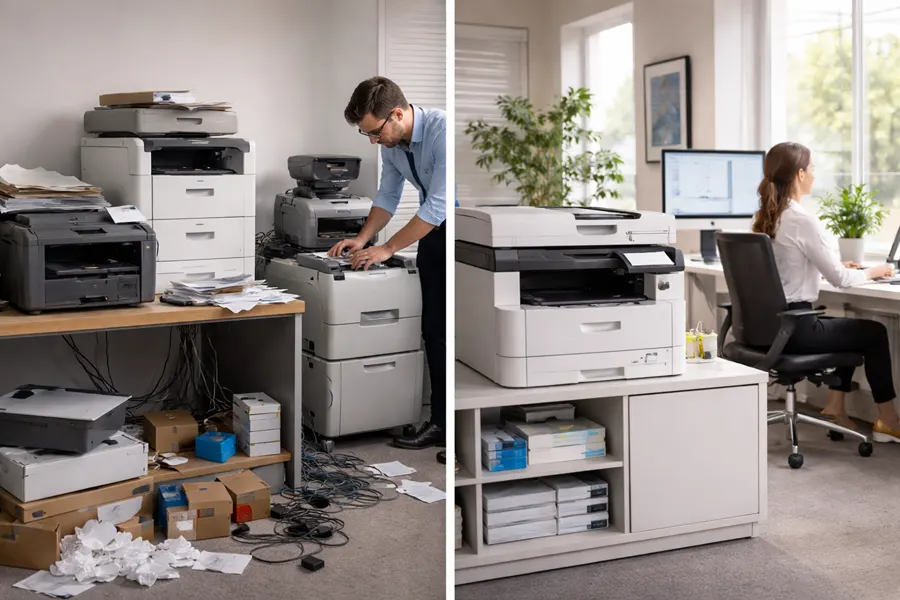
Organizational printing costs and complexities often fly under the radar, silently draining budgets and distracting IT teams. While printers seem like a basic office utility, their unmanaged presence can lead to significant inefficiencies, security vulnerabilities, and unpredictable expenses. Many Michigan businesses grapple with a sprawling fleet of devices from different manufacturers, each with its own supply needs and maintenance quirks. This reactive approach ties up valuable internal resources in troubleshooting paper jams and toner orders instead of focusing on core business objectives.
Managed Print Services (MPS) offer a strategic alternative, transforming this chaotic function into a streamlined, secure, and cost-effective operation. By partnering with an expert provider, companies gain a comprehensive solution that handles every aspect of their print environment, from hardware and supplies to security and support. This shift allows for precise budget control, frees up IT personnel for strategic projects, and provides a clear path to optimizing document workflows for tangible business growth.
This comprehensive guide breaks down the core benefits of managed print services into actionable insights. You will learn precisely how an MPS strategy can:
- Reduce operational costs and create predictable monthly budgets.
- Strengthen document security and ensure industry compliance (like HIPAA).
- Boost team productivity by minimizing printer downtime and supply shortages.
- Provide clear data on print usage to drive smarter business decisions.
Instead of just theory, we will explore practical examples relevant to industries from manufacturing to healthcare. The goal is to equip you with the knowledge to evaluate if MPS is the right strategic move to unlock hidden value within your organization.
1. Cost Reduction and Budget Predictability
One of the most immediate and impactful benefits of managed print services (MPS) is the significant, measurable reduction in printing-related expenses combined with newfound budget stability. Unmanaged print environments often hide substantial costs, including emergency toner purchases, unexpected repair fees, administrative overhead for supply management, and the capital expenditure of new hardware. MPS transforms this chaotic spending into a single, consolidated, and predictable monthly invoice.
This model typically operates on a cost-per-page basis, meaning you only pay for what you actually print. The provider covers all consumables (like toner and ink), maintenance, repairs, and support, bundling these into one transparent fee. This eliminates financial surprises and allows for precise budget forecasting, a critical advantage for small and mid-sized businesses (SMBs) in Michigan where cash flow management is key.
Real-World Savings and ROI
The financial impact is substantial, with most organizations reporting cost reductions between 20-30% within the first year of implementation.
- Healthcare: A multi-clinic healthcare system can consolidate a sprawling fleet of over 40 individual printers and copiers into a streamlined, managed fleet. This strategic optimization often saves over $200,000 annually while improving device uptime and HIPAA compliance.
- Legal: A mid-sized law firm in Grand Rapids that previously spent $150,000 annually on printing can reduce this figure to around $105,000. This is achieved by rightsizing their device fleet and implementing rules that default to double-sided, black-and-white printing for non-essential documents.
- Manufacturing: For a multi-site manufacturing company, MPS provides predictable quarterly expenses for all locations, simplifying accounting and freeing up capital that would otherwise be tied up in device ownership and supply inventory.
Actionable Tips for Implementation
To maximize your savings and ensure a smooth transition, consider these steps:
- Conduct a Baseline Audit: Before engaging an MPS provider, perform a thorough audit of your current print costs. Document everything from toner expenses and paper usage to repair invoices and employee time spent managing devices. This data provides a powerful baseline for negotiating your contract and measuring ROI.
- Negotiate Contract Terms: Pay close attention to the details. Discuss and define overage thresholds, service level agreements (SLAs) for device repairs, and contract length. A flexible contract that can scale with your business needs is ideal.
- Review Usage Reports: A key benefit of managed print services is access to detailed analytics. Use these monthly reports to identify high-volume users or departments, optimize device placement, and enforce cost-saving print policies.
By consolidating costs and providing clear visibility into usage, MPS empowers organizations to take control of their printing budget. If you want to dive deeper into how this works, you can explore more about how to slash your printing expenses on kraftbusiness.com.
2. Increased Operational Efficiency
A significant benefit of managed print services is the immediate boost in operational efficiency by offloading the entire lifecycle of print management. In a typical office, IT staff are frequently pulled away from critical, strategic projects to handle mundane printer issues like paper jams, low toner alerts, driver conflicts, and connectivity problems. MPS transfers these time-consuming responsibilities to a dedicated provider, whose sole focus is maintaining a healthy, high-performing print environment.
This proactive management model means your provider handles all device monitoring, preventative maintenance, automated supply replenishment, and expert technical support. This frees your internal teams, particularly your valuable IT staff, from the reactive cycle of printer troubleshooting. Instead of spending hours on printer-related help desk tickets, they can concentrate on initiatives that drive business growth, enhance security, or improve core operations.
Real-World Productivity Gains
The impact on team productivity is both direct and measurable, freeing up significant resource hours and reducing workflow interruptions.
- Corporate: A corporate office in Detroit can see help desk tickets related to printing plummet by over 50%. This reduction in low-level tickets allows the IT team to focus on high-priority network security and user support tasks.
- Financial Services: A financial services firm might find its IT resources were spending up to 20% of their time on print management. MPS reallocates those hours back to core activities like managing trading platforms and ensuring data integrity.
- Education: A university with multiple campuses can streamline device management across its entire system. Centralized support from an MPS provider ensures faculty and students have reliable access to printing resources without burdening the university’s central IT department.
Actionable Tips for Implementation
To ensure you gain the maximum efficiency from your MPS partner, focus on these key areas during setup:
- Define Clear SLAs: Establish and agree upon specific Service Level Agreements (SLAs) for device uptime, support response times, and issue resolution. This ensures your provider is contractually obligated to meet your performance expectations.
- Establish Escalation Procedures: Work with your provider to create a clear escalation path for critical issues. Knowing who to contact and what to expect when a high-priority device fails is crucial for minimizing business disruption.
- Request Performance Reports: Leverage the data your provider collects. Regularly review reports on device performance, support call volume, and resolution times to identify trends and hold your provider accountable for the promised efficiency gains.
3. Enhanced Security and Compliance
Beyond cost savings, one of the most critical benefits of managed print services is the fortification of your organization’s security posture and the simplification of regulatory compliance. Networked printers and multifunction devices are often overlooked endpoints, creating significant vulnerabilities if left unmanaged. MPS providers transform these potential liabilities into secure assets by implementing a multi-layered security strategy that protects sensitive data from unauthorized access, both internally and externally.
This comprehensive approach includes device hardening, user authentication protocols, data encryption for information in transit and at rest, and secure print release, which holds documents until the user is physically at the device to collect them. By establishing robust access controls and audit trails, MPS helps businesses in Michigan meet stringent compliance mandates like HIPAA, FINRA, and GDPR, safeguarding critical information and mitigating the risk of costly data breaches.
Real-World Security and Compliance Wins
Implementing MPS security protocols provides a tangible defense against data loss and ensures adherence to industry-specific regulations.
- Healthcare: A medical facility can ensure HIPAA compliance by using secure print release features, which prevent patient health information (PHI) from being left unattended in output trays. Audit trails also track exactly who printed, scanned, or copied sensitive documents.
- Financial Services: A financial institution protects confidential client data by requiring employees to authenticate via a PIN or ID badge at the printer. This simple step prevents unauthorized users from accessing or collecting sensitive financial reports.
- Government: A local government agency meets its compliance standards by leveraging MPS to configure its print fleet with secure network protocols, firmware updates, and hard drive encryption, protecting citizen data from potential cyber threats.
Actionable Tips for Implementation
To maximize the security benefits of managed print services and ensure a secure environment, take the following steps:
- Audit Current Security Vulnerabilities: Before deployment, work with your provider to identify existing gaps in your print environment. This includes assessing open network ports, outdated firmware, and a lack of user access controls.
- Request Vendor Security Certifications: Verify that your potential MPS provider holds recognized security certifications, such as ISO 27001 or SOC 2. These credentials demonstrate a commitment to maintaining high standards of information security management.
- Implement Secure Print Release: Prioritize the rollout of secure print release functionality, especially in departments that handle sensitive information like HR, finance, and legal. This is one of the most effective ways to prevent accidental data exposure.
By actively managing and securing every device in your fleet, MPS provides essential protection for your most valuable asset: your information. To understand more about the specific security features involved, you can discover more about managed print services security on kraftbusiness.com.
4. Improved Environmental Sustainability
Beyond the significant financial and operational advantages, one of the most compelling benefits of managed print services (MPS) is its positive impact on environmental sustainability. Unmanaged print fleets contribute to substantial waste, including excessive paper consumption, high energy usage from inefficient devices, and improper disposal of old equipment and consumables. MPS provides a structured framework to minimize this environmental footprint, aligning business operations with corporate social responsibility goals.
The service achieves this by optimizing device placement to reduce the total number of printers, implementing rules that encourage responsible printing, and managing the entire lifecycle of hardware. An MPS provider ensures that energy-efficient devices are deployed and that old machines and used toner cartridges are recycled according to environmental regulations. This strategic approach turns your print infrastructure from an environmental liability into a key component of your green initiatives.
Real-World Environmental Impact
Organizations that adopt MPS often see dramatic reductions in their consumption of paper, energy, and other resources, contributing to sustainability certifications and brand reputation.
- Corporate Offices: A large corporate campus pursuing LEED certification can leverage MPS to significantly cut paper consumption. By defaulting all printers to double-sided (duplex) and black-and-white printing, they can reduce paper usage by as much as 30% annually, helping meet a key criterion for certification.
- Higher Education: A university aiming for carbon neutrality can use MPS to consolidate hundreds of disparate desktop printers into a centralized fleet of efficient multifunction devices. This not only reduces the overall energy draw but also cuts e-waste by over 50% through a structured device lifecycle and recycling program.
- Manufacturing: For a Michigan-based manufacturer, an MPS provider can supply detailed environmental impact reports. These reports quantify reductions in CO2 emissions, energy use, and paper consumption, providing tangible data for annual corporate sustainability reports.
Actionable Tips for Implementation
To maximize the environmental benefits of your MPS engagement, focus on these practical steps:
- Establish Green Print Policies: Work with your provider to implement company-wide print rules from day one. Set duplex and monochrome printing as the default, and use “pull printing” solutions that require user authentication at the device. This simple step prevents uncollected print jobs, a major source of paper waste.
- Monitor Environmental Metrics: Use the analytics and reporting tools from your MPS provider to track your environmental progress. Review quarterly reports on paper and energy savings, and share these wins with employees to encourage continued responsible printing behavior.
- Verify Vendor Recycling Programs: Before signing a contract, inquire about the provider’s end-of-life process for hardware and consumables. Partner with a vendor that demonstrates a robust, certified recycling program for e-waste and toner cartridges to ensure you are not inadvertently contributing to landfill waste.
5. Better Asset and Device Management
A significant, yet often overlooked, benefit of managed print services extends beyond just supplies and repairs into comprehensive asset lifecycle management. In many organizations, printers are acquired sporadically, leading to a disorganized collection of devices with varying ages, capabilities, and operational costs. MPS replaces this chaos with a strategic, data-driven approach, providing a real-time inventory of all print assets and their utilization patterns.
This centralized oversight allows your provider to optimize the entire print environment. They manage the complete device lifecycle, from strategic procurement of the right equipment to secure, environmentally-compliant disposal at the end of its useful life. This ensures your fleet is rightsized, eliminating redundant, underutilized, or inefficient machines and placing the most capable devices where they are needed most. Integrating these print solutions with broader IT Asset Management best practices ensures comprehensive lifecycle control and optimization across your entire technology stack.
Real-World Fleet Optimization
The impact of strategic device management is profound, often uncovering substantial hidden costs and inefficiencies.
- Enterprise: A large corporation with multiple departments can identify and eliminate 25% of its device fleet by analyzing usage data, redeploying high-capacity machines to high-demand areas and retiring costly desktop printers.
- Financial Services: A financial firm can discover and properly dispose of nearly $500,000 in “stranded” equipment that was forgotten in storage closets or left behind after office moves, removing it from asset logs and reducing tax liability.
- Healthcare: A hospital network can use MPS data to strategically place specialized devices, such as those for prescription or wristband printing, ensuring they are always available and functioning optimally in critical patient care areas.
Actionable Tips for Implementation
To get the most out of MPS asset management, a proactive approach is essential:
- Provide Baseline Data: Before implementation, share at least three to six months of available print data with your potential provider. This allows them to make more accurate and impactful initial optimization recommendations.
- Schedule Regular Fleet Reviews: Don’t treat optimization as a one-time event. Schedule quarterly or semi-annual reviews with your MPS partner to analyze the latest utilization reports and adjust device placement or policies as your business needs evolve.
- Balance Cost with Convenience: While data might suggest removing a departmental printer, consider the impact on workflow. Work with your provider to find a balance that reduces costs without negatively affecting employee productivity and convenience.
Effective fleet management is a core component of a successful MPS strategy. If you’re interested in the specifics, you can learn more about the process of managing your printer fleet on kraftbusiness.com.
6. Scalability and Flexibility for Business Growth
As businesses evolve, their operational needs change. One of the most powerful benefits of managed print services is the inherent ability to scale your print infrastructure up or down in direct response to your organization’s growth or changing demands. An unmanaged environment makes expansion difficult, requiring large capital investments for new hardware and complex internal procurement cycles. MPS replaces this rigidity with an agile, service-based model.
This framework allows your business to add or remove devices, support new office locations, and accommodate fluctuating print volumes without disruption. Your MPS provider handles all the logistics, from deploying new printers at a new branch to adjusting your service level agreement to match new output requirements. This ensures your print capabilities always align with your business strategy, transforming what was a static capital expense into a dynamic operational one.
Real-World Scalability in Action
The flexibility of MPS is a critical asset for businesses focused on growth, allowing for rapid and cost-effective adaptation.
- Retail: A Michigan-based retail chain expanding from 10 to 25 stores can use a single MPS partner to rapidly deploy and standardize point-of-sale (POS) printers and back-office devices across all new locations, ensuring consistent operations from day one.
- Startups: A tech startup experiencing rapid workforce expansion can scale from a single multifunction printer to a full fleet supporting 50+ employees without locking up crucial growth capital in hardware purchases. The MPS contract simply adjusts to the new device count and usage levels.
- Professional Services: A consulting firm that adds a large team for a specific project can temporarily increase its printing capacity. Once the project is complete, the devices can be removed, and the contract scales back down, preventing payment for underutilized assets.
Actionable Tips for Implementation
To ensure your MPS agreement fully supports your growth trajectory, build scalability into your plan from the beginning.
- Include Growth Projections: During initial consultations, share your one-year and three-year business growth projections with potential MPS providers. This allows them to propose a contract and fleet strategy that anticipates future needs for additional devices or higher print volumes.
- Ensure Contracts Have Scaling Provisions: Your service level agreement (SLA) should clearly outline the process and costs for adding or removing devices. Look for clauses that offer flexibility without imposing significant penalties for changes.
- Establish Regular Capacity Reviews: Schedule quarterly or semi-annual reviews with your provider to discuss print usage data and upcoming business changes. This proactive approach ensures your print environment is always optimized for your current and future state.
By partnering with an MPS provider, your print infrastructure becomes an enabler of growth rather than a logistical hurdle. This strategic flexibility is a key reason why growing Michigan businesses are turning to managed services.
7. Reduced Capital Expenditure and IT Burden
A significant financial advantage of managed print services is the shift from capital expenditure (CapEx) to a predictable operational expense (OpEx). Owning a printer fleet requires a substantial upfront investment in hardware, which can strain cash flow and tie up capital that could be used for core business growth. MPS eliminates this barrier by providing state-of-the-art equipment as part of the service agreement, freeing your balance sheet from large, depreciating assets.
This model not only preserves capital but also drastically reduces the burden on your IT department. Instead of spending valuable hours researching, procuring, installing, troubleshooting, and maintaining printers, your technical staff can focus on strategic initiatives that drive revenue and innovation. The MPS provider handles the entire device lifecycle, from deployment and network integration to ongoing maintenance and eventual replacement, absorbing the associated time and labor costs.
Real-World Capital Preservation
The ability to avoid large upfront costs is a game-changer for organizations of all sizes, allowing them to allocate funds more strategically.
- Mid-Market Growth: A Michigan-based distribution company planning a facility expansion can preserve over $50,000 in capital by using MPS for its new office, redirecting those funds toward critical logistics technology and inventory.
- Startup Agility: A tech startup in Ann Arbor can avoid an initial $20,000+ equipment investment, maintaining a lean operational model and protecting precious venture capital for product development and marketing efforts.
- Non-Profit Focus: A charitable organization can bypass a major hardware refresh, ensuring that donor funds are directed toward mission-critical community programs rather than being sunk into office infrastructure.
Actionable Tips for Implementation
To fully leverage the financial and operational benefits, approach your MPS agreement with a strategic mindset.
- Align Contract with Budget Cycles: Structure your MPS agreement so that payments align with your company’s fiscal quarters or annual budget cycles. This simplifies accounting and makes financial planning more predictable.
- Clarify End-of-Lease Options: Before signing, understand your options at the end of the contract term. Negotiate flexible terms that may include a fair market value buyout, a simple equipment return, or a technology refresh lease for the latest hardware.
- Compare TCO Diligently: Ask your potential provider to help you calculate the Total Cost of Ownership (TCO) for your current unmanaged environment. Compare this figure directly against their proposed OpEx model to clearly visualize the long-term financial benefits of managed print services.
By converting a hefty capital outlay into a manageable operating expense, MPS offers immediate financial relief and allows your IT team to concentrate on what they do best: driving your business forward.
8. Advanced Analytics and Reporting Insights
Beyond simple cost savings, one of the most transformative benefits of managed print services is the access to powerful analytics and detailed reporting. An unmanaged print environment is a black box of unknown behaviors and hidden costs. MPS replaces this ambiguity with clear, data-driven insights, providing comprehensive reports on user activity, device usage, departmental costs, and environmental impact.
This level of visibility allows organizations to understand exactly who is printing what, when, and on which device. MPS platforms collect and analyze this data, presenting it through intuitive dashboards and regular reports. This information is crucial for identifying waste, optimizing workflows, and making strategic decisions about your entire document management strategy, turning raw data into a competitive advantage.
Real-World Savings and ROI
Harnessing print data allows businesses to make targeted improvements, often revealing surprising opportunities for efficiency and cost reduction.
- Education: A school district in Michigan can use MPS reports to discover that 15-20% of all print jobs are unnecessary duplicates or web pages with minimal content. By implementing policies to curb this, they can significantly reduce paper and toner consumption across all schools.
- Government: A state agency can analyze departmental printing trends and find that certain teams are over-relying on expensive color printing. Sharing these reports with department heads can foster accountability and lead to a voluntary shift towards more cost-effective black-and-white printing.
- Finance: A financial services firm can use predictive analytics from its MPS provider to forecast printing expenses with high accuracy for three-year budget planning, eliminating guesswork and ensuring financial stability. The power of Managed Print Services lies in transforming raw usage data into actionable intelligence, mirroring the broader business trend of moving from data to informed business decisions.
Actionable Tips for Implementation
To get the most value from your MPS analytics, a proactive approach is essential.
- Establish Baseline Metrics: Before you fully implement MPS, work with your provider to capture a snapshot of your current print volumes, costs per department, and device usage. This baseline is critical for accurately measuring the impact of your new strategy.
- Set Specific KPIs: Define what success looks like. Your Key Performance Indicators (KPIs) could include a 15% reduction in color printing, a 10% decrease in overall print volume, or achieving a specific cost-per-page target.
- Schedule Regular Report Reviews: Make analytics a part of your routine. Start by reviewing reports monthly with your MPS provider and key department heads to identify trends and enforce policies. As processes mature, you can shift to a quarterly review cadence.
Managed Print Services: 8-Benefit Comparison
| Benefit | Implementation complexity | Resource requirements | Expected outcomes | Ideal use cases | Key advantages |
|---|---|---|---|---|---|
| Cost Reduction and Budget Predictability | Low–Medium: audit and contract setup | Baseline print audit; vendor management | 20–30% TCO reduction; predictable monthly costs | High-volume print environments, multi-device fleets | Consolidated billing, per‑page pricing, predictable budget |
| Increased Operational Efficiency | Medium: onboarding, SLA definition | Vendor integration, IT handover, user training | Fewer help‑desk tickets; reduced IT time on printers | Corporates, universities, IT‑managed environments | Proactive monitoring, automatic supplies, faster fixes |
| Enhanced Security and Compliance | Medium–High: security configs and audits | Authentication tools, encryption, staff training | Lower breach risk; regulatory compliance and audit trails | Healthcare, finance, legal, government | Secure print release, encryption, centralized policy enforcement |
| Improved Environmental Sustainability | Low–Medium: policy and defaults setup | Reporting tools, eco supplies, user adoption programs | 20–40% less paper; reduced energy and e‑waste | Organizations with sustainability targets or certifications | Duplex defaults, device consolidation, recycling programs |
| Better Asset and Device Management | Medium: inventory setup and integrations | Device telemetry, analytics dashboards, data access | Optimized fleet; fewer redundant devices; lifecycle planning | Multi‑location enterprises and large fleets | Real‑time inventory, utilization analytics, replacement planning |
| Scalability and Flexibility for Business Growth | Low–Medium: contract and logistics planning | Vendor deployment support; cloud print platform | Rapid device scaling; supports remote/hybrid work | Startups scaling, retailers, M&A or rapid expansions | No CapEx for growth, flexible service levels, multi‑site support |
| Reduced Capital Expenditure and IT Burden | Low: shift from CapEx to OpEx via contracts | Contract negotiation, billing setup, managed upgrades | Improved cash flow; reduced procurement and IT workload | Startups, mid‑market firms, organizations preserving capital | Hardware included, OpEx model, fewer procurement tasks |
| Advanced Analytics and Reporting Insights | Medium: data collection and dashboarding | Analytics platform, baseline data, BI integration | Visibility into waste; accurate forecasting; chargeback | Finance, procurement, large orgs seeking cost control | Real‑time analytics, cost allocation, trend forecasting |
Your Next Step: Partnering for a Smarter Print Strategy

Transitioning from a reactive, break-fix approach to a proactive, managed print strategy is a significant operational upgrade. We have explored the multifaceted benefits of managed print services, moving far beyond the surface-level assumption of just saving money on toner. The journey has taken us through eight critical pillars of improvement, from establishing predictable budgets and reducing capital expenditure to fortifying your network against sophisticated security threats. For a Michigan manufacturing firm with sites in Detroit and Grand Rapids, this means standardizing equipment and workflows for seamless efficiency. For a Traverse City healthcare provider, it means achieving HIPAA compliance through secure print release and detailed audit trails.
The core takeaway is that a managed print services (MPS) partnership is not merely a vendor relationship; it’s a strategic alliance. It’s about transforming a historically overlooked business function into a powerful asset that supports growth, enhances security, and drives efficiency. The true value emerges when you see how these benefits interconnect. For instance, advanced analytics don’t just provide data; they inform better asset management, which in turn reduces waste and supports your sustainability goals. Similarly, enhanced security measures don’t just protect data; they reduce the burden on your IT team, freeing them to focus on core business initiatives.
From Insight to Action: A Practical Roadmap
Understanding the advantages is the first step, but realizing them requires a clear plan. The most effective way for your organization to begin this journey is by gaining a crystal-clear understanding of your current print environment. Without accurate data, any decision is just a guess.
Here is a practical, step-by-step roadmap to guide your evaluation process:
- Conduct a Comprehensive Print Assessment: Before you can optimize, you must analyze. This involves a thorough audit of your entire print fleet. How many devices do you have? Who manufactured them? How old are they? What are their individual print volumes and operational costs? A qualified MPS provider can perform this assessment for you, using specialized software to gather precise data without disrupting your team.
- Analyze Workflows and User Needs: Go beyond the hardware. Map out how your teams use print, scan, and copy functions. A government agency in Lansing will have vastly different document workflow needs than a K-12 school in Ann Arbor. Identify bottlenecks, security vulnerabilities (like sensitive documents left on a printer tray), and opportunities for digital workflow integration.
- Define Your Strategic Objectives: What are you trying to achieve? Your goals will shape the solution. Are you focused primarily on cost reduction? Is regulatory compliance (like HIPAA or CMMC) your top priority? Or is your main goal to improve productivity for a hybrid workforce? Clearly defined objectives will ensure your MPS strategy aligns perfectly with your broader business goals.
- Engage a Proven Local Partner: Select an MPS provider with a documented history of success, particularly within your industry and region. A Michigan-based partner understands the local business climate and can provide responsive, on-site support when you need it most. They should function as a consultant, using the assessment data to design a custom-tailored strategy that solves your specific challenges.
By embracing this structured approach, you move from abstract benefits to tangible outcomes. Mastering your print environment is no longer about managing machines; it is about leveraging technology to build a more resilient, efficient, and secure organization. The benefits of managed print services provide a direct path to achieving that operational excellence, empowering your business to thrive in a competitive market.
Ready to uncover the hidden costs in your print environment and build a strategy for success? The experts at Kraft Business Systems specialize in creating tailored managed print solutions for Michigan organizations, from secure healthcare systems to efficient manufacturing plants. Contact us for a no-obligation print assessment and see how the Kraft Business Systems team can transform your operations.