

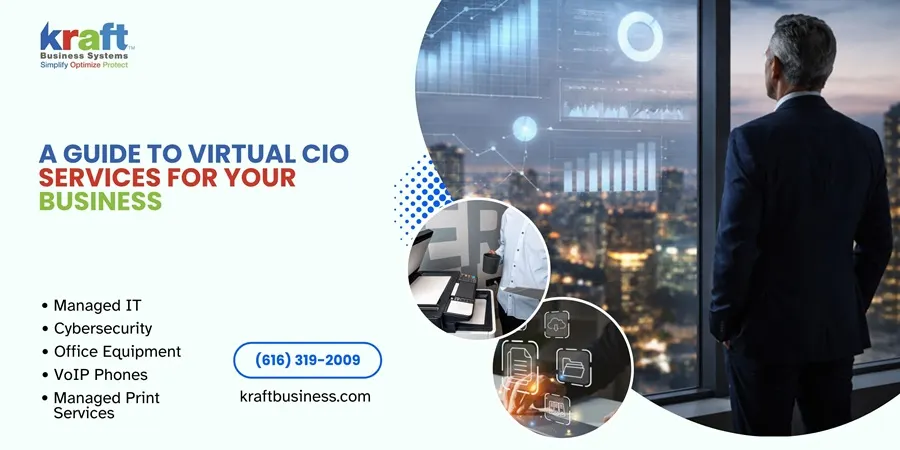

Ever feel like you have a top-tier IT strategist on your team, guiding every tech decision to perfectly match your business goals, but without the six-figure executive salary? That’s the entire idea behind virtual CIO services: on-demand executive leadership that connects the dots between your day-to-day IT grind and your long-term business vision. This model gives your company access to C-suite brainpower at a fraction of the cost.
What Are Virtual CIO Services

So many businesses get trapped in a reactive IT cycle. The internal team, often small and completely swamped, spends all day just trying to keep the lights on—resetting passwords, fixing printer jams, and closing out support tickets. It’s essential work, but this constant firefighting means there’s zero time left for strategic thinking. Nobody is asking the big-picture questions that actually drive growth.
This is exactly where virtual CIO services change the game. A virtual Chief Information Officer, or vCIO, is your part-time strategic IT coach. They aren’t there to handle helpdesk tickets; instead, they live and breathe the “why” behind your technology, making sure every dollar you spend on IT is pushing your business forward.
Bridging Strategy and Operations
Think of your current IT team or Managed Service Provider (MSP) as the players on the field, running the plays. The vCIO is the coach on the sideline, calling the shots, studying the competition, and mapping out the game plan for the whole season. They don’t run the routes themselves, but they make damn sure every player knows where to go and why it matters.
A vCIO’s main job is to get your technology initiatives perfectly in sync with your biggest business goals. They translate aspirations—like “increase revenue by 20%” or “expand into a new market”—into a clear, actionable technology roadmap.
A Virtual Chief Information Officer provides the same high-level IT leadership and strategic guidance as a traditional or in-house CIO—without the full-time expense. It’s about making executive-level strategy accessible and affordable for growing businesses.
This strategic oversight involves a few key activities that shift your IT from being just another cost center to a genuine value driver. A vCIO helps you:
- Develop a Long-Term IT Roadmap: They’ll build a multi-year plan that lays out the tech upgrades, software rollouts, and infrastructure changes needed to support your growth.
- Manage the IT Budget: A vCIO ensures your tech spending is optimized for the best possible return on investment (ROI), stopping wasteful purchases in their tracks and spotting cost-saving opportunities.
- Oversee Cybersecurity and Risk Management: They develop the security policies and disaster recovery plans that protect your company’s most critical data and keep you in business when things go wrong.
- Guide Technology Decisions: When it’s time to pick a new software platform or move to the cloud, the vCIO offers expert, unbiased advice to make sure you land on the right solution for your business.
By handing off these strategic duties to a dedicated expert, you free up your internal team to focus on what they do best: keeping the daily operations running without a hitch. The result is a more proactive, secure, and forward-thinking approach to your technology. For a deeper dive, you can learn more about what a vCIO is and if you need one. This partnership ensures your technology doesn’t just work—it works for you.
What Does a Virtual CIO Actually Do?
A virtual CIO does far more than just give you advice every now and then; they roll up their sleeves and take ownership of your technology strategy. This isn’t the person you call to fix a printer. This is the executive who architects your company’s technological future to make sure it’s fueling business growth, not holding it back.
Their responsibilities really boil down to four critical pillars that form the foundation of true IT leadership. When these functions work together, they transform IT from a reactive cost center into a proactive, strategic asset. It’s no wonder the global market for virtual CIO services was valued at roughly USD 4.96 billion in 2024 and is projected to hit USD 15 billion by 2035.
Let’s break down exactly what a vCIO handles day-to-day.
Core Responsibilities of a Virtual CIO
A virtual CIO’s role is multi-faceted, blending high-level strategy with practical, hands-on management. The table below summarizes the key areas where a vCIO delivers value, turning technology into a competitive advantage.
| Responsibility Area | Key Activities | Business Impact |
|---|---|---|
| Strategic IT Planning | Creating a multi-year technology roadmap aligned with business goals. Regular strategic reviews and adjustments. | Ensures technology investments directly support growth, efficiency, and long-term objectives. Prevents wasted spending. |
| Financial Management | Developing and managing the IT budget. Analyzing costs to find savings. Building ROI cases for new tech. | Maximizes the value of every dollar spent on technology. Turns IT into a profit-driver instead of just a cost. |
| Cybersecurity Leadership | Designing security policies. Overseeing risk assessments and compliance. Planning for disaster recovery. | Protects the business from costly data breaches, downtime, and reputational damage. Builds a resilient organization. |
| Vendor & Tech Management | Vetting technology solutions. Negotiating contracts with vendors. Managing supplier relationships. | Guarantees you get the best tools and service at the right price, without getting locked into bad contracts. |
By taking charge of these four areas, a vCIO provides the executive-level oversight that helps your business navigate technology decisions with confidence.
Strategic IT Planning and Roadmapping
The most fundamental job of a vCIO is to build a long-term vision for your technology. They aren’t just thinking about what you need next quarter; they’re creating a multi-year technology roadmap that lines up perfectly with your core business objectives. This roadmap becomes the blueprint for every single IT decision and investment you make.
For instance, let’s say your company’s goal is to boost operational efficiency by 25% over the next three years. A vCIO’s roadmap would lay out a clear, phased plan. It might involve implementing a new ERP system in year one, automating key workflows in year two, and shifting your data infrastructure to a more scalable cloud platform in year three. This kind of forward-thinking planning prevents chaotic, last-minute tech purchases and makes sure every dollar is spent with a purpose.
A vCIO’s roadmap isn’t a static document set in stone. It’s a living guide that gets reviewed and tweaked regularly to reflect changing business priorities, market shifts, and new tech opportunities, keeping your strategy sharp and relevant.
Financial Management and Budget Optimization
A great virtual CIO brings serious financial discipline to your tech spending. They are responsible for developing, managing, and optimizing the entire IT budget to squeeze the maximum return on investment (ROI) out of every dollar. This means looking way beyond the initial price tag of a new tool to understand its total cost of ownership and long-term business value.
This function involves a few key activities:
- Budget Creation: Working hand-in-hand with your leadership team to build an annual IT budget that actually supports the strategic roadmap.
- Cost Analysis: Scrutinizing every current expense to find waste, like redundant software licenses or over-provisioned cloud servers.
- ROI Justification: Crafting a rock-solid business case for any new technology investment, clearly showing how it will boost productivity, cut costs, or open up new revenue streams.
By managing technology finances with an executive mindset, a vCIO makes sure your capital is allocated wisely and contributes directly to your bottom line.
Cybersecurity and Risk Management
Protecting your business from digital threats is completely non-negotiable. A vCIO takes the lead on developing and enforcing a robust cybersecurity posture, shifting your organization from a reactive, “put-out-the-fire” mode to a proactive security model. They are the architect of your digital defense.
This means creating comprehensive security policies, rolling out employee training to prevent simple human error, and making sure you’re compliant with industry regulations like HIPAA or CMMC. They also oversee the creation of business continuity and disaster recovery plans, ensuring your company can get back on its feet fast after a disruptive event. A huge part of this is conducting regular threat assessments to find and fix vulnerabilities before they can be exploited. Understanding this process is key, and you can learn more about it in our guide to IT risk assessment services.
Vendor and Technology Management
Finally, a virtual CIO serves as your expert liaison to the complex world of technology vendors. They manage relationships with all your hardware suppliers, software companies, and internet service providers to make sure you’re getting the best possible service and value for your money.
When you need a new software platform, for example, the vCIO leads the entire selection process. They’ll define the requirements, vet the potential vendors, negotiate the contracts, and oversee the implementation to ensure it meets your business needs without causing a massive disruption. This expert oversight keeps you from getting locked into bad contracts or choosing a solution that’s a poor fit for your team. Their goal is to build a technology stack supported by strong, reliable partners, giving you an effective toolkit to crush your goals.
Choosing Your IT Leadership Model

Picking the right kind of IT leadership is one of those big decisions that ripples through your entire company, affecting growth, security, and day-to-day efficiency. It’s not always a simple choice, because each model—a virtual CIO, an in-house CIO, or a Managed Service Provider (MSP)—plays a very different role. Figuring out those core differences is the first step toward building a tech foundation that actually helps you hit your business goals.
The most common mix-up we see is confusing high-level strategy with daily operations. Think of it this way: an in-house CIO is the traditional, full-time executive who lives and breathes your company’s mission. A virtual CIO service gives you that same strategic brain but on a fractional basis. An MSP, on the other hand, is completely focused on the hands-on, get-it-done work of managing your IT infrastructure.
To help clear things up, let’s compare these models head-to-head.
vCIO vs. In-House CIO vs. Managed Service Provider (MSP)
Each of these IT models brings something different to the table. An in-house CIO offers deep, dedicated focus, a vCIO provides flexible strategic expertise, and an MSP handles the essential day-to-day technical work. Understanding where they overlap—and where they absolutely don’t—is key to making the right choice for your business stage and budget.
| Attribute | Virtual CIO (vCIO) | In-House CIO | Managed Service Provider (MSP) |
|---|---|---|---|
| Primary Focus | Strategic planning, IT roadmap, budget, risk management | Full-time executive leadership, long-term vision, cultural integration | Daily operations, network monitoring, helpdesk, infrastructure maintenance |
| Cost Structure | Monthly retainer or project-based fee (fractional cost) | Full C-suite salary ($175k-$300k+) plus benefits, bonuses | Monthly recurring fee, typically based on users or devices |
| Engagement | Part-time, external partner | Full-time employee, deeply embedded in the company | External partner, focused on service-level agreements (SLAs) |
| Role | The “architect” – designs the IT blueprint | The “executive” – owns the entire IT department and strategy | The “builder & mechanic” – executes tasks and fixes problems |
| Best For | SMBs needing C-level strategy without the C-level price tag | Large enterprises with complex, mission-critical IT departments | Businesses of all sizes needing to outsource daily IT management |
This table lays out the core functions, but the real magic is in understanding how these roles complement each other. Often, the best solution isn’t picking just one, but combining them to cover all your bases from the server room to the boardroom.
vCIO vs In-House CIO
The biggest difference between a virtual and an in-house CIO boils down to two things: commitment and cost.
An in-house CIO is a full-time employee, completely immersed in your company culture and available around the clock. This is the right fit for large enterprises with sprawling, mission-critical IT departments that demand constant executive oversight. But that level of dedication comes with a hefty price tag—salaries for seasoned CIOs often start at $175,000 and can easily climb past $300,000 a year, not including hefty benefits and bonuses.
A vCIO, on the other hand, delivers the exact same strategic functions—tech roadmapping, budgeting, cybersecurity planning, risk management—but as an external partner on a part-time schedule. This model opens the door for small and medium-sized businesses (SMEs) to get genuine executive-level guidance without having to fund a full-time C-suite salary. It’s no surprise the market is exploding; research firms project the virtual CIO services industry will grow by 18% to 19.4% annually in the coming years, mostly because SMEs are eager to cut costs while gaining access to top-tier strategy.
This is a great visual of the core functions a vCIO handles. From managing the budget to wrangling vendors, these are the pillars of high-level IT leadership.
Each of these areas is about making sure your technology isn’t just working, but working for the business.
vCIO vs Managed Service Provider (MSP)
This is where the lines can get blurry for people, but the distinction is critical. A vCIO and an MSP are not interchangeable—in fact, they work best as partners.
Here’s a simple analogy: The vCIO is the architect who designs the blueprint for your house. The MSP is the general contractor who builds it, keeps the lights on, and makes sure the plumbing works.
An MSP’s job is tactical and operational. They handle the essential, hands-on work that keeps your business running every single day:
- Watching your network for problems.
- Managing servers and making sure your data is backed up.
- Running the helpdesk for your employees.
- Patching software and maintaining your hardware.
Their world revolves around uptime, performance, and fixing technical problems as they pop up. It’s also helpful to understand the different ways you can engage these services, which you can read about in this breakdown of Staff Augmentation vs. Managed Services.
A vCIO operates on a completely different level. They aren’t fixing laptops or restarting servers. Instead, they’re asking the big “why” questions:
- Why are we investing in this new software?
- How does this IT project support our five-year business plan?
- What is our real-world cybersecurity risk, and how do we budget to manage it?
A Managed Service Provider keeps your technology running. A Virtual CIO ensures your technology is running in the right direction.
A truly effective IT setup often has both. The vCIO sets the strategy and lays out the roadmap, and the MSP executes the daily tasks needed to make that vision a reality. If you want to dive deeper into the operational side, you can learn more about the role of Managed IT Service Providers in our detailed guide. This partnership ensures your day-to-day IT grind is always perfectly aligned with your most important business goals.
How Virtual CIO Services Are Priced
Let’s talk money. Trying to figure out the cost of a virtual CIO can feel a bit like nailing Jell-O to a wall, especially when you’re used to thinking in terms of a straightforward (and hefty) executive salary. But that’s the whole point. vCIO pricing is built for flexibility, letting you tap into C-suite-level IT strategy without having to fund the corner office.
The goal is to pay for exactly the amount of strategic guidance your business actually needs. The models can vary, but they all ditch the one-size-fits-all approach for something that scales with you.
Exploring Common Pricing Models
When you partner with a virtual CIO services provider, the arrangement will almost always fall into one of three buckets. Each one is designed for a different level of engagement and type of work.
- Monthly Retainer: This is the most common setup for businesses looking for a true, ongoing strategic partner. You pay a flat monthly fee, which secures a set number of hours or a clear scope of services. This keeps your vCIO consistently plugged into your business strategy, tech roadmap, and risk management.
- Project-Based Fee: Got a specific, one-time mountain to climb? This is your model. Think big lifts like a full cloud migration, a major software rollout, or a complete cybersecurity overhaul. You agree on a fixed price for the entire project, start to finish.
- Hourly Consulting: Sometimes you just need an expert opinion on a smaller issue or a tactical question. Hourly rates give you that flexibility. You can use the service as you need it without getting locked into a long-term commitment.
But the market is always shifting. We’re seeing a move away from just selling hours and toward models that tie cost directly to the results you get.
Emerging service models such as hourly engagements for tactical issues, project-based scopes, and retainer agreements for ongoing advisory support have become common. Furthermore, outcome-based and subscription pricing frameworks are gaining traction, enabling predictable costs aligned with business performance. Discover more insights on the virtual CIO consulting service market.
This is a great development for businesses. It puts the focus squarely on delivering measurable value, not just clocking in.
Key Factors That Influence Cost
So, what determines the final number on the proposal? A few key variables will shape your investment, ensuring the price tag makes sense for the size and complexity of your organization.
Providers will look at these factors when they quote you:
- Company Size: A 20-person startup has a much simpler tech footprint than a 250-employee manufacturing firm with three locations. The number of people, devices, and sites all play a role in the level of strategic oversight needed.
- Technology Complexity: There’s a big difference between a business running on standard cloud software and one juggling custom applications, a complicated network, and a handful of legacy systems. The more moving parts, the higher the cost.
- Compliance Requirements: If you’re in a regulated industry like healthcare (HIPAA) or finance (PCI DSS), a huge part of the vCIO’s job is managing compliance and risk. That specialized expertise and accountability adds to the cost.
- Scope of Engagement: What exactly do you want the vCIO to own? If they’re just building your tech roadmap, the cost will be lower than if they’re also managing the IT budget, leading cybersecurity programs, and handling all your vendor contracts.
What to Expect in Your Agreement
Your partnership with a vCIO provider will be formalized in a Service Level Agreement (SLA). This isn’t just paperwork; it’s the blueprint for your entire engagement. You need to read it carefully.
A good SLA will spell everything out in plain English, including:
- Scope of Services: A detailed list of every single responsibility the vCIO will take on.
- Communication Cadence: How often you’ll have strategic meetings, when to expect reports, and the plan for regular check-ins.
- Key Performance Indicators (KPIs): The actual metrics that will be used to measure whether the engagement is a success.
- Onboarding Process: The steps the provider will take to get up to speed on your business, goals, and team.
Don’t underestimate the importance of that last point. A thorough onboarding process is the foundation for a great partnership. It should feel like a deep dive into your current tech, your business goals, and all your biggest headaches. This initial phase is what allows your new vCIO to start delivering real strategic value from day one.
Finding the Right Virtual CIO Partner
Choosing someone to provide virtual CIO services isn’t like picking a typical vendor. You’re not just buying a piece of software or hiring a consultant for a one-off project. You’re bringing a long-term strategic partner into your leadership circle, someone who will have a direct hand in shaping your company’s future.
Get it right, and you gain a trusted advisor who helps you grow. Get it wrong, and you could end up with wasted investments and a technology plan that’s completely disconnected from your business goals. This decision deserves a thoughtful, structured approach. You’re looking for an organization with more than just technical chops; you need a partner with real business acumen who fits your company culture.
Essential Criteria for Evaluating Providers
Let’s be honest: not all vCIO providers are created equal. You have to look past the sales pitch to see their real capabilities and track record.
A huge differentiator is industry-specific experience. If you’re a healthcare practice, a provider who lives and breathes HIPAA compliance is non-negotiable. For a manufacturing company, you need someone who understands the tech on the production floor and in the supply chain. This specialized knowledge means their strategic advice will be practical and compliant from day one.
Also, look for a provider with a clear, proven strategic framework. They should be able to walk you through exactly how they build technology roadmaps, manage budgets, and measure success. Don’t be afraid to ask for case studies or examples of their work with businesses similar to yours.
Critical Questions to Ask Potential Partners
Once you’ve narrowed down your list, the interview process is where you really get to dig in. Your mission is to understand their philosophy and how they handle real-world problems.
Here are a few questions that cut right to the chase:
- Strategic Alignment: How will you make sure your technology roadmap directly supports our specific business goals over the next three to five years?
- Communication and Reporting: What does your regular communication look like? Can we see an example of a monthly or quarterly strategic report you provide to clients?
- Risk Management: Walk me through your process for finding, assessing, and dealing with cybersecurity and operational risks.
- Measuring Success: What Key Performance Indicators (KPIs) do you use to show your vCIO services are working? What does a successful partnership look like to you?
- Team and Expertise: Who would be our main point of contact? Tell us about their background and the team that backs them up.
Their answers will tell you a lot about how mature their process is and whether their style meshes with yours.
The ultimate goal is to find a partner who thinks like a business owner, not just a technologist. They should be just as concerned with your ROI and market position as they are with your server uptime.
When it’s time to formalize the evaluation, using a Request for Proposal (RFP) can help you compare providers apples-to-apples. A well-structured RFP ensures you get all the critical info needed to make a smart choice. To get started, you can download a helpful an RFP template that can streamline your selection process.
Look for Cultural Fit and True Partnership
Lastly, never underestimate the importance of cultural fit. Your vCIO will be working elbow-to-elbow with your executive team, so you need a strong, collaborative relationship. This person has to be able to explain complex tech concepts in plain English and earn trust across your entire organization.
Pay attention to their communication style during your talks. Do they listen more than they talk? Do they seem genuinely curious about your business challenges? A true partner feels like an extension of your own team—someone whose commitment to your success goes way beyond the fine print in a contract.
Got Questions About Virtual CIO Services? We’ve Got Answers.
Even after you see the strategic upside, the practical questions always start bubbling to the surface. Deciding to bring in a virtual CIO is a big move, so it’s completely normal to have questions about the cost, the scope, and how it all fits together.
Let’s clear up the most common questions we hear from business leaders. We’ll give you direct answers to help you get rid of any lingering doubts and make a choice you feel great about.
How Much Does a Virtual CIO Cost Compared to a Full-Time CIO?
This is where the vCIO model really shines. You get the executive-level thinking you need for a fraction of what it costs to hire a full-time, in-house Chief Information Officer.
Think about a full-time CIO. Their total compensation package—salary, bonuses, health insurance, retirement—can easily blow past $250,000 to $300,000 a year, especially in a competitive market like Michigan’s. For most small and medium-sized businesses, that’s just not in the budget.
A vCIO, on the other hand, usually works on a monthly retainer. That fee can range from a few thousand to around ten thousand dollars per month, all depending on your company’s size, how complex your tech is, and exactly what you need them to do. It’s a fractional cost model that makes top-tier IT strategy affordable, letting growing companies tap into executive brainpower without the executive price tag.
What Size Business Gets the Most Out of a vCIO?
While businesses of all sizes can get value from a vCIO, the service really hits the sweet spot for small to medium-sized businesses (SMBs). We find that companies with between 20 and 250 employees are usually the perfect fit.
These are businesses that have hit a critical growth spurt. They’re big enough that strategic IT leadership is no longer a “nice-to-have”—it’s a must-have for scaling up, managing serious cybersecurity risks, and making sure tech investments are actually helping the bottom line. The problem is, they often aren’t quite big enough to justify the hefty salary of a dedicated, full-time CIO.
A vCIO steps right into this leadership gap. They provide the essential, high-level guidance you need to make smart, forward-thinking tech decisions without the financial burden of adding another C-suite executive to the payroll.
This lets you keep growing with a rock-solid, professional IT strategy lighting the path forward.
How Does a vCIO Work with Our Existing IT Team or MSP?
This is a common misconception—that a vCIO is coming in to replace your current IT people. It’s actually the exact opposite. A great vCIO is there to complement and level up your current team, whether that’s an in-house IT staff or an outsourced Managed Service Provider (MSP).
Think of it like a coach and their players. The vCIO is the head coach, the high-level leader who sets the vision and the game plan. They answer the “what” and the “why” of your technology strategy:
- What’s our technology roadmap for the next three years?
- Why are we investing in this new CRM system?
- How does our IT budget directly support our main business goals?
Your internal IT team or MSP? They’re the players on the field, executing the plays. They handle the “how”—the day-to-day tasks, managing the infrastructure, and putting out technical fires. This partnership creates an incredible synergy, ensuring the daily grind is always perfectly aligned with the big-picture business goals the vCIO helped set. It makes your entire IT operation smarter and more effective.
Can a vCIO Help with Compliance Needs Like HIPAA or CMMC?
Yes, one hundred percent. In fact, managing IT risk and navigating the maze of regulatory requirements is a core part of what an experienced vCIO does. This is an area where they provide massive value, especially for businesses in regulated fields.
A quality vCIO provider brings deep expertise in all sorts of industry-specific compliance rules. They get that compliance isn’t just a technical checklist; it’s a non-negotiable business requirement.
- For a healthcare clinic: A vCIO can build, implement, and oversee a comprehensive program to ensure you’re compliant with the Health Insurance Portability and Accountability Act (HIPAA).
- For a manufacturer in the defense supply chain: They can provide the strategic leadership needed to tackle the complexities of the Cybersecurity Maturity Model Certification (CMMC).
The vCIO’s job is to translate those dense, confusing regulations into practical IT policies, procedures, and controls. This proactive approach helps your business sidestep the crippling fines, operational headaches, and reputation damage that come from non-compliance. They make sure your technology doesn’t just work—it protects your entire organization.
Ready to align your technology with your business goals? The experts at Kraft Business Systems provide Michigan organizations with the strategic guidance of virtual CIO services, ensuring your IT investments drive growth, improve security, and deliver measurable returns. Contact us today to schedule a consultation.