


When you hear “business process automation,” you might picture a complicated piece of software you buy off a shelf. That’s not what a BPA service is about. Think of it as bringing in a dedicated team of experts—a strategic partner—to overhaul how work gets done in your office.
Their job? To pinpoint the manual tasks and frustrating bottlenecks that slow you down, then design, implement, and manage automated workflows that eliminate them for good. This isn’t just about technology; it’s about delivering real, measurable results like slashing costs and boosting accuracy.
What Is a Business Process Automation Service, Really?

Picture a perfectly tuned assembly line, but instead of building cars, it’s processing your invoices, onboarding new hires, or managing client intake. With a BPA service, an employee no longer has to manually key in data from an invoice or tediously work through a long checklist. The system orchestrates every step, automatically.
This partnership is designed to solve specific operational headaches and move your business beyond simply getting tasks done. The real goal is to achieve genuine operational excellence with a smart, secure, and holistic solution.
Beyond Software to a Strategic Partnership
The most important word here is “service.” You aren’t just handed a tool and a user manual and wished good luck. You gain a partner who guides you through the entire journey, from the initial analysis to ongoing management. This hands-on, comprehensive support is exactly why the business process automation market is getting so much attention.
A great service provider doesn’t just install software. They analyze your current state, design an optimized future state, and manage the technology to ensure it continuously delivers value and adapts to your business needs.
This approach guarantees the technology is perfectly aligned with your actual business goals. For Michigan’s core industries, this translates to tangible results, from stronger compliance in healthcare to more efficient supply chains in manufacturing. To see how this applies directly, it’s worth exploring this guide on healthcare business process automation.
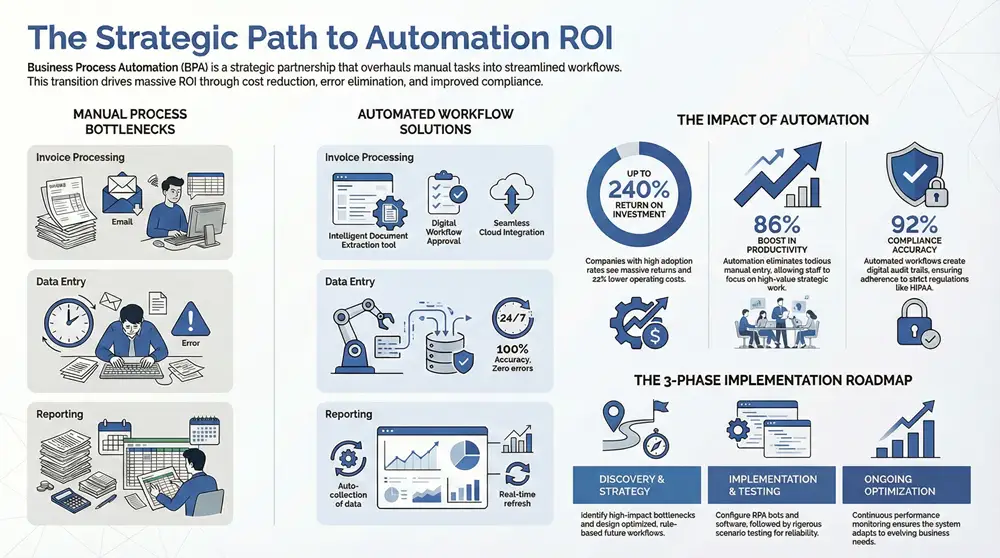
To see the difference a BPA service makes, just compare the old way of doing things with a new, automated workflow.
Table: Manual Processes vs Automated Workflows
| Operational Area | Manual Process | Automated Workflow with BPA Service |
|---|---|---|
| Invoice Processing | AP clerk manually enters data, matches POs, routes for approval via email. | Software automatically extracts data, validates against POs, and routes for digital approval. |
| Employee Onboarding | HR sends dozens of emails, manually tracks paperwork, and coordinates with IT. | A single form kicks off a workflow that notifies all departments and tracks tasks. |
| Data Entry | Staff spends hours copying and pasting information between spreadsheets and apps. | “Bots” mimic human actions to move data between systems 24/7 without errors. |
| Reporting | Managers pull data from multiple sources and build reports in Excel weekly. | Dashboards update in real-time with automated data collection and visualization. |
| Compliance | Relies on checklists and manual audits to ensure procedures are followed. | Workflows enforce compliance rules automatically, creating a digital audit trail. |
The contrast is stark. Automation doesn’t just speed things up; it fundamentally changes how work is managed, tracked, and secured.
The Engine Behind Modern Automation
At the heart of many BPA strategies is Robotic Process Automation (RPA). This technology uses software “bots” that are trained to mimic the repetitive, rules-based actions a human would take on a computer—like clicking, copying, and pasting. RPA is a cornerstone of how a BPA service delivers such dramatic efficiency gains.
You can learn more about how robotic process automation can transform your business in our detailed guide.
The market for this is exploding for a reason. It’s projected to grow by an incredible USD 17.68 billion between 2024 and 2029, with North America expected to contribute 38% of that growth. Businesses that are already on board are seeing powerful results:
- 86% report productivity gains
- 59% see cost reductions
- 92% achieve improved compliance
These numbers aren’t just hype; they show the real-world impact of a well-designed automation strategy.
Unlocking Tangible Benefits and Calculating Your ROI

Let’s get straight to the point. Investing in business process automation isn’t about chasing buzzwords or abstract concepts. For Michigan business owners, it’s about seeing a powerful, tangible Return on Investment (ROI) driven by real improvements across the entire organization. This is about working smarter and leaner, not just faster.
The first thing you’ll notice is a dramatic jump in productivity. Think about the tasks that eat up your team’s day—manually processing invoices, compiling weekly reports, endless data entry. Automation can shrink those hours-long jobs into minutes. This frees up your best people to focus on strategic work that actually grows the business, instead of getting buried in repetitive administrative tasks.
Driving Down Costs and Eliminating Errors
That massive boost in productivity leads directly to significant cost savings. When you automate labor-intensive processes, you drastically cut down on the payroll hours tied to manual work. Suddenly, you can reallocate your team to customer-facing roles or innovation projects, getting more value out of every dollar you spend.
On top of that, automation brings a whole new level of accuracy to your operations. Human error is an unavoidable—and often expensive—part of any manual workflow, especially in critical areas like financial reporting or order fulfillment. A business process automation service is designed to eliminate these mistakes, ensuring your data is clean and preventing the costly fallout from incorrect entries or missed details.
A well-implemented automation strategy doesn’t just make your existing processes faster; it fundamentally strengthens them by removing the single largest point of failure—human error. This leads to higher quality outcomes, greater consistency, and reduced operational risk.
This is especially critical for local businesses in regulated industries. For a healthcare provider, flawless automated document handling is key to maintaining HIPAA compliance. For a manufacturer with multiple sites, BPA ensures every process is executed the exact same way, every single time. For a standout example of just how measurable the ROI can be, just look at the impact of UPS Orion AI route optimization.
Quantifying the Return on Your Investment
So, how do you actually calculate your ROI? It starts with identifying the key performance indicators (KPIs) in the processes you want to automate. By getting a clear baseline before you start, you can track undeniable improvements once the service is up and running.
Here are a few common metrics we use to measure success:
- Process Cycle Time: How long does it take to complete a task from start to finish? We’ve seen automation take this from days down to hours or even minutes.
- Cost Per Transaction: Figure out the labor cost for a single manual task (like processing one invoice). Automation pushes this cost down significantly.
- Error Rate: What percentage of tasks need to be redone because of mistakes? A successful BPA project should get this number as close to zero as possible.
- Employee Productivity: How much can one employee get done in a given timeframe? When you automate the tedious stuff, your skilled people can take on higher-value work.
The numbers don’t lie—these improvements are not just marginal. Business process automation delivers a massive return, with 70% adoption rates yielding up to 240% ROI. Companies regularly see an average 22% reduction in operating costs, while over 90% of workers report higher productivity. For industries like healthcare and government, compliance improvements can hit 92%, ensuring adherence to HIPAA and other critical regulations. You can discover more about these automation statistics and see how they’re changing the competitive environment.
Your Step-by-Step Implementation Roadmap
Jumping into a new technology project can feel like trying to build a complex engine without the instruction manual. But a good business process automation service doesn’t just hand you a box of parts; they provide a clear, proven roadmap. This approach breaks the entire journey down into manageable phases, ensuring a smooth and predictable transition from manual grunt work to intelligent, automated workflows.
It all starts with a collaborative and surprisingly deep discovery process. This isn’t about guesswork; it’s about precision.
Phase 1: Discovery and Assessment
The first, and arguably most important, step is figuring out which of your current processes are the best candidates for automation. A skilled partner will work right alongside your team to pinpoint the workflows that are repetitive, suck up too much time, and are frustratingly prone to human error.
This isn’t just about finding bottlenecks for the sake of it. It’s about targeting the areas where automation will deliver the biggest and fastest return on your investment. We dig into the numbers—task volume, completion times, and error rates—to build a data-driven case for change. The goal is to start with a clear, undeniable win that makes an immediate impact on your operations.
Phase 2: Strategy and Design
Once we’ve identified the prime candidates, the next phase is to design what the future will look like. This is where we get really collaborative, mapping out the new, optimized workflow from start to finish. We don’t just slap technology on top of an old process; we completely re-imagine it for peak efficiency.
This involves defining the rules, the logic, and the decision points that will guide the automation. For example, an automated invoice approval process would have crystal-clear rules for matching purchase orders, flagging discrepancies, and routing invoices to the right manager for a quick digital sign-off. You can get a much deeper understanding of how these mechanics work in this complete document management workflow software guide.
Phase 3: Technology Implementation
With a solid design blueprint in hand, the technical work begins. Your BPA service partner takes full ownership here, selecting and configuring the right tools for the job—whether that’s Robotic Process Automation (RPA) bots or sophisticated document capture software.
The real value of a service model is that your team doesn’t need to become technology experts overnight. The provider handles all the complex development, integration, and configuration, letting you stay focused on running your business. This is where the workflow we designed on paper becomes a functional, working reality.
Phase 4: Testing and Deployment
Before any automated process goes live, it has to be put through its paces. This phase involves running the new workflow through every possible scenario to hunt down and fix any potential hiccups. We test for accuracy, speed, and reliability to guarantee the automation meets—and hopefully exceeds—the standards we defined back in the design phase.
Once testing is complete and the system gets the green light, the new workflow is carefully deployed into your live business environment. We often do this in a phased approach to minimize disruption and make the transition as smooth as possible for your team.
Phase 5: Ongoing Optimization
Automation isn’t a “set it and forget it” project. A top-tier business process automation service provides continuous monitoring and fine-tuning. After deployment, your partner will keep a close eye on the performance of the automated workflow, gather data, and actively look for opportunities to make it even better.
This proactive management ensures your automation investment continues to deliver value for the long haul, adapting to changes in your business and evolving as new technological capabilities emerge.
Real-World Automation for Michigan Industries
It’s one thing to talk about the theory behind automation, but seeing it solve actual, everyday problems is where the lightbulb really goes on. For leaders across Michigan, a business process automation service isn’t just some abstract tech concept—it’s a hands-on solution for the specific challenges we face right here at home.
Let’s get out of the boardroom and onto the ground floor to see how automation is making a real difference in the industries that drive our state’s economy. Each of these examples is a short story of a common headache and the powerful, automated fix that made it go away.
Streamlining Care in Detroit Healthcare
A busy clinic in Detroit was getting buried under paperwork. Their patient intake was a slow-motion crawl of clipboards and manual data entry, requiring staff to painstakingly type every detail from paper forms into their electronic health record (EHR) system. This process created long waits in the lobby, frustrated patients, and opened the door to costly typos that could mess up billing or even impact patient safety.
The fix was an automated patient intake workflow that completely changed their front-desk operations.
- Digital Pre-Registration: Before even walking in the door, patients now get a secure link to fill out their forms on a phone or tablet.
- Automated Data Extraction: Smart software instantly reads the submitted info, pulling data from uploaded insurance cards and IDs.
- Seamless EHR Integration: A Robotic Process Automation (RPA) bot then securely plugs all that validated data directly into the right fields in the clinic’s EHR. No more typing.
This one change slashed patient check-in times by over 70% and practically eliminated data entry errors, all while keeping every step fully HIPAA compliant. The admin team, finally freed from mind-numbing keyboard work, could put their full attention back where it belongs: on the patients.
Building Resilience for Grand Rapids Manufacturing
Near Grand Rapids, a multi-site manufacturer was constantly fighting supply chain fires. Their procurement process was a chaotic mix of emails and spreadsheets spread across different locations. Trying to manage purchase orders (POs), track shipments, and process invoices this way created zero visibility, leading to expensive delays and leaving them exposed to unexpected shortages.
A business process automation service can transform a reactive supply chain into a proactive, resilient operation. By creating a single source of truth and automating communication, manufacturers gain the agility needed to navigate market volatility.
An end-to-end procurement automation system gave them the control they needed. The new workflow centralized all purchasing, creating a process that was both efficient and tough enough to handle disruptions. The system automated PO creation and approvals, tracked shipments with real-time alerts, and used bots to perform three-way matching between POs, receiving docs, and invoices.
The result? A 30% reduction in their procurement cycle time and a huge improvement in inventory accuracy. That newfound efficiency gave them a serious leg up on the competition.
Improving Service for a Local Government Office
A local government office was struggling to keep up with a high volume of public records requests and an overflowing mailroom. Staff spent hour after hour manually sorting mail, scanning documents, and digging through disorganized archives to find what residents needed. It was slow, tedious work that led to complaints and raised red flags about regulatory compliance.
Automation isn’t just a trend for big corporations; it’s a strategic necessity for organizations of all sizes. A remarkable 66% of companies are already automating at least one business process, and that number is projected to hit 85% by 2029. The data shows that Robotic Process Automation gets results, with 86% of businesses reporting higher productivity, 59% cutting costs, and an incredible 92% improving their compliance rates. These figures aren’t just numbers; they’re a roadmap for Michigan industries. You can discover more insights about these business automation statistics and what they mean for the future.
By bringing in a business process automation service, the office digitized its entire mailroom and records system from top to bottom.
- Digital Mailroom: All physical mail is now scanned the moment it arrives. Smart software then automatically figures out what each document is and sends it to the right department’s digital inbox.
- Automated Request Fulfillment: Now, when a records request comes in, a bot can search the entire digital archive, pull the relevant documents, and compile them for review in a tiny fraction of the time it used to take.
This overhaul didn’t just speed up response times for public inquiries; it created a perfect, auditable digital trail for every single document, ensuring they met every state regulation with ease.
How to Choose the Right Automation Partner
Picking a business process automation service isn’t like buying software off the shelf. It’s more like choosing a strategic partner. Your success is completely tied to their expertise, security chops, and ability to mesh with how you already work. The right partner becomes a true extension of your team, while the wrong one can create a bigger mess than the one you were trying to fix.
You have to look past the sales pitch and really dig into what a provider can do. You need a partner who doesn’t just get the technology but also understands the specific headaches and compliance rules of your world, whether that’s healthcare, manufacturing, or government.
Evaluate Deep Industry Expertise
A generalist provider might know the ins and outs of automation, but do they know the specific regulations that govern your business? For a healthcare organization, for example, a partner’s deep understanding of HIPAA isn’t just a nice-to-have; it’s a non-negotiable requirement for protecting patient data and avoiding crippling fines.
Likewise, a manufacturer needs a partner who gets the tangled web of supply chain logistics and the need for consistency across multiple sites. You have to confirm they have a proven track record of solving problems for businesses just like yours. A partner with real-world experience in your field will see challenges coming and design solutions that are not just technically sound but actually work in your specific environment.
The most critical question you can ask a potential provider is: “Can you show us case studies from businesses in our industry, with similar challenges and scale?” Their answer will reveal more about their true expertise than any marketing material ever could.
A good partner will speak your language from day one. They won’t need a crash course on your industry’s regulations or common operational hurdles because they’ve already navigated them with other clients. This specialized knowledge drastically shortens the implementation timeline and leads to a much more impactful outcome.
Scrutinize Their Security and Integration Capabilities
Effective automation can’t operate in a bubble. It has to be securely woven into the fabric of your existing IT infrastructure. A potential partner’s security posture should be a primary focus of your evaluation. You need to ask direct questions about how they will protect your sensitive business and customer data.
This means getting clear on their protocols for data encryption, access control, and audit trails. A premier business process automation service provider will have robust, documented security measures that align with industry best practices and can stand up to tough scrutiny.
On top of that, their ability to integrate with your current systems is critical. Ask them to walk you through exactly how their proposed automations will connect with your core software, like your ERP or CRM. Seamless integration prevents creating new data silos and ensures your automated workflows enhance, rather than disrupt, your company’s technology. A partner who also offers managed IT services often has a huge advantage here, as they can provide a more cohesive and secure operational environment from the start.
A Checklist for Making Your Decision
To make a confident and informed choice, you need a structured way to compare your options. The checklist below gives you a straightforward framework with key questions to guide your conversations with potential partners. Think of it as your playbook for vetting providers.
Vendor Selection Checklist
| Evaluation Criteria | Questions to Ask | What to Look For |
|---|---|---|
| Industry Experience | Can you provide case studies or references from our industry? What specific challenges have you solved for companies like ours? | Proven success stories from businesses similar in size and sector. They should speak your industry’s language fluently. |
| Security and Compliance | How do you ensure the security and compliance of our data in automated workflows? Can you walk us through your security protocols? | Clear, documented security policies, encryption standards, and relevant compliance certifications (e.g., HIPAA, SOC 2). |
| Implementation Process | What does your implementation roadmap look like, from discovery to optimization? Who will be our point of contact? | A transparent, phased approach with clear milestones, deliverables, and communication channels. No black boxes. |
| Technology Integration | How will your solution integrate with our existing IT systems and software (ERP, CRM, etc.)? What’s your experience with our specific platforms? | A clear strategy for seamless integration without disrupting current operations. Evidence they’ve done it before. |
| Support and Optimization | What kind of ongoing support and process optimization do you offer after deployment? How do you measure success? | Proactive monitoring, performance reporting, and a clear commitment to continuous improvement. They should be invested in your long-term success. |
Using a consistent set of questions for every potential partner makes it much easier to compare apples to apples. This process helps you move beyond flashy presentations and identify the partner who truly has the expertise and commitment to help you succeed.
Integrating Automation with Managed IT and Security
Effective business process automation doesn’t exist in a vacuum. It has to be woven securely into the very fabric of your company’s technology. Think of it like adding a powerful new engine to a car; for it to work right, it needs to be perfectly connected to the transmission, the electrical system, and the onboard computer.
Trying to manage automation, IT, and security with separate vendors is a recipe for dangerous gaps and inefficiencies. This disjointed approach almost always creates communication breakdowns, conflicting priorities, and security vulnerabilities that can bring your operations to a screeching halt. A holistic strategy, on the other hand, aligns these critical functions under one roof.
Building a Secure and Cohesive Ecosystem
A top-tier business process automation service provider understands that every automated workflow touches sensitive company data. For this reason, security isn’t just an afterthought—it’s baked into the design from day one. This means building security measures directly into every automated process before it ever goes live.
This proactive approach includes critical security practices that protect your information at every point in the workflow.
- Encrypted Data Handling: All data, whether it’s sitting in your systems or in transit between applications, must be fully encrypted to keep it out of the wrong hands.
- Strict Access Controls: Automation tools are set up with role-based permissions, making sure that only authorized people and systems can trigger or change workflows.
- Comprehensive Audit Trails: Every single action taken by an automated process is logged, creating a transparent and detailed record for compliance checks and security reviews.
This integrated security posture is absolutely vital for organizations handling regulated information, like financial records or patient data.
The Advantage of a Single Technology Partner
The benefits of combining your automation with a comprehensive IT management strategy are immense. When a single partner oversees your entire technology environment, you get a level of resilience and efficiency that’s impossible to achieve when juggling multiple vendors. For instance, a well-integrated system can dramatically cut down on IT help desk tickets.
When automation eliminates the manual errors that cause system glitches, the IT support burden naturally decreases. This frees up your IT team to focus on strategic initiatives instead of constantly fighting fires caused by preventable mistakes.
This unified management model gets rid of the headaches that come with vendor coordination and finger-pointing. When an issue pops up, there’s one team with full visibility and accountability to fix it—fast. This approach is central to the value provided by leading providers of managed IT services in Grand Rapids MI who recognize that all your technology components have to work together seamlessly.
Ultimately, choosing a single, holistic partner to manage your IT, security, and automation creates a more robust, efficient, and protected operational environment. This synergy ensures your business is not just automated, but also secure and ready for whatever comes next.
Frequently Asked Questions About Automation Services
Diving into automation naturally brings up some big questions. We get it. Business leaders across Michigan want straight, practical answers before they commit to a new way of working. Here are the most common questions we hear, answered directly to clear up any confusion about what this really means for your business.
How Much Does Business Process Automation Cost?
The investment isn't a one-size-fits-all product; it's a solution built specifically for your workflows. The cost really depends on the complexity of the processes you want to automate. Typically, there’s an initial setup fee and then an ongoing management fee for support and optimization.
But here’s the key: a great partner will always start with the processes that give you the highest ROI first. This way, the cost savings and productivity gains you see right away more than justify the investment. We want you to see measurable value from day one.
Will Automation Replace Our Employees?
This is easily the biggest myth out there. The goal of automation is to empower your team, not replace them. It’s designed to take over the mind-numbing, repetitive tasks that nobody really enjoys anyway—things like manual data entry, compiling routine reports, or shuffling files between systems.
Think about what happens when you free your skilled people from that kind of work. They can finally focus on the high-value stuff that requires critical thinking, creative problem-solving, and building real relationships with your customers. Automation actually boosts job satisfaction and lets your business grow without piling more tedious work on your best people.
How Long Does Implementation Take?
The timeline is tied directly to how complex the process is. A simple, straightforward workflow within a single department? We could have that designed, tested, and running in just a few weeks.
On the other hand, a more intricate process that has to connect multiple systems and departments might take a few months to fully roll out. The real advantage of working with an experienced partner is that we have a proven method to get things done efficiently, with minimal disruption to your daily operations.
Security isn't an afterthought; it's built into the foundation of any professional business process automation service. A qualified partner weaves security into every single stage, using encrypted data transmission, strict access controls, and detailed audit logs to protect your information.
How Secure Is Business Process Automation?
Security is completely non-negotiable. For industries with strict rules, like healthcare providers who have to meet HIPAA requirements, a qualified partner will guarantee that every automated workflow is 100% compliant. When done right and integrated with a solid cybersecurity strategy, automation actually makes you more secure. It dramatically cuts down on the human errors that so often lead to data breaches.
Ready to see how automation could solve your specific operational headaches? The experts at Kraft Business Systems are here to build a custom roadmap that lines up with your goals and delivers a powerful return on your investment. Visit us at https://kraftbusiness.com to schedule a consultation.