
AI Overview:
This blog explains why small businesses need professional IT support to stay secure, productive, and competitive. It highlights common challenges—limited budgets, cyber threats, downtime, lack of expertise, and compliance risks—and shows how managed IT services solve them through 24/7 monitoring, cybersecurity, cloud solutions, help desk support, and data backup.
It also compares in-house IT vs. outsourcing to a Managed Service Provider (MSP), emphasizing lower costs, access to expert teams, proactive problem prevention, and predictable monthly pricing. The guide ends with tips for choosing the right IT partner to ensure long-term security, efficiency, and business growth.
Why Small Businesses Need Professional IT Support More Than Ever
IT services for small businesses encompass managed support, cybersecurity, cloud computing, and technical assistance designed to keep operations running smoothly without the overhead of hiring full-time IT staff.
Essential IT services for small businesses include:
- Managed IT Support – 24/7 monitoring and maintenance of systems
- Cybersecurity Solutions – Protection against ransomware, phishing, and data breaches
- Cloud Computing – Secure data storage and collaboration tools like Microsoft 365
- Help Desk Support – Quick resolution of technical issues
- Data Backup & Recovery – Automated protection against data loss
- Network Management – Reliable internet connectivity and system performance
If you’re a small business owner, you’ve likely experienced the frustration of technology working against you instead of for you. Maybe your team has dealt with dropped calls, slow internet, or that dreaded moment when critical files disappear.
As one industry expert puts it: “You are great at your job and operating your small business, but sometimes you get bogged down in technology issues.”
The reality is stark: Small businesses face the same cyber threats as large corporations, but often lack the resources to build comprehensive IT defenses. With 40% of businesses potentially failing within the next decade if they don’t modernize their technology infrastructure, the stakes have never been higher.
This guide breaks down the essential IT services that can transform your technology from a daily headache into a competitive advantage. We’ll explore cost-effective solutions that let you focus on growing your business while experts handle the technical complexities.
Key it services for small businesses vocabulary:
Core IT Challenges for Small Businesses (And How Services Solve Them)
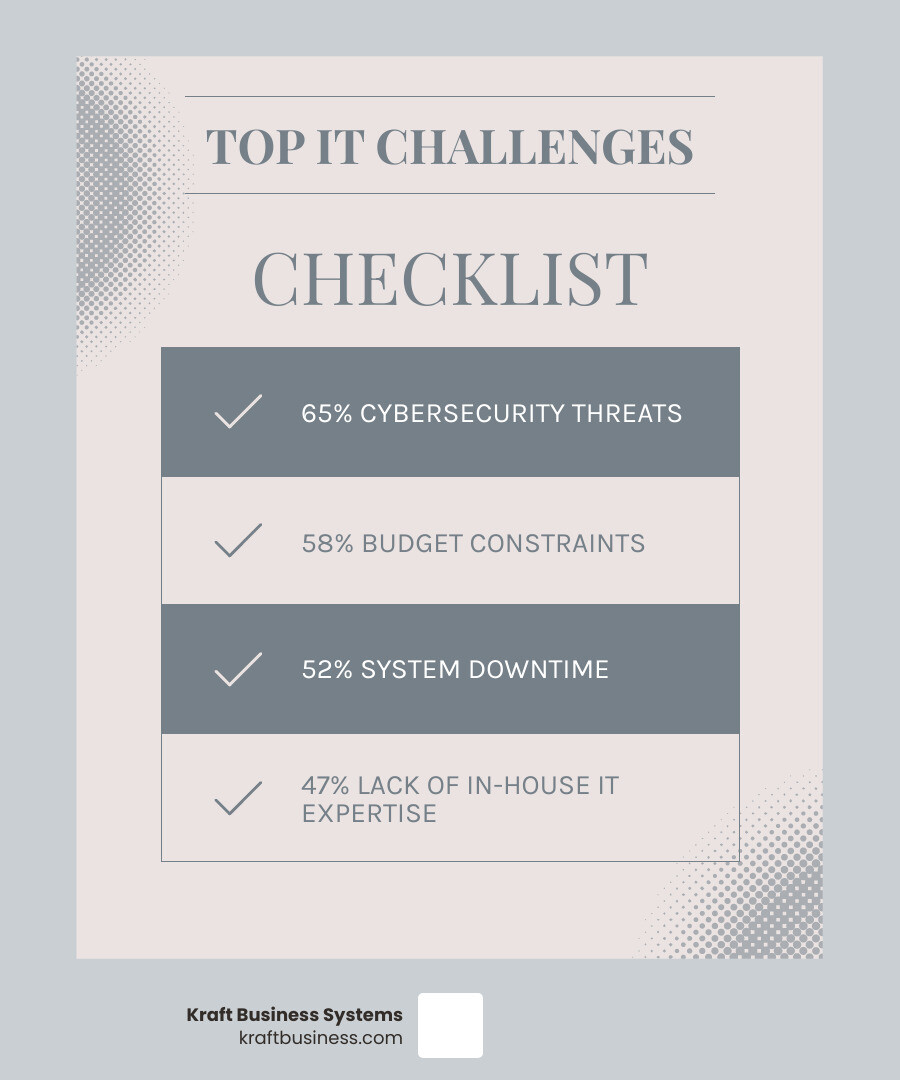
Running a small business means juggling a lot of priorities. From facing larger competition to retaining employees and balancing growth, there’s no shortage of issues to tackle. On top of everything, managing IT workloads and controlling technology costs can feel overwhelming. Many small businesses find themselves in a reactive loop, only addressing technology problems once they’ve already caused disruption.
One of the biggest problems for growing small businesses is the struggle to hire, train, and retain the right IT talent to keep their technology up-to-date. As a small business, it doesn’t always make sense cost-wise to staff a full IT team, but you still have urgent IT needs to address. This creates a significant gap: you need expert IT support, but the traditional in-house model is simply not feasible or cost-effective.
Beyond staffing, small businesses face unique challenges:
- Limited Budgets: Every dollar counts. Investing in robust IT infrastructure and cybersecurity can seem daunting when resources are tight.
- Lack of In-House Expertise: Without a dedicated IT department, small businesses often rely on generalists or even business owners themselves to handle complex tech issues, leading to inefficiencies and potential vulnerabilities.
- Data Security Risks: It can be difficult to keep small business technology secure from cyber threats. Unfortunately, it’s not a matter of if disaster will strike, but when. Cyber attacks are a major risk to IT systems, and small businesses are frequently targeted.
- Compliance Requirements: Depending on your industry (e.g., healthcare, finance), you might have strict data protection regulations to follow, which require specialized IT knowledge to steer.
- Downtime Costs: Downtime with computers, servers, and other office network technology can result in a short or long-term loss of productivity. Certain technical problems can even contribute to direct losses in revenue.
- Scalability Issues: As your business grows and changes, your IT needs evolve rapidly. Adapting your technology infrastructure to meet these demands can be a significant challenge without proper planning.
This is where professional it services for small businesses step in. Instead of a reactive “break/fix” model – where you only call for help when something is already broken – these services offer a proactive approach. Proactive IT support aims to optimize your systems, anticipate problems before they occur, and prevent costly disruptions, allowing you to realize your full potential using the right IT tools.
More info about small business technology services
Understanding the Need for Professional IT Support
We’ve seen countless small businesses bogged down in technology issues, diverting precious time and energy away from what they do best: running their business. Keeping a tech support person on your staff is expensive and often wasteful for a small or medium-sized business. This is why many are turning to external IT support.
Consider these realities:
- IT Talent Retention: Small businesses can often struggle to hire, train, and retain the right IT talent. Outsourcing provides access to a full team of experts without the HR overhead.
- Focusing on Core Business: When you’re working in an industry where people come first, you don’t want to spend your precious time dealing with IT problems. Letting us handle your network and all your IT needs allows you to focus on your core business.
- Revenue Loss from Tech Problems: When systems go down, productivity plummets, and revenue can be directly impacted. Imagine if your phone or email communications were interrupted – that’s direct loss. Proactive IT management minimizes these risks.
- Juggling Priorities: Small businesses (SMBs) must juggle a lot of priorities at once. Adding complex IT management to that list can be overwhelming. A dedicated IT partner centralizes your IT concerns, making it easier to feel confident in your infrastructure.
IT Support for Small Businesses
The High Cost of Doing Nothing
Ignoring your IT needs isn’t saving money; it’s accumulating silent costs and risks. The “if it ain’t broke, don’t fix it” mentality in IT can lead to catastrophic consequences.
- Productivity Loss: Staff members often spend time waiting for updates, dealing with dropped calls, low call quality, slow internet, and accidental file deletions. These small frustrations add up to significant lost productivity.
- Data Breach Consequences: The biggest risk to your IT system beyond your control is a cyber attack. Companies who lose their critical data often go out of business. If you aren’t backing up your data on a regular basis — you probably shouldn’t have a computer.
- Reputational Damage: A data breach or prolonged downtime can severely damage your brand’s reputation, leading to loss of customer trust and future business.
- Inefficient Workflows: Outdated technology or a poorly managed network can create bottlenecks, slow down processes, and hinder collaboration, preventing your team from working efficiently.
- Missed Growth Opportunities: Proactive small business technical support can optimize services and help companies realize their full potential. Without it, you might miss out on leveraging new technologies that could give you a competitive edge.
A Breakdown of Essential IT Services for Small Businesses
To truly thrive in today’s digital landscape, small businesses need more than just reactive fixes. They need a strategic partner who can manage their technology proactively, ensuring efficiency, security, and scalability. This is where comprehensive it services for small businesses shine.

Let’s explore the specific IT services that are most beneficial for small businesses:
Managed IT Services: Your Proactive Partner
Imagine having a full team of IT experts dedicated to your business, without the overhead of hiring them in-house. That’s the essence of managed IT services. This subscription-based model provides ongoing, proactive management of your IT infrastructure, often for a predictable monthly cost.
- Predictable Monthly Costs: Say goodbye to unpredictable IT expenses. Managed IT services offer clear, defined service levels through Service Level Agreements (SLAs), making IT budgeting straightforward.
- 24/7 Monitoring: Our IT environment is constantly and properly monitored, identifying and resolving issues before they impact your operations. This includes remote monitoring and management (RMM) of servers, networks, and endpoints.
- Reduced Downtime: Proactive maintenance and rapid response from experts mean less downtime for your team. This increases productivity and prevents revenue loss.
- Access to Expertise: Instead of a single IT person, you gain access to a diverse team of specialists with a broad range of skills and certifications. This is especially valuable for navigating complex issues like cloud migration or advanced cybersecurity.
- Strategic IT Planning: Managed IT services can transform IT from a challenge into a competitive advantage. We work with you to align your technology with your business goals, providing strategic guidance and ensuring your IT infrastructure supports your growth.
As PwC highlights, managed IT services are a critical foundation for success for businesses. They offer scalable support that adjusts as your business needs change.
Cybersecurity Solutions: Protecting Your Digital Assets
Cyber threats are constantly evolving, and no business is immune. For small businesses, cybersecurity is not just about having an antivirus; it’s about layered protection and a proactive approach.
- Threat Protection: We implement enterprise-grade security measures to safeguard against viruses, malware, ransomware, phishing attacks, and other sophisticated cyber threats.
- Ransomware & Phishing Defense: These are two of the most prevalent and damaging threats. Our solutions include advanced email filtering, web security, and sensitive data monitoring to prevent these attacks from crippling your business.
- Data Encryption: Protecting your sensitive data, whether in transit or at rest, is crucial. We help implement encryption protocols to keep your information secure.
- Compliance Management: For industries with specific regulations (like HIPAA for healthcare or PCI DSS for businesses handling credit card data), we provide the expertise to ensure your IT practices meet compliance standards, reducing the risk of costly fines.
- Employee Security Training: The human element is often the weakest link in cybersecurity. We help implement security awareness training programs to teach your employees to identify and avoid common cyber threats.
Cybersecurity Solutions for Small Business
Cloud Computing: Fueling Flexibility and Growth
Cloud services have revolutionized how small businesses operate, offering unprecedented flexibility, scalability, and cost savings.
- Data Accessibility: Access your data and applications from anywhere, on any device. This is essential for remote work, mobile teams, and business continuity.
- Collaboration Tools: Services like Microsoft 365 (including Teams, Outlook, Word, Excel, SharePoint) provide powerful tools for real-time collaboration, streamlining communication and productivity.
- Scalable Infrastructure: The cloud allows you to easily scale your IT resources up or down based on demand, ensuring you only pay for what you use. This is perfect for growing businesses with fluctuating needs.
- Reduced Hardware Costs: By moving to the cloud, you can significantly reduce your upfront investment in expensive servers and other on-premise hardware, as well as the ongoing costs of maintenance and upgrades.
- Business Continuity: Cloud solutions offer inherent redundancy and disaster recovery capabilities, ensuring your business can continue operating even if local systems fail.
Data Backup and Disaster Recovery: Your Business Insurance
It’s not a matter of IF disaster will strike — it’s just a matter of when. Whether it’s a cyber attack, hardware failure, natural disaster, or accidental deletion, data loss can be catastrophic. A robust data backup and disaster recovery plan is your business’s ultimate insurance policy.
- Automated Backups: We implement automated, regular backups of all your critical data, ensuring that your information is always protected and available.
- Quick Data Restoration: In the event of data loss, we can rapidly restore your systems and data, minimizing downtime and getting your business back on its feet quickly.
- Business Continuity Planning: Beyond just backups, we develop comprehensive disaster recovery plans that outline procedures for maintaining business operations during and after a crisis.
- Protecting Against Data Loss: This includes protecting against both malicious attacks and accidental deletions. We ensure your irreplaceable information is safe.
- “When, Not If” Mindset: We help you adopt a proactive mindset, understanding that preparing for potential data loss is a non-negotiable aspect of modern business.
Data Backup and Recovery Solutions
In-House vs. Outsourced IT: A Cost-Benefit Analysis
When it comes to managing your business’s technology, you essentially have two paths: building an in-house IT team or partnering with an external IT service provider (Managed Service Provider, or MSP). While the idea of having your own IT staff might seem appealing, the reality for most small businesses paints a different picture.
The True Cost of an In-house IT Team
At first glance, hiring an IT person might seem like a simple solution. However, the true cost extends far beyond just their salary.
- Salaries and Benefits: A competitive salary for a skilled IT professional is substantial, and that’s before factoring in health insurance, retirement plans, paid time off, and other benefits. Keeping a tech support person on your staff is expensive and often wasteful for a small or medium-sized business.
- Training and Certification: Technology evolves rapidly. To keep an in-house IT team up-to-date, you’d need to invest continuously in training, certifications, and conferences, which are significant additional costs and time commitments.
- Staff Retention Challenges: The IT job market is competitive. Small businesses can often struggle to hire, train, and retain the right IT talent, leading to high turnover and the constant need for recruitment.
- Limited Skill Set: Even the most talented IT generalist can’t be an expert in everything. An in-house team might lack specialized knowledge in areas like advanced cybersecurity, specific cloud platforms, or complex network architecture.
- Tool and Software Licensing: An IT department requires a suite of specialized tools for monitoring, management, security, and support. The licensing costs for these can be considerable.
The Value Proposition of a Managed Service Provider (MSP)
Outsourcing your IT to an MSP like Kraft Business Systems offers a compelling alternative, particularly for small businesses looking for cost-effectiveness and comprehensive support.
- Cost-Effectiveness: Managed IT services offer access to top talent and advanced tools at a fraction of the cost of full-time salaries, benefits, and ongoing training. Gartner predicts that by 2025, 70% of businesses will outsource at least one critical IT function, and it’s estimated that outsourcing IT management can lower operational expenses by up to 30%.
- Access to a Team of Experts: Instead of relying on one or two individuals, you gain an entire team of specialists with diverse skills, available 24/7/365. This provides higher availability and a broader skill set than a single in-house engineer.
- Predictable Budgeting: With managed services, you pay a fixed monthly fee, making your IT costs predictable and easy to budget for. This eliminates surprise expenses from unexpected IT crises.
- Proactive Approach: MSPs focus on preventing problems before they occur through continuous monitoring, regular maintenance, and timely updates. This significantly reduces downtime and improves overall system reliability.
- Focus on Core Business: By offloading your IT burdens, your internal staff can focus on their core competencies and strategic initiatives, driving innovation and growth for your business.
Here’s a quick comparison:
| Feature | In-House IT | Managed IT Services (MSP) |
|---|---|---|
| Cost | High fixed costs (salaries, benefits, training, tools); Unpredictable costs for emergencies and upgrades. | Predictable monthly subscription; Lower overall operational expenses. |
| Expertise | Limited to individual staff’s skills; Can be generalist. | Access to a diverse team of specialists; Broad and deep expertise. |
| Availability | Typically 9-5; Subject to sick days, vacations. | Often 24/7/365 monitoring and support; Redundant staffing. |
| Scalability | Difficult to scale up/down quickly; Requires hiring/firing. | Easily scalable resources; Adjusts with business growth/needs. |
| Tools/Technology Access | Requires purchasing and managing own software/hardware. | MSP provides and manages cutting-edge tools and technology. |
| Focus | IT staff manages daily operations and reactive issues. | Business focuses on core objectives; MSP handles IT strategy and support. |
Learn more about choosing a Managed Service Provider
How to Choose the Right IT Service Provider
Selecting the right IT service provider is a critical decision for your small business. It’s about finding a partner who understands your unique needs, aligns with your goals, and can provide reliable, proactive support.
When we work with clients, we emphasize transparency and a clear understanding of expectations. Here’s what you should look for:
- Assessing Your Needs: Before you even start looking, clearly define what you need. Are you looking for full managed services, or specific support like cybersecurity or cloud migration? What are your budget constraints? What are your pain points?
- Industry Experience: Does the provider have experience working with businesses in your specific industry (e.g., healthcare, manufacturing, legal)? Industry-specific knowledge can be invaluable for understanding unique challenges and compliance requirements.
- Local Support: While remote support is powerful, having a local presence can be a huge advantage for on-site needs and faster response times. Kraft Business Systems is located in Grand Rapids, MI, and serves numerous communities across Michigan, including Acme, Ann Arbor, Bellaire, Benzonia, Central Lake, Dearborn, Detroit, Elk Rapids, Empire, Flint, Frankfort, Glen Arbor, Honor, Interlochen, Kalkaska, Kingsley, Lansing, Leland, Livonia, Maple City, Northport, Sterling Heights, Suttons Bay, Thompsonville, Traverse City, Warren, Westland, and Wyoming. This local presence ensures we can provide personalized, rapid support when you need it most.
- Service Level Agreements (SLAs): A good MSP will provide a clear SLA outlining response times, uptime guarantees, and what services are included. This ensures accountability and sets clear expectations.
- Client Testimonials & References: Don’t just take their word for it. Ask for references and check online reviews to see what other businesses say about their experience. Positive testimonials indicate trustworthiness and quality service.
- Scalability of Services: Your business is growing, and your IT partner should be able to grow with you. Ensure their services are flexible enough to accommodate your evolving needs, whether that means adding users, new technologies, or expanding infrastructure.
Here is a list of key questions to ask a potential provider:
- What is your approach to proactive IT management?
- How do you ensure data security and compliance?
- What are your typical response times for critical issues?
- Do you offer 24/7 support, or just during business hours?
- How do you handle onboarding new clients and migrating existing systems?
- Can you provide references from businesses similar to ours?
- What kind of reporting and communication can we expect?
- How do you stay updated on the latest technology trends and threats?
- What is your pricing model, and what exactly is included?
Key Qualities of a Great IT Partner for small businesses
Beyond the checklist, a great IT partner embodies certain qualities that foster a successful long-term relationship:
- Proactive Strategies: They don’t just fix problems; they prevent them. This means constant monitoring, regular maintenance, and strategic planning to keep your systems running smoothly.
- Clear Communication: IT can be complex, but your partner should be able to explain things in simple, understandable terms. They should communicate transparently about issues, solutions, and future plans.
- Customized Solutions: A one-size-fits-all approach rarely works. A great partner will tailor solutions to your specific business needs, budget, and industry requirements.
- Strategic Insight: They act as your virtual CIO, providing expert guidance on technology investments that align with your business goals and help drive growth.
- Technical Expertise: This is a given, but ensure their team has deep knowledge across a wide range of technologies relevant to your business.
Red Flags to Watch Out For
Just as important as knowing what to look for, is knowing what to avoid.
- Vague Contracts: If the terms of service or pricing are unclear, proceed with caution. Everything should be explicitly stated in the Service Level Agreement.
- Lack of References: A reputable provider will be happy to provide references. If they hesitate, it’s a warning sign.
- One-Size-Fits-All Approach: If they try to push a generic package without understanding your unique business, they might not be the right fit.
- Poor Response Times (during the sales process): If they’re slow to respond to your inquiries during the sales phase, imagine how slow they’ll be when you have a critical IT emergency.
- Hidden Fees: Always ask for a comprehensive breakdown of all potential costs. Surprises are never good in business relationships.
Frequently Asked Questions about IT Services for Small Businesses
Conclusion
Navigating technology can be daunting for small businesses. From managing limited budgets and securing against changing cyber threats to simply finding reliable support, the challenges are significant. However, the solution isn’t to struggle alone.
By embracing professional it services for small businesses, you transform your technology from a source of frustration into a powerful strategic asset. These services offer a proactive approach, providing expert support that alleviates stress, minimizes costly downtime, and frees you to focus on your core business. You gain access to a team of specialists, robust cybersecurity, flexible cloud solutions, and reliable data backup – all for a predictable cost.
Imagine a streamlined, efficient, and innovative approach to managing your business, where technology works seamlessly for you. That’s the power of strategic IT partnership.
At Kraft Business Systems, located in Grand Rapids, MI, we pride ourselves on providing custom, proactive IT solutions. With our diverse team of consultants and industry experts, we are dedicated to addressing your unique business challenges and empowering your growth. We understand what’s important for a small business when it comes to delivering business IT solutions, ensuring your technology environment is constantly and properly monitored for smooth operation.
Don’t let IT challenges hold your business back. It’s time to lift your operations.
Explore our comprehensive IT solutions to lift your business